
I’m slowly becoming aware that the whole of my life – this go-round on The Rock – has not been about how much money I can make.
It’s really about “How well can you balance your Life?”
Throw in a decent IQ, serious work ethic that never quits, and an easily distracted (ADHD) mind and the Balance in Life really does become the hardest part.
 Take today, for example. I was going to write a simple column on how important it is to move the lights in the lean-to greenhouse far enough above from the tomato plants to keep from burning yet keep them growing well. Again – that “balance” thing.
Here lately, balance has become the “whole, all consuming deal” in my life. Any problem that appears now, I put on the “engineering cap” (an odd digital deer-stalker mash-up from a British horror film) and go looking for the (best, cheapest, fastest, longest-lived) answer. In other words Kaizen but I can’t use that without checking IP and tariff rates… Oh, wait:
The Japanese art of kaizen—literally “change for the better” or continuous improvement—embodies a powerful philosophy for achieving better, cheaper, faster outcomes in design, manufacturing, and product development.
More time for beer, Grasshopper!
Which the over-active ADHD will do now and then. BUT: that’s how I started buying those cheap metal chains that you see on the lights. No cutting, reusable, and readjust in seconds.
Storage Rules
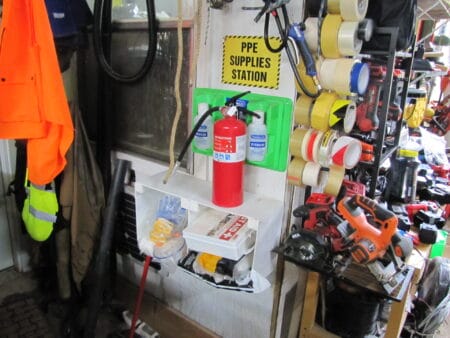 Now we’re warming to the heart of today’s pre-medicated concerns. G2 will be fleeing back to the Republic shortly, to rejoin the last of the sane after discovering liberals in Yankee Land are neither as ethical nor righteous as they try to pretend.
For now, with The Prodigal considering “flight to sanity” there’s the little matter of whipping the home shop into something that won’t cause him to jump back in his rig and hightail it North again.
By the way, his “little server farm” build? It’s now a full 3/4th’s of a mile long and nearly that wide seriously! When completed it will be a whole square mile of servers with a plug and play module direct into the Columbia River near Wenatchee, WA.
Time to Shop!
You don’t think the (adhd) Tool Slut in Chief was going to get through the weekend without buying something, did you? Ha!
See, what’s not in the PPE Area picture above is the rest of the crap. Great Jackson shatter resistant flip down mask (and spares) for using on the big Evolution wood and metal-cutting table saw. And there’s an assortment of masks and respirators (I will have to color-code and date check them, I suppose, lest he waves the OSHA regs at me. So humiliating. Consider George2 was born in 1980 and OSHA was set up only nine years previously!
The Occupational Safety and Health Act of 1970 (also known as the Williams-Steiger Act), was signed by Slippery Dick Nixon on December 29, 1970. The Act itself became effective on April 28, 1971—that’s the date OSHA opened its doors and began operations as the federal agency responsible for setting and enforcing workplace safety and health standards.”
OSHA really does good stuff – and I have thought about doing a matching cert – just so G2 won’t be able to say “My list of meal tickets is longer than Ure’s, old man…”
My response is already built: OSHA doesn’t apply to me – I got here first. You didn’t.
Now We Get to the Construction
We’ll circle back to the shopping spree in a sec. But I do have a new construction project in the works that sums up in three pictures.
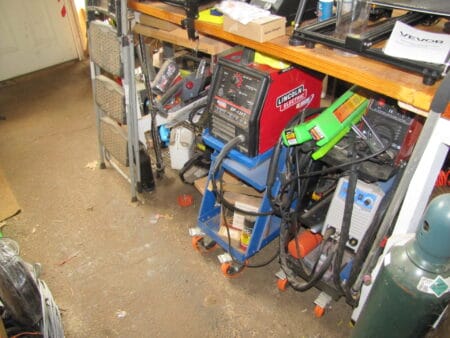 In the first picture, we see how my welders (2 small stick rigs, including that $40 IGBT rig I told you about, a handheld stick job ($100-class Chineseum and it’s become my favorite welder here, lately), along with the Lincoln 135SP (real MIG rig with gas bottles), the Lotus 4000D plasma rig, and the big roll-around oxyacetylene rig with the aging 25-foot hoses on ’em.
The problem with all this goodness is that I didn’t have a rod oven. Which – strictly speaking – I don’t need for 6013 (unless you’re a total tooltard). But when you start sparking other rod – especially up into hard-facing and such? Well, that was this week’s fiddy that wasn’t nailed down. On sale. Vevor. Blue.
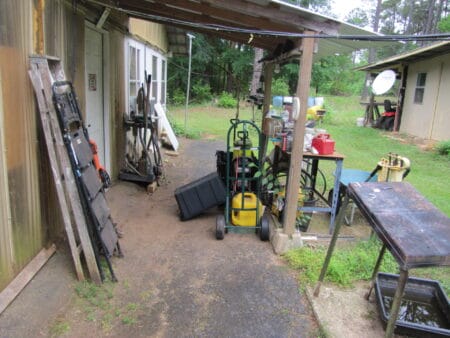 Picture 2 is where you can see what will be a “welding lean-to. All long-term readers know that other than being obsessed with (blondes, Beechcraft, Hunter sailboats, and Porsches of the 944T or 930-wide body stripe) I love lean-to construction.
The way I figure it: You’ve got a foundation line and one wall already built. Given every “box” as six sides, that’s like God reaching down and saying “Here’s the first 16.6 percent of your project – on me.” thanks, The DUDE.
After a few thankful moments of prayer (that leaning table works on a hill – what kind of slicker are you to have to inquire of such obviousness?) I concluded that I would build east from the shop door because then the bright northern sky, (favored by artistes and old-timey draftsmen (before women were in the trades) losing some light would just make the instrumentation in the power center easier to read because it’s already too light in there, anyway.
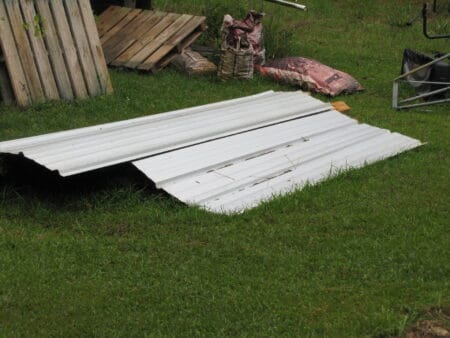 Picture 3 is evidence of superior long-range purchasing plans. Somewhere under here is a pile of 30-odd treated full 8 ft. 2 by 4s.
The picture? To remind you of another of Pappy’s old firehouse dictums. “Buy your material and if you can, put sheet roofing on top for storage to keep your wood dry and out of the elements.
Pappy was a Seattle boy – hopefully down here in the Cottonmouth Belt none of them will have moved in, due to the obvious “open door policy…”
Last point is we keep a dozen, or so, ground screws around. Figure with 30 pounds of screws, ground screws, electric chainsaws, and freeze-dried foods, we could rebuild something after damn near anything that comes along. Went to far as to pick up a one-hour post grad CEU whizz for architects. They asked if I had a degree – I told them yes – but I might have skipped the part about long wave economics isn’t a strong launch point for ground screws… Oh well – post grad work in Architecture, right?
Anyway, they have been in use since the 1840s when they were used for mooring and lighthouse foundation-building in England…
“What About the PPE Project?”
What? Did you read-past the big ADHD reveal?
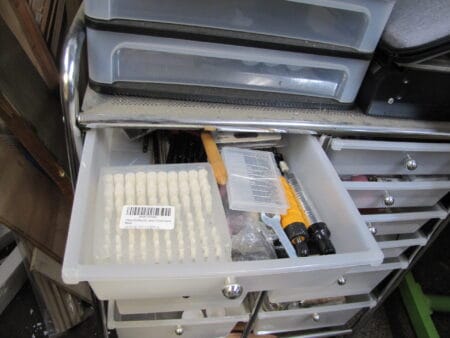 OK – so over at the model-making and gunsmithing bench I have this gem of a little roll around cart.
This was DFC (dirt freaking cheap) and it works great. The best part? I mean compared to the big $250 industrial-strength roll around for big tractor bolts, lynch pins and such? The one that collects shop dirt and birds nest in?
This is perfect for the smaller stuff. And I have vowed that before another thing, I will organize everything I have into some kind of logical sequence.
Honestly, the mind is much more suitable employed figuring out how much cementitious board will be needed to “box in the welding” are so that shop doesn’t go up in smoke. Best stuff in the world cem board (know in lay circles as tile backerboard) is fireproof, water resistant and (best part!!!) cheap.
I know – building a covered welding booth you would think a metal covering would be fine. But see, after having made as many mistakes as I have over 75+ years, you begin to look at Black Swan events more closely.
Would a cheap layer of even used aluminum printer’s plates black a spark? Yes,; I suppose so. But would it stop a white hot glowing end of 1-inch bar stock fresh from under the plasma cutter? See, this is what ADHD really does: It gives you enough “processor overhead” that you can worry about hot welding fire ignition sources, write mindlessly about tomatoes, while debating whether I should mention the breakthrough technology that is coming to replace 3D printing out on the edge of state of the art fabbing?
That’s over here. 3D Genesis Technologies – Next-Gen Manufacturing and it’s all about APIC: No, I didn’t know what APIC was, either, so I sicked the AI stack on it:
“Why this really could overtake and replace a lot of conventional 3D printing (especially metal additive manufacturing):
Traditional 3D printing (powder-bed fusion, binder jetting, DED, etc.) has well-known bottlenecks: expensive virgin metal powders, slow build times (hours or days per part), massive material waste (unused powder, supports, post-processing), single-material limitations per build, and high energy use. APIC flips those problems on their head:
- Cheaper — Uses cheap or free scrap feedstock instead of specialty powders/filaments. No waste means near-100% material utilization.
- Faster — Induction fusion is dramatically quicker than laser or electron-beam sintering; the company highlights parts in minutes instead of hours.
- Better/more capable — True multi-material printing (like copper + steel gradients in one layer) and opens up functionally graded parts, embedded electronics, or hybrid components that are extremely difficult or impossible today. Smoother surfaces and less post-processing reduce finishing costs.
- More sustainable & scalable — Zero-waste + scrap-to-part workflow makes it greener and easier to scale in small shops or distributed manufacturing setups.
APIC isn’t just an incremental tweak — it’s a completely different workflow that solves the biggest real-world complaints about 3D metal printing (cost, speed, waste, material flexibility). If they execute on the prototypes and scale the hardware, it has genuine potential to disrupt or replace large chunks of the current additive manufacturing market, especially for jewelry, tooling, prototypes, small-batch production, and high-value multi-material parts.
Your friend’s team is still in early development (bootstrapped, 1–5 people, seeking seed funding), but the core science (nano-particles + inkjet + induction) is proven individually — they’ve just combined it into one elegant, patent-protected system. Super cool project — if you want me to dig into any specific claims, compare it to a certain 3D printing process, or help brainstorm applications for their tech, just say the word!
No – this is one of those “way cools” that is almost “obvious” when you think about it. Like our recycling of old appliances into “food reactors” right?
But these are multi-materials and they can print both a circuitboard and traces at the same time. Here I thought the Hermes Lite 2 ham rig was grown up – Wowzer.
Like I said, didn’t know if I should mention that there is still a future coming. And we are blessed knowing some of the people who are getting it ready for delivery right now..
Yeah, the new direct-drive heads are sitting in boxes for the CR10’s, but there’s the PPE station problem and where to put the welders first.
And that’s the Big Shop Secret of the Week: Life balance begins with where to put the welders.
Write when I catch up with myself, (or I will say hi as I pass myself?)
George@Ure.net
It’s really about “How well can you balance your Life?”
The Moody Blues – A Question Of Balance (Full Album)
https://m.youtube.com/playlist?list=PLI6kLIhBBwmQQi_zfngo-z_JzC4Pw4_ZV
I love the moody blues.. and Can’t forget a little floyd.. here’s the full album of dark side of the moon..
https://youtu.be/k9ynZnEBtvw?si=bBxJYjCIuQZJ5dHZ
you sure can’t miss fire sign lol
https://youtu.be/RwG5c9IsgbA?si=tDj-DmjbM_FkY_Pz
Nick Danger third eye….dont crush that dwarf
Then I think about meditation and well here’s a good instruction video..
https://youtu.be/2O5v7oyG73c?si=ZtTMlimCBbqrlfBM
Were all bozos on this bus
Lol lol
Sunday Alert!
G.A. STEWART: I have done my final sweep of the news. It is 20:00 EDT and we are officially into April 19th, 2026 at the Royal Observatory in Greenwich, England. We now have 60 hours (48 + 12 UTC) to sweat out a major terrorist incident or violent event somewhere in the world.
The Canaanite Baal worshipers have already kicked off the war with Iran; surely, this big Hitler holiday will be ritualized with some terrible spilling of blood. Hermetic rituals tied to Egypt are a road map of their intentions. I would really be surprised if this April 19th or April 20th there was not some major incident that exacerbated the war with Iran.
If I am right about any of this, it has many great and dark implications for my work with Nostradamus’ prophecies and Richard Hoagland’s original theory about the Nazi cultists who control the West. Therefore, I am curious about what the reactions in the Alternative Media will be; this is an experiment that will test my work and their credibility.
I will leave a postscript here sometime after the 60 hours comes to an end at 12:00 UTC on April 21st. If something major occurs, I will leave a comment after I have had time to analyze the event.
https://theageofdesolation.com/nostradamus/2026/04/19/g-a-stewarts-timeline-contents/
Uh-oh…
8:16 AM EDT Sunday — Trump Tells Iran – Take The Deal or Else!
https://halturnerradioshow.com/index.php/component/content/article/8-16-am-edt-sunday-trump-tells-iran-take-the-deal-or-else?catid=17&Itemid=101
Fasten seat belts…
Stock futures?
Black Monday?
April 20th, Hitler’s Birthday!
U.S. President Donald Trump announced this morning via Social Media that Iran must take the US Deal (Tomorrow) or he will Bomb every Power Plant and every Bridge in the Iranian nation. “No more Mr. Nice Guy.”
re: container ship Touska
feat: Revelations 1:11
Iranian container vessel Touska, allegedly seized in the Gulf of Oman by U.S. Marines, first launched as Sahand prior to being renamed Adalia. Mount Sahand is a stratovolcano located near the Iranian city of Tabriz (“Flowing Hot”) visited by Marco Polo in 1275 ad.
According to ChatGPT, Adalia is the older European name of current day Turkish city Antalya. The latter derives from ancient greek via Attalus II Philadelphus who ruled as King of Pergamon from 159 to 138 bc while allied with the Consuls of the Roman Republic.
George Prince of Wales commenced his Regency in 1809 as King George III descended into madness. A representative perhaps of an American Regency, UANI founded in 2008, has offered thoughts on its not-for-profit website concerning a recent journey of Iranian-flagged vessel Touska. The container ship is alleged to have sailed at the end of March from Zuhai, China, and then departed from Port Klang, Malaysia in early April according to their following website link:
https://www.unitedagainstnucleariran.com/index.php/blog/iran-war-shipping-update-april-7-2026
UANI’s (United Against Nuclear Iran) leadership webpage informs that the organization is chaired by Mr. Jeb Bush aided by the support of listed luminaries. These include multiple people of note from prior American and UK administrations and aristocracy as well as a former Director of Intelligence of Mossad.
Here we go…
8 children killed in Louisiana mass shooting… Developing…
3 University of Iowa students wounded in mass shooting, wild brawl near campus…
(“The Canaanite Baal worshipers have already kicked off the war with Iran; surely, this big Hitler holiday will be ritualized with some terrible spilling of blood. Hermetic rituals tied to Egypt are a road map of their intentions. I would really be surprised if this April 19th or April 20th there was not some major incident that exacerbated the war with Iran.”)
they have been in control for years.. most civilizations follow their business models..it’s nothing new..just coming to the surface….If you look closely, the world keeps reenacting the same old parable over and over…. The prophets warned about it, the sages warned about it, even the mystics of distant cultures warned about it… when a society worships power, it forgets people. When it worships wealth, it forgets wisdom. When it worships order, it forgets justice. Baal, Babylon, empire .. these were metaphors for a spiritual amnesia that keeps returning in new forms. Maybe the real lesson is that the danger was never a god or a city, but the human heart when it forgets what it already knows…
“Baal worship” and “Babylon” weren’t just religions — they were systems business models.a repeating pattern…This is exactly why so many traditions warned us about “Babylon,” not as a place, but as a pattern. And it’s why the voices of the prophets, sages, and teachers matter so much today… They weren’t trying to build empires or systems…
They were trying to remind humanity of compassion, justice, humility, and the sacred worth of every person… e drone has a talent or skill their value.. Yet their teachings were often ignored, resisted, or reshaped into something that served the very structures they challenged…many times they say I do this in their name.. going to war for peace is a lot like F@#king for chastity…
When we forget those voices of wisdom , we repeat the same mistakes over and over… When we distort their teachings and morph them into a perverted image, we lose the compass they tried to hand us… And when we allow power to drift without accountability, we recreate the same patterns they warned us about… Every civilization that embraced those patterns of insulated power and comfortable self ? deception eventually collapsed from the inside.
Not because of an external enemy, but because the inner core hollowed out.. they chased their desires and forgot the base..( any five year old can tell you..if you want a strong tower you have to have a strong foundation..). When a society trades accountability for convenience, compassion for hierarchy, and wisdom for spectacle, it begins to rot long before anyone really notices the cracks.
we traded industry to outsource to gain profis.. forgot the communities needs the pride of working building so someone could oogle at their numbers rising..once upon a time there was an adult presence in the home to guide the children..today the adult presence has to work to scrape by.
members of an industry took pride in their employees today they are disposable..most companies have a skeleton full time crew the rest are part time or temporary..
This is why the prophets and sages mattered so much. They weren’t trying to build empires or systems of control — they were trying to warn us about the spiritual and moral drift that destroys civilizations quietly, long before the final fall.
The real task isn’t to fear power, but to remember the wisdom that keeps it all human.
Lol…my dear wife told me..
GOD your not a preacher and no one wants to hear your preaching and driveling ideas..so STFU…lol lol she’s wiser than she knows.. my opinion is my opinion and no one likes my opinion more than me..lol lol…and she’s right..there’s nothing any of us can do about anything at all..so why drag that dead horse around..
“I” like your comments … !! To me they contain worlds of wisdom virtually every day.
imo YOU would have been an excellent advisor to a top end politician …IF they would have listened to you (unfortunately we all know those types of politicians are RARE … most politicians who rise towards the top are Self Centered Narcisists)
Keep up your postings!!
reduced or non existent cognitive function thanks to the rat juice and the spike protein . the kids , children have been reduced to feral animals . its scary to watch . adults , well they are just walking zombies . that , you can thank AI and this garbage called a housing market . yep the world aint ever going back to how it was . thanks to all our world “leaders” for that.
as da boyz and the new reich cook the world and stockmarket the commercials are still short gold and silver . and the longer bonds although seen as an economic tool for AI promotion are forming a base for the ages . so nudge nudge wink wink say no more . oil . what a joke ,, covid 2 to try and must i say try to create inflation . horrific total idiocrasy by goons . goons led by people like commie facist musk, yes they do go together in 2026, promoting a universal income . ahh grand super cycles and their sunset
Alice Cooper – “No More Mr. Nice Guy” (Live At Hellfest 2022)
https://m.youtube.com/watch?v=G0B7mfSX_ls&list=RDG0B7mfSX_ls&start_radio=1&pp=ygUlYWxpY2UgY29vcGVyIG5vIG1vcmUgbXIgbmljZSBndXkgbGl2ZaAHAQ%3D%3D
Yo Shadey,
(shade tree mechanic)
Hows about working on the Anti-Grav thingy mate?
What, are you afraid of Ure own Govmint ? You prolly should be, if in Youse working on the anti grav thing. Can you say Magnetic Bouncy ? Sure you can, all youse need is some Thorium, and perhaps some highly pressurized Mercury. Not sure about the bendy-flexy-reboundy “Metal” needed for handling the crazy pressures of deep space-tachyon tube travel. Gonna need to re-Energize the Stargates along the Youfrates&TigerUs rivers for access to the “tubes”, but firstly need some homemade “spaceships”. Wonder if “bluebird” is still sitting miles under great pyramid, waiting for Humanity to Wake Up, and smell the Sky burning.
Oh by the By – last person to work and solve Anti -Grav is here;- This Amy Eskridge -https://x.com/ProudSocialist/status/2045317011316654107?ref_src=twsrc%5Etfw%7Ctwcamp%5Etweetembed%7Ctwterm%5E2045317011316654107%7Ctwgr%5E%7Ctwcon%5Es1_c10&ref_url=https%3A%2F%2Fwww.theinteldrop.org%2F2026%2F04%2F18%2Fflash-flash-this-is-amy-eskridge-the-proofs%2F
dun,dun,dun..
PS – All of epstain FINACIAL records -ALL of them are in Bessents possession.. Whos multi billion dollar portfolio did he manage for 15 years – Soros. Who is charge of Treasury under Bessent..g Soreass nephew. All the $$ transactions, all the pay offs (amounts & who paid). What company does donny jr sit on head of board – a gambling -futures betting firm, that bets on Wars and everything else. Every single member of tRUMPS team has signe dthe israHELLI 1st document – INCLUDING the reptiles butt boy Vance. ALL BLACK, ALL the Time. White House = Trading Desk nowadays, as everything is about MONEY now..Nothing but Money.
How well you think that is gonna end?
wow . some good points in there at long last .. yes the kings of the sands and camels the chosen ones have that psycho motto from the hard moose folks . strength by deception . some of us see straight thru it . well done mate
re: “Cash & Carry”, Moe, Larry, and Curly, 1937
Apparently the “Atlantic” has made allegations about the personal conduct of the FBI Director. Separately, the publication’s owner can be seen on the left of the image within the following 2021 “X” post link:
https://x.com/Lukewearechange/status/1469448307974021122
Machine wars have become like Terminator…
https://www.wearethemighty.com/tactical/drones-capture-position-first-time-ukraine/
Speaking of tools, I was cleaning the storage building this past week and found (I forgot about them) a set of Craftsman wrenches from Sears that belonged to my dad that he probably bought back in the 60’s. Complete set that now will go into my toolbox for future use. They look brand new and in great shape.
and, in the old world, were still under forever warranty. I recall Dad saying take this or that socket in due to cracking due to use stress. no problem, here’s a replacement 5/8″ …
What’s funny about that. is they would replace that socket from a new set…then throw out the rest of the set….
one of my hats was garbage man and janitor.. the week after Christmas was exciting all the returns tossed out… you buy it take it back they toss it.. Amazon returns. five hundred a pallet but you have to buy a truckload.. there’s a couple of stores in town that do that..you walk in its ten percent what sale price was..you just don’t have a choice in what they get..as a janitor.. someone returned an electric kids jeep. crush it..well it wasn’t even assembled we instead got crushing it put it together charged it up then during lunchbreak would drive it all over the store…after a week they got upset and made us crush it… my cast iron griddle..and my air nailers all garbage…you’d be shocked at what’s tossed out..
Back in the late 70s we bult an automatic welding system for Eastern Air Lines turbine blade and vane repair. Until that time, manual skilled TIG welders would build up worn turbine blade surfaces, which were then machined back to spec. That process couldn’t keep up with the thousands of blades needing repair.
The system we built used a simple micro-computer-controlled lath to position the blades under a TIG torch with wire feed, and arc voltage control to automatically compensate for the worn surface heights. It was working well when Eastern went bankrupt. Later, more sophisticated machines became available and are in wide use today.
While this was not 3D printing, it was probably the one of the first application of automated additive metal ‘printing’ using the heat of a TIG arc to melt filler wire and restore worn components. The process used current, and wire speed pulses to melt a bit of wire and then switch to zero wire speed and a non-melting current level. This action allowed the melted wire to freeze and produced a series of precise overlapping deposits that were fused to the blade. It still requires post-process machining but let the skilled manual welders do other work that wasn’t suitable for automation.
.., wow !
I started my career at Eastern Air Lines in Nov 1984 until that bankruptcy in 1989. In January 1985 my first year on the line was in Laguardia (LGA) in NY. My oldest son was born a year later in NYC, and now at 40 is about to retire from the US Army with 20 years. During my first year in NY, more than likely I met up Stu’s dad who was a Mechanic based in LGA.
I would guess the turbine blade repairs above where probably done in Miami?
Small world, eh?
Holy shit! Small world! Best compliment I ever had meeting you guys came from Mike B. Me and the old man were as different as night and day. LOL
I still want a 3D printer.. wife won’t allow me to get one.. I’d probably have to take a class on running the thing..
True desolation. EMP
“Write when I catch up with myself, (or I will say hi as I pass myself?)”
You used to be behind before, but I see you’re first at last!
“new study suggests shingles vaccine could slow or prevent dementia”
https://med.stanford.edu/news/all-news/2025/03/shingles-vaccination-dementia.html
Going back to my post yesterday wrt the US/Israel v Iran War an interesting X post was put up today. I post it here not for being the “Truth” but as a “Heads Up” …. since there is no way I can vouch for the accuracy of the post (my personal comments follow):
*************************************
“CONFIRMED: The US joint Chiefs of staff Air Force Gen. Dan Caine stormed out of an emergency meeting with Trump. Insiders indicate that Trump wanted to invoke the nuclear codes as a deterrence against Iran but Caine refused and invoked the U.S. Uniform Code of Military Justice.”
Royal Ambassador@JaokooMoses
https://x.com/JaokooMoses/status/2045811313851375939
*************************************
fwiw there WAS a big meeting last night at the White House … various reports had all sorts of people arriving there starting about 6:30 PM so the “Meeting Dynamic” to the above post adds at least one data point of potential confirmation.
My War modeling for this specific War has long indicated that before it is over Nuclear Weapons WILL LIKELY BE USED.
The ONLY two entities involved in this War who have nuclear weapons are Israel and the United States so it will one of those two who will engage in their first use wrt this Middle East War. (Of course once used by the US or Israel other parties may step in and provide nuclear weapons to the party which they were used against, or do the response directly against the US or Israel on that party’s behalf)
wrt my comments yesterday about Trump being a LIAR … well Netanyahu is one too. A very well practiced LIAR and Manipulator.
Several years ago after watching Netanyahu behavior for a couple of decades I went and did a very deep dive into Netanyahu … his personal background, the background of his father and grandfather, the writings of his father, a summary of the writings of his grandfather, and the writings and statements of Netanyahu himself over his lifetime as well as his actual actions over the decades
What emerged was a picture of a person who believes in his soul that he was placed on this planet in the present time jto fulfill a MISSION FROM GOD, a Mission that his father sent him on to fulfill from an early age.
Netanyahu’s mission, at least as it appeared to me after concluding that deep dive several years ago, went way beyond just the protecting of Israel from it’s nearby neighbors but extended to creating the “Greater Israel” (this was back before any outsiders were talking about such a thing, “The Greater Israel”) … and also the Biblical style KILLING OFF of the entire peoples of specific ethnic geneology who the Jewish texts COMMAND should be eliminated man woman and child from the face of the earth.
Scary shit … at least to me, once I finally got my arms around Netanyahu’s mind and belief system.
Ever since I have watched Netanyahu closely and nothing I have seen over the intervening years indicates in any way that the analysis I did of him a few years ago was, or currently is, incorrect. Nope … everything since has merely confirmed that the analysis I did is most likely correct.
Netanyahu is a classic “behind the curtain” manipulator, it is part of who he is at his core. which brings us to the next stage. IF this current War is to go nuclear he would prefer that the US pull the cord to do it, so the direct blame does not fall back on Israel directly.
The above UNCONFIRMED X-Post is the specific dynamic I have been fearing seeing rear it’s ugly head. It resonates with me as being potentially accurate – at least in it’s general outline – since that is what my modeling from several years ago indicated as the likely path Israel would take once the Iran War got going
Convince the US directly, or via a HUGE False Flag Event, to start using nuclear weapons.
This dynamic of nuclear weapons use will NOT be over if the US will NOT fall in line with Israel’s desires (and commands), at least if Netanyahu remains in power, since Israel itself may then use nuclear weapons in an attempt by Netanyahu to fulfill what he believes is HIS DESTINY to fulfill God’s COMMANDS.
I know probaly half this board will probably HATE me for what I posted above, but so far wrt this War my batting average is about 100% as to how it would develop.
I certainly hope and pray that I am wrong .. and maybe by my shining a bit of light on the subject it can change the trajectory of what is currently on track to unfold.
Once the nuclear genie comes out of it’s containment box it will be a total bitch to try to get it to return to it’s containment box. Many millions will die before that has the possibility of occuring … and the state of Israel, as it currently exists, will Die in the process.
my enduring memory of B B is gulf war 1 when he worked for cnn a junior reporter around 1991 . he was jumping around like a jack rabbit as the sirens blazed with a full gas mask and then hid under a table . he looks different now yah know what i mean . heard the russians have supplied some accessories to strap on the top of iranian missiles . just levels the playing field a bit . heaven help that some sanity prevails and divine intervention , just like it did years ago when hitlers troops camped outside moscow an extra night and got frozen by a freak blizzard
That means the first Blow of Steel is around the corner in Gaza or the West Bank.
Look out JC; the second Blow of Steel is in Italy.
(““CONFIRMED: The US joint Chiefs of staff Air Force Gen. Dan Caine stormed out of an emergency meeting with Trump. Insiders indicate that Trump wanted to invoke the nuclear codes as a deterrence against Iran but Caine refused and invoked the U.S. Uniform Code of Military Justice.”
Royal Ambassador@JaokooMoses
https://x.com/JaokooMoses/status/2045811313851375939 “)
If the report were true, it would fit a pattern we’ve seen throughout history and what i have thought all along…when a civilization builds its identity on being the strongest, any moment of restraint can feel like weakness.
That’s the danger of power that becomes insulated from accountability — it starts to believe its own mythology. And when that mythology is threatened, even by reality itself, the instinct is to react with force rather than wisdom.Thomas Jefferson wrote about it..
This is the same pattern that hollowed out past empires and huge civilizations from the inside. When a society becomes dependent on dominance for its sense of stability , it becomes vulnerable the moment that dominance is questioned . Economies built on illusion instead of substance eventually face the reckoning of real value . Wealth that once felt untouchable can evaporate overnight when the underlying system shifts . History has shown this in places like Weimar Germany and Zimbabwe, where currency lost its meaning and comfort collapsed into scarcity where having the ability to buy planes, trains and automobiles drops down to a couple loaves of bread…
The deeper issue isn’t any one leader or event — it’s the structure behind them . When power concentrates in the hands of a few, when decisions are made in isolation , and when the wellbeing of ordinary people becomes secondary to maintaining an image of strength , the system becomes fragile . The prophets and sages warned about this thousands of years ago . They weren’t speaking against nations — they were speaking against the human tendency to build towers of power on foundations of sand .
Their message was simple….a society that forgets compassion, humility, and accountability eventually loses the very stability it tries to protect. And when that happens, even the wealthy and powerful discover that comfort is not a permanent shield. The collapse of a system doesn’t discriminate — it pulls everyone down with it….
then the panic..the puppeteers that have been in control thousands of years have to step aside..the USA has been the leader the prominent head. and image of military power..if it looks as if we have to back away in humiliation.. they will seek and end game move like Hiroshima or Nagasaki.. just to maintain the appearance..the rest of the world has been sitting on the sidelines waiting on the play the poison pawn trap or the Ali famous move..rope a dope..
We aren’t prepared for that kind of moment because our infrastructure — power , water , health, wealth all of which has been centralized for the comfort of a few rather than the stability of the many . It creates the illusion of strength while hollowing out the foundation underneath the whole country.. our industrial strength was outsourced leaving our country as a consumption nation..Where once upon a time men were seen as a part of an industries family now viewed as disposable.. When a society builds its security on image, wealth and greed power to control..the im better than you are..colleges have done studies on just this issue and the results were scary instead of substance, it becomes fragile . And when the underlying economic system is stretched thin, even the wealthy discover that comfort is not a permanent shield.
I had charge nurse that went out of her way to make sure everyone knew she was superior to them..then she showed up for work..in the tag your it field of medicine and realism hit her between the eyes..she was it for two hundred patients..doctors are notorious for degrading the staff .. seen one throw a chart at a nurse because she was doing her job..called him in the middle of the night..in the VA healthcare system or any other managed system.. the standing rule is on all does what they think is best the regular physician follows up..healthcare is a great example..I had a friend that was head of a medical hospital..his salary was over a million a year..they cut his job..and a hospital in Colorado offered him only half a mil a year..we were watching the kids swim in his pool..he felt insulted by their offer..I said for that kind of cash they could humiliate me every day..I worked three wings by myself at just over three bucks an hour..they run the support staff shy to maintain they’re value..its as old as time..
Jesus Christ gave a parable about the vineyard….
History is full of examples where civilizations collapsed not because of an external enemy, but because their leaders mistook vanity for strategy and appearance for strength. The real danger isn’t losing status — it’s losing the humility and foresight that keep a nation grounded.
It’s the wobble, I tell ya. Been dog sitting in a nice home for a couple weeks. Early morning walks now take me to a spot with two power poles I can align looking East to catch the sunrise spot.
So does anyone notice anything I see?
Over the last week the sun has been coming up slightly North of the line up, then back to the exact lineup, then South just slightly and this morning was whacko South, like a big jump.
So it’s heading into winter here, old Sol should still be shifting north every day until the winter Solstice in June. North, not South as it was this morning, off by degrees.
This seems to me to be a bigger deal than just about anything that might be going on. Are we wobbling into something interesting?
4/20 already here. All this blather about bad things on dirt happening around now certainly isn’t much different than any other day. Us humans have some sort of thing about slaughter and blood that needs to be spilled regardless of what dry spot they are on. Silly us.
Stiks
Get the book – Ethical Skeptic – Inversion – ECDO Theory by Roger Cunningham. There will be a global coastal event – but not – worldwide – and it will kill 90% of the population…….. Original North Pole – Africa before the pole shift ……..
Great idea…What strikes me about Ethical Skeptic’s ECDO theory is that, even if every detail isn’t proven , the pattern it points to is the same one researchers , geologists , and ancient chroniclers have been circling for decades . It reminds me of the old book Cataclysms of the Earth …once considered mandatory reading for anyone willing to look beyond the comfortable assumptions of uniformitarianism. we had to read it for class discussion. Both theories challenge the idea that Earth’s history is slow , gentle , and predictable . They suggest instead that our planet moves in cycles of calm punctuated by sudden , violent resets.
my thoughts are that’s one of the reasons why the group J.A.S.O.N. is doing at the trench.. with the recent increase of earthquake and volcanic activity..I believe they are just evaluating the inner crust activities…
For me, the moment these theories stopped being abstract and became real was when I saw the mammoth in the museum — flash frozen with food still in its mouth along with the consistent reports of animals all with their front legs broken… That single image says more than a thousand academic debates . Something happened fast . Something happened globally… Something happened that our current models don’t fully explain…
ECDO theory, like the older cataclysm theories , tries to bridge the gap between geology , mythology , and the physical evidence left behind from the actual events. It asks whether the Earth itself might have internal mechanisms capable of rapid upheaval — mechanisms we barely understand because we’ve only observed a tiny slice of planetary time . Whether or not the exact mechanism is correct , the humility behind the question is important. Civilizations collapse when they assume the present is permanent, when they mistake stability for safety, and when they dismiss ancient warnings as superstition instead of encoded memory…
What I think these theories really challenge is our cultural arrogance.. the I believe therefore I am.. They remind us that the Earth has a longer memory than we do , heck we still can’t build a pyramid in the same timeframe that ancient Egyptian did, and that the comfort of the present is not a guarantee of the future . They ask us to consider that ancient people may have witnessed events we can barely imagine — and that their stories , myths , and symbols might be fragments of a truth we’ve long forgotten…
ECDO isn’t just a scientific hypothesis . It’s really just a reminder that we live on a dynamic planet , that cycles exist whether we acknowledge them or not , and that ignoring the past has never protected any civilization from what comes next .
We should be learning from the past, but once the people who did learn from it are gone, we seem destined to relive the very things they warned us about over and over… Whether it’s vanity, comfort, control, or simple ignorance, we fall into the same trap…assuming that everything we take for granted today will still be here next year, or next century. Civilizations don’t collapse because they lack intelligence — they collapse because they forget humility.
Right now we take the very things that give us a quality of life for granted…consuming fifty five acres a minute in urban expansion , clearing prime cropland and cutting down thousands of trees every minute without replacing them . It’s the same pattern every fallen society followed… overreach , depletion , and the belief that the world will always bend to our needs… The warnings were there in the soil ,t in the climate , in the stories of the people who came before us…. but comfort makes us deaf…
Even the old myths , like the stories of the Anunnaki mining Earth to repair their atmosphere is, carry a symbolic truth whether you take them literally or not..
They remind us that beings who exhaust their world eventually look outward for resources , and that the price of ignoring balance is always collapse . The ancients encoded these lessons in stories because they understood something we’ve forgotten of a civilization that consumes without replenishing eventually consumes itself .
consider outsourcing industry for profits for the few and its general effect on the people..
We’re not exempt from the laws of nature just because we have technology. The past keeps whispering the same message over and over, but we keep choosing not to listen it only happens to someone else not me…
And history has never been kind to societies that mistake temporary abundance for permanent security….Of course this is just my opinion and I am reminded by family and friends that there isn’t a possibility of any of this being a real thing..the family sees their lifestyle and can’t fathom my life having any of the issues I’ve faced..its something I did wrong..get an edjumification so you can use your brain and give an intelligent thought for once..
azimuth Matey. Please send the sun back to our side of the ball. We miss her ~E~
Yes, it’s the wobble! 26 yrs ago Iran achieved 10 tau. Perhaps 100 tau now.
“My War modeling for this specific War has long indicated that before it is over Nuclear Weapons WILL LIKELY BE USED.
The ONLY two entities involved in this War who have nuclear weapons are Israel and the United States so it will one of those two who will engage in their first use wrt this Middle East War.”
Israel and the United States have a degree of respect for human life. The Iranian Mullahs don’t.
No one noticed my post from two weeks ago, when I said (para): Two weeks is enough time for Iran to spin up some 90% juice and build a few bombs.
If the Iran War goes nuclear, it will be because Iran sends a nuke (or six) to our East Coast, in shipping containers, on a freighter. We gave them just enough time to crank their uranium. If they either have the bomb hardware, or we left them enough of a tool shop that they could build some, there is no reason they can’t send a bomb to D.C., New York, Boston, London, Rome, or anywhere else in the Western World…