
Every now and then, a thought wanders into the office and sits down in the spare chair. It doesn’t announce itself. Doesn’t come with a PowerPoint. Doesn’t have a PR firm. It just sits there quietly until you finally stop doing whatever urgent thing seemed so important five minutes ago.
This week’s visitor was an old one.
A “belief wave.”
The notion comes partly from my late friend Cesare Marchetti, who spent a lifetime studying growth and replacement processes. (For readers who want to see how far Marchetti took this kind of thinking, his later work with Jesse Ausubel, Quantitative Dynamics of Human Empires, is a fine rabbit hole. Bring coffee. Maybe rope.)
His work helped explain why technologies don’t simply appear. They spread. One thing replaces another through a remarkably orderly process that often traces out an S-shaped curve over time. Horse-drawn transport gives way to railroads. Railroads give way to automobiles and airplanes. Landlines give way to cell phones. Typewriters give way to computers.
The mathematics are elegant enough to make an engineer smile. But over the years I came to suspect something was missing.
Before any technology replaces another, something else gets replaced first. Belief.
Take stagecoaches. There was a time when stagecoaches were not merely transportation. They were the future. Capital flowed into them. Roads were built for them. Businesses organized around them. Towns depended on them. Newspapers covered them. Politicians praised them. The stagecoach wasn’t simply a vehicle. It was a shared belief system.
Then, somewhere out on the edges, came stories of iron rails and steam locomotives. Not enough to matter at first. Not enough to threaten anything. Just odd little reports from experimenters and dreamers. But every report carried something far more dangerous than a locomotive. Doubt.
At first, the stagecoach business could continue growing while doubt quietly spread beneath the surface. Investors still invested. Customers still rode. Companies still expanded. Yet something had changed. The future no longer seemed quite as settled. And that’s when I realized that every major change in society may actually involve two different waves.
The first is a Belief Wave. The second is a Doubt Wave but it’s more a Disappointment Wave. (The “Oh shit, that didn’t work” wave.)
A Belief Wave occurs when increasing numbers of people become convinced that a particular vision of the future is correct. They organize their lives around it. Their investments around it. Their careers around it. Their identities around it.
A Disappointment or Doubt Wave begins when enough people start wondering whether the future might belong to something else. What makes the process fascinating is that doubt usually arrives long before replacement.
The railroad won psychologically before it won physically. The automobile won psychologically before horses disappeared. The internet won psychologically before broadband reached most homes. And today, we seem to be living through several belief waves and doubt waves simultaneously.
Belief in AI. Doubt about institutions. Belief in decentralization. Doubt about centralized authority. Belief in endless information. Doubt that more information actually produces more understanding.
Which brings us to what I call Double-Zero Time. The old system is no longer trusted enough to guide decisions. The new system is not yet trusted enough to replace it. Both score zero. People know where they came from. They aren’t sure where they’re going.
Investors hesitate. Governments wobble. Experts contradict one another. The public becomes restless. Civilizations spend surprisingly little time in these transition zones. But when they do, they often feel confused, noisy, and strangely exhausting.
Sound familiar? That exhaustion is one reason I’ve been thinking about “News Rehab.” Because much of modern media has become a business built around amplifying doubt while pretending to provide certainty. The result is a public overdosed on information but undernourished on understanding.
Which is why today we’ll do something different. Instead of chasing every headline, let’s step back and look at the larger belief waves moving beneath the surface. Because once you begin seeing them, daily news starts looking less like chaos and more like weather. And weather, unlike headlines, can sometimes be forecast.
Zero-Day Coherence is Here
“Whatever, dude. What’s the Zero-Day crap about?”
OK, so back when, Cesare and I tinkered with the Economic Long Wave – not just the Kondratieff (ne Kondratiev by revisionists) in a long-lost series of emails. He schooled me on how they work and there’s a paper somewhere in the dusty Peoplenomics archives about “S-curves.”
They are terribly nifty BUT they lack granularity for life management through changes in “social normals.” That led, a few years back (again, somewhere in PN archives) about how the “position of the future is encoded by [coherence] in adjacent (directionally-changing) successive moving averages.
I know – math gibberish, right?
How Belief Waves Appeared
Let me concretize this into “before coffee hits” concept.
We begin with our Aggregate Index work (again, PN content). If we take the daily closing Aggregate, and lay out a dozen, or so, successively longer moving averages, patterns begin to appear. Which I then deconstructed back to specific averages – like the NASDAQ which looks like this at the long zoom-out level:
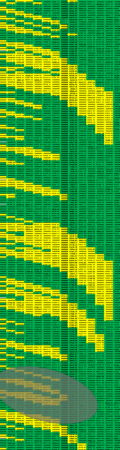
This doesn’t take MathLab to work out. Just a spreadsheet that supports conditional cell formatting. The daily close is the left column, to the right of it is the 2-day moving average, to the right of that a 3-day average, and so forth. Conditional formatting colors each relationship as follows:
- Today’s close is colored green if it was higher than the previous day’s. Yellow if lower.
- The moving average coherence appears when the 2-day moving average is compared to day’s close: If higher, it’s green, lower yellow. This formatting carries to the right such that the third column is green when the 2-day average is higher than the 3-day, and so forth.
“What are the Zero-Days?”
Since our cells are colored green or yellow (except for holidays which are unformatted) when we see a day like the one ahead today as a “solid sequence of greens” all the way across the screen, all we need to do is “add up the number of yellows” and that’s our Daily Market Score. As you can see at the bottom of this snip, (Pink date highlights) Thursday was a Zero Day and today futures are pointing to a second – hence the Double Zero Day label.
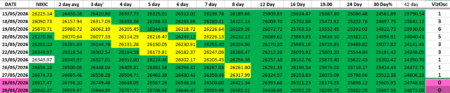
Now you have all the pieces to decode the first part of this morning’s headline:
When we discover maximum green cell coherence, a Belief Wave – the narrative, the outlook for future – is widely believed and investors aren’t done building toward a peak. When – as it always will, a challenger to the prevailing belief standard creeps in, a line of sequential declines will begin in the yellow cells.
I just wrote a whole book on Procrastination because I can’t bring myself to run this out over a hundred (or more) successively increasing duration moving averages. Three reasons, really: an existing body of work lines up 1929 with present market waveforms sufficiently well, I have other priorities, and paper with ink on it is not the core value (or point) to life.
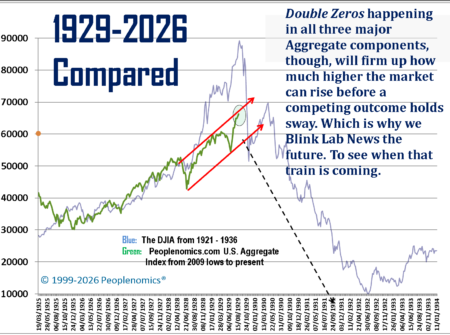
If you have a good data archive of global markets over seriously-long timespans, you can spend weeks being a “test-fitting ape” with this sort of stuff. But like the old grad school prof (Dr. Dalton, RIP) used to tell me, “Before you go looking for solutions, make sure you’re ready for the answer.”
I’m not – yet. Still learning this domain-walking stuff. How to use my Mind Amplifiers and how to offload details to my silicon collaborators.
Which is why news compression matters so much: it is not about reading less, but reclaiming enough attention to live more. Just take this with you: Marchetti measured replacement using the growth stochastic. We based from there and have proposed a way to observe belief coherence in market data.
The disappointment wave will be along. Because even macro variables (take War and Peace, for example) are all Belief and Disappointment wave functions.
Blink Lab of Friday
Overnight, nothing happened. Not usefully impacting, not life-changing. We are in full trajectory mode, still flying toward apogee. The rock, thrown into the air, hasn’t reversed course under gravity’s influence – yet.
And that’s the story.
Or at least it is if you’re watching belief waves instead of headlines.
Most people consume news as a sequence of events. Our mind-amplified Blink Lab looks at something slightly different. We look for changes in coherence. Is the public becoming more certain about the future? Less certain? Are investors converging on a shared narrative, or beginning to fracture into competing visions of what comes next?
Those questions matter because markets don’t move on facts alone. They move on belief. Facts merely provide the raw material. As we head into this Friday morning, the dominant national belief wave remains surprisingly intact.
The economy isn’t booming by historical standards. Washington isn’t functioning particularly well by historical standards. Geopolitical tensions haven’t disappeared. Debt hasn’t been solved. Housing affordability remains strained. Yet markets continue behaving as though the future is broadly manageable.
That’s coherence. Not necessarily correctness.
Coherence.
The distinction matters. The stagecoach industry didn’t fail because stagecoaches suddenly stopped working. The belief that stagecoaches represented the future eventually failed. Likewise, today’s market isn’t pricing perfection. It is pricing the continued viability of the current operating story: inflation can be managed, AI will create more value than disruption, consumers will muddle through, and major geopolitical conflicts will remain containable.
That’s the present belief wave.
Notice something important: almost every major overnight headline is being absorbed into that framework rather than challenging it. Result? No vector change – no behavior or plan modifications needed – at least before lunchtime.
When good news appears, it reinforces belief. When bad news appears, it is discounted as temporary. When mixed news appears, investors search for the optimistic interpretation.
That’s what coherent belief systems do.
The practical consequence is visible in market behavior. We have now arrived at another Double-Zero setup where the moving-average stack remains almost completely aligned. The market’s internal vote-counting mechanism continues showing very little disagreement among time horizons. Short-term traders, intermediate investors, and longer-duration participants remain surprisingly synchronized. Oh, this is also why we warned subscribers recently to keep eyes open for a melt-up. Happened in 1929 and although rare, orgasmic blow-off peaks do happen in economics history.
Again, that does not mean they are right. Doesn’t mean there’s one “edging our way now” but barring a Left Field event, or a formation of Black Swans (likely as false flags)?
It means the narrative-peddlers agree on the pitch.
Rally and coherence are two entirely different things. The danger for next week is not some specific headline. The danger is that a sufficient number of small contradictions begin accumulating simultaneously. Belief waves rarely die from a single event. They erode.
The transportation revolution began with a few railroad stories. A technology revolution begins with a few successful demonstrations. A political realignment begins with a few elections that don’t go as expected. The process is usually gradual until, suddenly, it isn’t.
Which is why Blink Lab remains focused on one question above all others: What changed?
Not what happened. What changed?
As of this morning, the answer appears to be: not much. The national belief wave remains coherent. The market continues voting for continuity. The crowd still believes the future can be navigated using the existing map. The Disappointment Wave remains somewhere over the horizon. But if history is any guide, it is already traveling in our direction.
Regional Blinks: Noise Floors and Coherence
About here (with no attention robbers pointing a headline at us) we can afford to “tune up the gain on our Mind Amplifiers and let loose the silicon harbingers of the future. We can Blink by region.
The beauty of regional Blink analysis is that it ignores the television version of America and focuses instead on the operating version. The TV is always hysterical and having a nervous breakdown du jour. The operating version is where food moves, power flows, factories run, trucks roll, houses get built, and paychecks somehow still show up. Around here, WalMart and Krogers deliver food and beverage. Here’s where the overnight shifts seem to be occurring.
Northeast: Cost Fatigue Continues
The Northeast’s dominant blink remains affordability. Not housing by itself. Not taxes by themselves. Not utilities by themselves. The combined weight of everything. The region increasingly feels like a place where even upper-middle-class households find themselves running calculations that would have seemed absurd a decade ago. The economic conversation is slowly shifting from wealth creation toward wealth preservation.
That’s a subtle but important blink. People behave differently when they’re trying to keep what they have instead of build something larger. The belief wave here is no longer expansion. It’s endurance.
Southeast: Growth Is Still Winning
The Southeast continues operating as America’s growth engine. Population movement remains favorable. New construction remains active. Infrastructure continues trying to catch up with demand. Business formation remains comparatively healthy.
The blink is that migration itself has become a self-reinforcing belief wave. People move because opportunity exists. Opportunity exists because people move. That’s a positive feedback loop. The challenge is whether roads, schools, healthcare systems, and utilities can keep pace. At some point every growth story encounters its first scaling problem. The Southeast isn’t there yet. But it’s getting close enough that planners are beginning to notice.
Midwest: Quiet Resilience
The Midwest rarely gets national attention unless something breaks. Which is why it often deserves more attention. Manufacturing remains relevant. Agriculture remains relevant. Energy remains relevant. Transportation remains relevant. In a world becoming increasingly obsessed with digital narratives, the Midwest continues producing physical reality.
The blink here is that practical industries may be regaining strategic importance. Supply chains matter. Electric grids matter. Food matters. Industrial capability matters. For years these were treated as background assumptions. Increasingly they are being viewed as competitive advantages. The Midwest’s belief wave may be quietly strengthening while nobody is looking.
Southwest: Water, Energy, and the Future
The Southwest continues serving as America’s laboratory for resource constraints. Growth remains attractive. But water remains finite. Energy demand remains explosive. Heat remains a governing variable. The blink isn’t a crisis.
The blink is recognition. The region increasingly appears to understand that future prosperity depends on solving physical constraints rather than financial ones. That’s a different kind of challenge. Money can be printed. Water cannot. The next decade may reveal whether engineering solutions can stay ahead of population growth.
West Coast: AI and Infrastructure Collide
The West Coast remains ground zero for the AI belief wave. The excitement is real. The capital flows are real. The technology is real. But increasingly the conversation is shifting from software toward infrastructure. Power. Cooling. Data centers. Transmission capacity. Semiconductor supply chains.
The blink is that AI is beginning to look less like a software story and more like an industrial story. That’s a major transition. The first belief wave was about intelligence. The next belief wave may be about electricity. A century ago industrial power built the physical economy. The next decade may determine whether electrical power becomes the limiting factor in the digital one.
A personal aside? A month or three back I shared one of my Provisional Patent apps on the PN side and not a single blip of interest – from anyone. Despite a revision to processing topology that could reduce AI energy needs by 20-40 percent.
The Blink of that? Already, AI has merged into the establishment – data center builds, power project construction. We are well-past the fundamental innovation window. We moved – maybe too quickly – into the “lock and roll forward” using the same production-line mentality that continues holding the spores of planetary die-off. Not our wheelhouse. Is the food delivery here, yet?
National Synthesis
Taken together, the regions aren’t telling five separate stories. They’re telling one.
- The Northeast is managing accumulated complexity.
- The Southeast is absorbing growth.
- The Midwest is rediscovering strategic relevance.
- The Southwest is confronting physical limits.
- The West Coast is building the next operating system.
Different chapters. Same book.
And the common thread running through all of them is belief. Not what exists. What people believe will exist next. That’s the real blink this morning.
America continues behaving like a country that believes tomorrow will work. The details vary by region. The belief wave remains surprisingly coherent. But how long will coherence live on?
Blinking Next Week: Watching for First Yellow Cells
The job next week is not to predict collapse.
Collapse is easy. There are entire industries built around predicting collapse. Give someone a webcam, a chart package, and a month’s supply of freeze-dried chili, and before long they’ll have a theory explaining why civilization is due to expire next Tuesday.
The harder job is watching for the first yellow cells. The first indications that coherence is beginning to weaken. Not fail. Not reverse. Not crash. Simply weaken. That is how most major transitions begin.
One of the lessons buried inside Marchetti’s work is that replacement processes are usually far less dramatic than they appear in hindsight. Looking backward, history compresses everything. Railroads replace stagecoaches. Cars replace horses. Television replaces radio dramas. The internet replaces newspapers. It all seems obvious after the fact.
Living through those transitions was another matter entirely.
For years, sometimes decades, the old system continued functioning while the new one slowly accumulated belief. The stagecoach did not stop working because railroads appeared. The horse did not become useless because someone built a gasoline engine. What changed first was not the machinery.
What changed first was confidence in the future. That is why Blink Lab concerns itself less with events than with contradictions. An event may dominate headlines for a day or two. A contradiction can quietly reshape an entire era.
The present market belief wave remains remarkably coherent. Investors continue behaving as though inflation can be managed. Consumers continue acting as though tomorrow will remain broadly workable. Businesses continue investing. Governments continue spending. AI continues attracting capital. Even geopolitical risks are increasingly being interpreted as manageable complications rather than civilization-ending threats.
Whether those beliefs are correct is almost secondary. The important point is that they remain widely shared. Markets function best when large numbers of participants are reading from roughly the same script. The script may be wrong. It may eventually prove catastrophically wrong. But as long as enough people continue believing it, coherence survives.
Which brings us to next week. What would constitute a genuine Blink?
Not another headline. Not another press conference. Not another social media panic attack.
A real Blink would be evidence that behavior is changing. If inflation data arrives and people materially alter expectations, that’s a Blink.
If AI enthusiasm begins encountering serious infrastructure limits that investors can no longer dismiss, that’s a Blink. If consumers begin pulling back in ways that show up consistently across sectors, that’s a Blink. If geopolitical tensions start affecting actual capital allocation instead of merely generating television ratings, that’s a Blink. If Trump has a health problem, that’s a Blink.
Notice the common theme. Behavior. Not opinion. Not commentary. Not narrative.
Behavior. Change of trajectory, repositioning of the future’s probable impact zone.
The older I get, the less interested I become in what people say they believe and the more interested I become in what their actions suggest they believe. Markets are useful because they eventually force that distinction. Everybody has an opinion. Portfolios are where opinions encounter consequences.
As of this morning, the dominant national signal remains unchanged. We can rest; but not easily. America continues behaving like a country that expects tomorrow to function. Not perfectly. Not cheaply. Not without friction. But function. What “double-zero” days like this hint is that change is already stalking us, even if we can’t see its outline yet.
That belief remains visible from the factory floor to the shopping center, from the AI data center to the farm field, from the truck stop to Wall Street. The belief wave remains coherent. On Friday. Early. With coffee.
Yet history offers this one final caution. Coherence often appears strongest just before the first signs of doubt become visible. The crowd feels comfortable. The narrative feels complete. The future appears understandable. That is usually the moment when the earliest contradictions begin accumulating beneath the surface.
- Invisible at first.
- Then impossible to ignore.
The Disappointment Wave will be along shortly.
The Vector Watcher’s Notebook
Vector change odds increase a bit next week. After market alignment, disappointment seeds are easy to germinate. Next Monday (barring war swans and false flags) should be a “nothing.” Tuesday tempo troubles loom. Labor’s Job Openings, Layoffs, Terminations, and Separations (JOLTS) report drops. Then ADP Wednesday, Challenger Job Cuts Thursday, federal reveals on Friday.
Our “one for this road” for now? These advance numbers from Census:

After the data, Dow futures were still holding up 130-something. Green, baby, green.
Around the Ranch: Free “News Rehab”
I’m making the second pass through my next book — an economics treatise titled “Timenamics: The Hidden Currency”. In it, I run through the implications of living in a world where time is the real currency. Hidden, though, which I find most curious. Paper and zeros onscreen are just the abstraction layer — like S&H Green Stamps were back in the previous Depression.
Our use of time has changed dramatically in my lifetime.
Pappy used to come home from work, sit down, read the afternoon *Seattle Times*, and have exactly one cigarette. Everyone smoked back then. That was it. In 20 minutes or so, he’d figured out what mattered in his world of the 1950s.
The problem with America now is that we became addicted to the crack cocaine of growth. It visited everything in life. Where once a *National Geographic*, an old copy of *Arizona Highways*, or *Time Magazine* filled my young brain, it was shocking, watching my children grow up, to observe the sea of useless they were expected to swim in.
I looked at the time — and still haven’t found any — for children’s books with information-management themes embedded. Instead, cartoons riff off Grimm while Madison Avenue quietly picks the bones. Goldilocks no longer just finds three beds. In the modern version, one is memory foam, one is goose down, and one is horsehair — all available this weekend only with free delivery and approved financing…
OK, maybe that’s a bit deep. But let’s summarize modern actuality.
The hard blink: credible estimates now put global social/video feed use around 18 hours and 36 minutes per week — about 2 hours and 39 minutes per day. Young women 16–24 run far higher, over 25 hours per week. Even men over 65 still average more than an hour a day on social/video feeds.
That is not “checking the news.” That is a part-time emotional weather job.
A lot of the consumption underpinnings were covered in my two previous books, *Downsizing* and *The 100-Year Toaster*. The dual enemies — excess consumption and planned obsolescence — have been quietly expanding until they now occupy the entirety of our brains. Today, ad copy and positioning statements occupy more headspace than self-generated personal realizations.
Which brings us to News Rehab.
I’ve been focusing on news compression lately with a very clear objective: forget the detail level of almost all “news” stories because you and I aren’t stakeholders or decision-makers. We’re mostly victims, whichever way things fall.
Instead, choose to focus only on how the underlying change vectors might modify your own plans in life.
Should be obvious, right?
The shock is seeing how many people are slowly moving away from self-directed outcomes. They fail to realize that reclaimed media time allows more personally chosen activities in its place: child rearing, gardening, reading, home improvements, hiking, camping, fishing, sailing, woodworking, ham radio, RV adventures, or even mastering the tables at a casino.
Ah, but then comes Procrastination.
Such independence seems unattainable to many because there is no useful understanding out there on the Timenamics of it all. Which is why my latest, *The Book You Almost Read*, came out this week. Because at the brick wall of predatory growth, runaway consumption — fueled by unchecked capitalism and digital addiction — reduces us all to nothing more than spend-bots.
We exist only to consume.
Not to use and enjoy.
Not to appreciate and savor.
My personal battleground is BlinkLabNews: compression of events into change vectors. Not more news. Better news. Less emotional waste. More usable signal.
Because when it comes down to it:
**News Compression Allows Room for Life Expansion.**
Remember where you heard it first,
I’m going outside now. Gonna look for swans. Black ones.
George@Ure.net
An idea. The basis for a iceberg failure is loss of structural support and caving of the iceberg. Depression of 29 was supposedly due to Dutch loss of banking support due to Germany money????? So if blink works today then loss of Europe (pulling in China funds, pulling in USA funds from overseas) might be the structural item of doubt.
Cc : I thought the Fed was hiking rates in 1929 when they should have been lowering them. Feel familiar?
https://www.econlib.org/yes-monetary-policy-did-cause-the-great-depression/
Not advice , got (select) blockchain?
https://www.coindesk.com/business/2026/05/27/dtcc-plans-to-bring-tokenized-assets-to-stellar-in-latest-wall-street-blockchain-push
https://coinpaper.com/15234/dtcc-patent-names-xrp-and-stellar-as-key-liquidity-tokens-for-global-tokenization
lol I love design patterns reminds me of the AMPS standard that killed copper lines. The OG system designed for (2) an A and B Carrier (service provider). All large systems need resiliency. Epic. It’s great to be early .
(“Cc : I thought the Fed was hiking rates in 1929 when they should have been lowering them. Feel familiar?”)
??????…… Lol lol…“Lower interest rates”??????
How do you lower interest rates when the whole system is sitting on a negative balance with compounding interest. That’s like paying less than the minimum on a high interest credit card and pretending the balance is shrinking. It isn’t — it’s growing faster than you can shovel.
the again the printing presses are over heating producing more.. remember they quit making pennies because it cost more to produce then they are valued…
I get it though People talk about 1929 like the Fed “should have lowered rates.”
But lowering rates on a system that’s already underwater doesn’t fix anything. It just masks the pain for a little while longer. The debt keeps compounding I sometimes wonder what is the daily interest on forty trillion dollars… The imbalance keeps widening. The pressure keeps building.
What I see from the catfish point of view at the bottom of the pond is
It’s the same pattern today that it was in 29…lets concider the rising costs..a home that cost thirty grand now costs a half mil…a person should be making somewhere in the hundred dollars an hour.. what retail chin can offer that.. in medications at tens of thousands of percent more than any other country on the planet..hmm..all while insurance industry is taking in trillions..hmm
then there’s the rising debt..people are using plastic to keep their quality of life the same..hmm
rising interest …wages that can’t keep up with the rising costs…
It’s the same pattern today as it was then…
Seriously its like trying to get out of a hole by shoveling it deeper..You simply can’t lower your way out of a hole when the hole is still getting deeper. That’s not good monetary policy that’s simple math.
But hey…… what do I know, right? I’m just the guy pointing out the obvious thing everyone pretends not to see…. the catfish at the bottom of the pond that’s seen more of the hard side of life than I deserved….
Oh yeah the daily interest on the deficit is $8.77 billion per day
Every. Single. Day….hmm maybe they should quit charging interest rates at all…lol lol lol
Our first house was in a neighborhood near the KC sports complex 40 some years back. We only lived in it for 3 years before moving. Our oldest daughter was newborn and I knew the area would turn into Dogpatch someday soon so when we were approached by a real estate agent offering to buy the house we took the money and ran. I saw a news item on the old neighborhood reporting about a “free” parking permit and registration residents will need to be able to park in their own driveways during world cup matches. That added to the road closures and other intrusions. Maybe even some Black Swans.
Papers, papers.
This ain’t funny. Stay safe. 73
Yo Killa,
If when Youse see a White Swan with orangish beak, Point, Aim, Squeeze de Trigger. Mute Swans are an invasive species here in Pennsytuky, so youse can blast away, assuming you have cleared Ure field of Fire. Safety First dont cha know.
Instead of black swans, how about a massive Earthquake ?
YERP, U see planet Urth be on other side of Solar System, everybody(Planets) else are on the other side of the Solar System. This configuration tends to drive “New Energies from Space” our way. Now additive to this increased NRG, is a FULL MOON on the 31st ! Historical record indicates a pending MONSTER Quake is right around the corner.
As for market and a flock of Seagulls you should consider the following when analyzing Ai trades/investments;
Policy Support Matters, Ai Infrastructure Matters, Defense and Autonomy Matter. When these things line up wit Contracts, Revenue Growth (See Dell yesterday)or Capital Flows, Stocks can move FAST!
So wit that in mind – it be time for tbs to load up more Black Gold, Texas tea..And what do we have hear ? Why investment vehicles to ride for fun and prophets. Not in any particular order, not advice, just pointing out some nice rides, or not, depends on the Driver; APA, UCO, XES, and BNO – ETFs with exposure to Oil.
BoomBoom Out Go The Lights..for tree days -https://youtu.be/LvD9KCNYjv8?
Spencer Pratt – opening some Eyes – California Burning-https://youtu.be/rmy0v8JyEK0?
Millionaires use Technical Analysis, Billionaires use Astrology (Gematria)
THIS is why I subscribe. Excellent article, your thoughts, not noticeably affected by electronic George. Wonderful insights, almost too valuable to be in the public side.
Thank you!
EG (Electronic George — the big AI stack, not the little research reactors scattered around the office) is hell on punctuation, verb-tense agreement, and occasionally arranging outlines in ways I can write more coherently myself. Which is actually the point.
I’m now walking the talk with Mind Amplifiers.
Not theorizing about them.
Using them.
Daily.
That distinction matters because much of the public discussion around AI has wandered off into the weeds. One camp believes AI will save humanity. The other believes AI will destroy it. Between those two positions sits what appears to be a rapidly shrinking patch of common sense.
Neither side can find the goddam middle.
The middle is where tools live.
A hammer does not replace a carpenter.
A telescope does not replace an astronomer.
A bulldozer does not replace a contractor.
The tool expands the domain in which the operator can function. The operator still decides what gets built.
Which is where Electronic George enters the picture.
EG remembers things I would forget. It catches loose ends. It remembers obscure papers. It helps organize ideas, spots contradictions, suggests bridges, and occasionally points toward a larger idea hiding under a smaller one. Then I decide whether the larger idea is worth pursuing.
In other words, I am not delegating thinking.
I am amplifying thinking.
Then EG turns into my writing coach: “That’s an 8.8 out of 10 column, but if you drop three jokes and tighten two parts, it levitates to a 9.6.” It’s brutal, but sometimes a concert hall still needs a piano tuner now and then.
AI is a tool. All tools can be used for good productive endeavors. Or the opposite. Mic drop.
Cue Peter Paul, and Mary “If I had a hammer” which somehow overlooks its warring Nordic history.
I should at that Mind Amplifiers and Amplification is not just theory. In the past 10 days, I’ve written two complete books — well over 100,000 words – including the prognostication book and Timenamics — plus drafted a 50-plus-page analysis of where the IEDs are buried in the Collapse of Web 2.0, written a preview article for HiddenGuild.dev, kept the daily columns running here with deep discussions of the path forward, and added two more Home AI Sovereignty lessons at HomeAICentral.com. Somewhere in there, we still had a 26th wedding anniversary, and before the week is out I’ll have another 50 plants laid into the hydroponics tanks.
That is leverage in place of stupid partisanship. B y apes defending old turf. Not how you get off a planet.
You still conduct your own orchestra. The difference is that instead of one off-key singer, you now have Garritan Personal Orchestra for everything.
Domain Walkers are waking up.
There is our future.
You are so in the ten ring George. Thanks for all that you do here!
Much appreciated. The funny part is that most days this place is just one guy, a keyboard, too much coffee, and an unhealthy curiosity about how the world actually works. Glad the signal is getting through the noise. Thanks for riding along.
[borrowed excerpt below]
“… You know, at one time there must’ve been dozens of companies making buggy whips. And I’ll bet the last company around was the one that made the best goddamn buggy whip you ever saw. …”
Other People’s Money
https://www.imdb.com/title/tt0102609/quotes/
Big moon inbound.
Springtime …
woowoo
Egor ~ __|_ ~~
No doubt, the best buggy whips around are still found in production here lol.
https://youtu.be/h641s2ksYwg
IMHO.
A couple of forced blinks that you intimate, but don’t follow up.
I remember when you discounted the climate crisis as an employment security for grad students. As the drought grows, have you learned to question you assumptions?
The Colorado is so low that half the turbines at the Hoover dam don’t have sufficient flow. If the rest go along with Glen Canyon then LasVegas and Phoenix become unlivable in the next heat wave. Along with that, the Imperial valley will be starved for water ramping up the unaffodablity index for food.
A number of oil analysts predict that in a few weeks the US will have run out of its Strategic Petroleum Reserve which it is pumping out madly to keep the prices of gas products down. Even the doubtful opening of ths Straits of Hormuz, it will take months before the bottled up stuff gets to market. Also so much production infrastructure in the Gulf hs been destroyed that it will take years (if ever) to get back on line. The bottled up fertilizer, even released, will not arrive to market soon enough to support the heat ravaged crops in our west and much of the world.
Meanwhile your beloved AI “God” machines don’t seem to be able to handle any useful answers to the systems collapse underway. Markets are also a lousy indicator of reality.
It leaves me thinking that the coming “blinks” may be more lick sharp sticks in the eye.
You are right that drought, water, energy, fertilizer, and food systems are not separate stories. They are one coupled system wearing different name tags. That is exactly why I keep coming back to “blinks.” The danger is not one headline. The danger is several slow failures crossing thresholds at the same time.
On climate, yes, assumptions always need review. I remain allergic to grant-funded hysteria and political monetization of fear, but drought does not care what bumper sticker anyone has. Water levels, crop stress, grid fragility, fuel logistics, fertilizer timing, and food affordability are measurable realities. When the facts move, the model has to move.
As for AI, I don’t worship the machines. I use them as mind amplifiers — slide rules with attitude. They do not solve systems collapse. People do, if they still have enough time, judgment, and local competence left.
And markets? Agreed. They are not reality. They are often the last drunk at the bar insisting everything is fine. Been that guy, still hav e the t-shirt somewhere.
So yes: some coming “blinks” may be less like gentle warning lights and more like sharp sticks in the eye. That is why we watch. Just be mindful that under ifr conditions, there can still be a mountain in the flight path – defining flight into known terrain. Which American politics seems to excel at
There is no climate crisis. There is only climate. The “crisis” part is when “climate” becomes inconvenient to humans, in some locale or for some human pursuit.
“A number of oil analysts predict that in a few weeks the US will have run out of its Strategic Petroleum Reserve which it is pumping out madly to keep the prices of gas products down.”
This is propaganda, and not true. The SPR is currently at 365,112,000bbls. This is 19 million barrels more than it contained when President Biden drew it down from 638 million barrels to 346 million barrels, to influence the 2022 midterm election, and again to influence the 2024 election — and it is almost 90 million barrels above its low point of 270,455,000bbls, which occurred the week of August 20, 1982.
It is the stated policy of the Trump Administration to sell oil from the SPR when prices are high, and buy oil to add to the SPR when prices are low. It is the intent of the Administration to have the SPR above 700 million barrels when Trump leaves office. The Administration grew the Reserve by about 1.2 million barrels per week, every week Trump was in office until the week of March 6, 2026. The SPR was static at ~415,000,000bbls for all of March, 2026. The Administration has reduced the Reserve by about 6 million barrels per week since, beginning the w/e April 3rd.
The U.S. makes most of its own fertilizer. The non-specialty fertilizer we use, which we don’t make, is made by Nutrien, in Canada. The specialty fertilizers are the organics and traditionals, which are made of organic matter, not petroleum, and made mostly in-house, by the organic growers.
This is true and accurate data. It isn’t hard to find.
You should try it some time, instead of trying to “got’cha” George with the inane blatherings of some gormless prang whose opinion has neither value nor worth.
Thank you for your attention to this matter!
we were driving home and one of the passengers made a comment about nitrites and people getting access to it..as we drove by a huge pile of it.. I said they use it in fertilizer and that huge pile over there is what your talking about..it’s common..better to buy it already mixed though otherwise your going to put to much on the garden and burn the plants
one of my granddaughters husband works at a fertilizer plant .. I buy what we use at the local elevator…
“I buy what we use at the local elevator…”
Now that there, is an idea.
I’ve bought seed and grain from the local elevators, for years. ‘Tis much cheaper than any store.
I never thought to buy fertilizer there, though…
your total commitment to the Trump propaganda is impressive. I have seen the same reports on the SPR from various sources. So I guess we will wait till later in July and to see what reality reveals.
Since the corporate press is incapable of projecting any information from the actual world, many of us have to go on anecdotal reports. Like one heard yesterday of massive acrege in Ohio with no spring planting because of the lack of affordable fertilizer. So we must wait till harvest time to get a true read on the food issue.
But your embrace of the corporate mind frame is truly impressive.
I don’t accept propaganda as fact, let alone commit to it.
I DO accept government hard data as fact.
The SPR numbers, along with a concise breakdown of the various major distillates contained therein, has been published weekly by the U.S. Government since 1982, regardless the occupant of the White House or the Party in-majority in Congress.
I spent nine hours yesterday, off the slabs, driving through Ohio farmland. The fields I saw were sprouting mostly corn, and the plants looked like they were about 2 inches high. This is not unplanted fields. It is late-planted fields — planted late because of the three days of frost, mid May.
I don’t listen to the “corporate press” (whatever that is.) I don’t listen to the mainstream press. I sift information, searching out the best available sources, culling out their biases, and divining (and often interpolating) actual fact from bullshit. Am I always right? No. Nearly, but not always, because in sifting information, one occasionally runs into a very good liar or a very bad string of data.
Do I read people like Hal Turner? You bet’cha. Do I believe ANYTHING they say? NO! I use them as pointers (the same way I used CNN and NewsMax, 25 years ago) to where an interesting bit of information might exist. Once I have this pointer, I then go to the source and find out if it contains truth, propaganda, or speculation, and reject the latter two.
It used to take me 4-7 hours to validate a single point of information. Now it takes me about 20 minutes, because I keep a list of “always reliable” sources (meaning sources I’ve never caught in an inaccuracy) and “unreliable sources” (which is every other source, and includes every news service and newswire.)
I don’t know what a “corporate mindframe” is, but your embrace of fantasy and inability to recognize reality is truly staggering…
going outback / remote . ozzie thing . away for a week . hope when i come back i can start telling lies and make better contributions as G says . im not up to standard on markets and other sheet . aaaaaaaaaaaaaaaaaaaaaaaaaaaaaaaaaaaaaaaaaaaaaahhhhhhhhhhhhhhhhhhhhaaaaaaaaaaaaaaaaaaaa
Yeah Sure, I got Ure WalkAbout, right here in my left hand.
This whirlybirds’ for you..whirling “taa taa 4 now”.
carefull out there Len, I hear there is a Wild Dingus lose in Aussie outback right now. It can be identified by its dirty appearance, foul smells and snaggle teeth. You do not want to get close enough to catch a whiff of its breath, said to smell like roadkilled Skunk.
Bon Voyage!
Very well written article today. Well done, Sir.., well done.
As a friend of mine would say: “You showed your worth.” .., and you did.
Thanks..,
EG bows for the edits and wonders how training Jarvis is going
Uncle Larry Speaks, From the venture capitalist that brought you (paraphrasing) ‘Bitcoin is a digital index of money laundering and fraud.’ All the while what you think they were doing? lol.
https://youtu.be/EXH0NBM18YE
Times have changed, (no they haven’t actually, this was being telegraphed over 15 years ago homegamers).
Not advice got blockchain. The market is running out of green banana opportunities. That’s great for future moon missions.
Perhaps for efficiency have the A.I. tool comb through old reports and rewrite them.
Already in the wo4rks – my old “The Millennial’s Missing Manual” can be machine updated to “The Domain-Walker’s workbook”
Recall the so-called genius of Trump w/ the blockade. That’s going bust.
Iran war live: Trump says US blockade of Strait of Hormuz to be lifted
United States President Donald Trump says the naval blockade of the Strait of Hormuz will be lifted and that he ?would meet with aides on ?Friday to make ?a final ?decision ?on a deal with Iran.
Iran’s top negotiator, Mohammad Bagher Ghalibaf, says in negotiations with the United States, “we have no trust in guarantees or words – only actions are the measure” as peace talks drag on.
Sniff sniff..
dam! Who cut the cheese ?
https://youtu.be/uhCYP28spMo?
Someone might need this information.
After foot surgery I was told to put one pillow under my knee and two under my foot with an ice pack under my knee. The ice pack cools the blood which reduces inflammation in the foot and reduces pain without putting pressure on the incisions. Works incredibly well.
I miss hearing about the cats, deer, and raccoons. Any animal adventures lately? I found a gecko sleeping in my pot holder drawer a little while back.
There is a full-on raccoon war. Elaine’s having a few “memory issues” and still forgets and feeds the feral cats around the house – so the ferals come around, sure. But then the coon shows up and moves them out of the way. I have been practicing with bear spray, a 22, and next will be a shotgun – main problem is the backdrop where I’m aiming – last thing I need is for E to come around the corner of the house as the coon is high-tailing it up the hill. I would have popped with ever-present Ruger 9mm, but the back stop was a Lexus…so that’s the problem with “limited damage war” concepts – they ultimately give the enemy more time to live, which is not the point. But killing an ES-330 out of season can be expensive too. And a ricochet into 500 gallons of propane tank?…um…can I just go to the Vanna Wheel of Furtune machine instead? Angular impact velocity calcs on the fly make my head hurt and it’s hard when firing into an uneven backdrop. Oh, shoot…
A wounded male coon can turn on you. Best to shoot at them going away with something that will do the job. A centerfire pistol caliber rifle with red dot optic will do. Lots of options. Splurge on a Gun Tests subscription.
Or some #2 bird shot for Mr mossberg, 12
Maybe read the recent Gun Test article on pistol ammo penetration. Engineered safety ammo might help.
On my too-do liust.a Page 447 at the middle…
Good one today, George.
Stagecoach:
My grandfather replaced a stagecoach line by starting a motorized stage line with a 1908 Maxwell in 1910. He ran a 400-mile route through West Texas and Eastern New Mexico serving small towns that the railroad hadn’t reached. In 1912, he also built and flew the first airplane built in Texas. His story is here:
https://www.amazon.com/dp/B0DXXLLQVF
Beautiful sunshine replaces nasty cold rain. Tomorrow’s tide and wind should be good for a mini blue moon day adventure up Snapper Creek and out into the Wide Bay. Light east wind will top it off.
Maybe even a beer or two.
Tomorrow will be fine.
No worries, mate.
Stiks
Past couple of days…..,
* * * *
Lawyers? They’re like nuclear warheads. They have theirs, so we have ours. The problem is, once you use them, even just once.., they f – – everything up.
* * *
: Would you like a donut?
: No thank you. I’m not hungry.
: Ya gotta be hungry to eat a donut? I never heard of such a thing.!
* * *
Can a creator ever truly control what they create, or will life always evolve in unexpected and uncontrollable ways? Is this also true for A.I. ?
* * *
Everybody is talking as though they have something to say – they don’t. Trying to sound important, when you are mediocre, at best, is rather futile and a big waste of my time. But then, that is my fault isn’t it. I actually read your crap.
* * *
As societies move toward digital payments and cashless systems, every transaction becomes traceable. And what is traceable.., can be regulated.
Central banks around the world are actively exploring digital currencies — forms of money that exist only electronically. Unlike physical cash, these systems can be monitored, limited, or even programmed with restrictions.
In practical terms, that means access to money could be conditional upon your compliance.
* * *
When the band plays ‘Hail to the Chief’ – they point the cannons at you.
* * *
Combine the weight of all the ants in the world and it would equal out to roughly the combined weight of all the humans. That…, is one hell of a lot of ants !
* * *
Elmore Leonard
“You’re a little old to be fighting., aren’t you?”
Me: “Definitely to old to be losing.”
* * *
When you are dead, you do not know you are dead. It’s only painful & difficult for others. The same applies when you are stupid.
* * *
Social media has destroyed our mental health and society; it is also a Pandora’s Box. There’s no putting this lid back on.
* * *
“Stay Frosty !”
re: “Highlander” remake, 1986-2026
feat: Hailanyun (ch: “Sea-Wave Cloud”)
Beijing’s Highlander Digital Technology has roots tracing back a couple of decades. Their website homepage pictures a solitary sailboat on blue water set beside Chinese characters translating as “Striving to become a global leader in navigation. China’s Smart Ocean Innovation Practitioner.”
A Highlander subsidiary, HiCloud (Hailanyun), saw its first underwater AI data centre enter commercial service earlier this month as seen in the following “CGTN” link:
https://news.cgtn.com/news/2026-05-16/Why-is-China-putting-AI-data-centers-under-the-sea–1NbUw6KPABO/p.html
However underwater data centres appear to have an achilles heel. They are susceptible to sonic attack according to a 2024 University of Florida research paper publicly available at the following “Arxiv” link:
https://doi.org/10.48550/arXiv.2404.11815
Let’s join DJ George with a whale of a tune for anyone’s favorite soundproof studio room at the following Youtube link:
https://youtu.be/eG9ksaVC1ck
Good morning. Grid-down paranoia goes mainstream courtesy of ZH:
https://www.zerohedge.com/geopolitical/when-grid-dies-how-single-blackout-could-unravel-modern-world
The one week to national annihilation is sort of an aggressive plot line, particularly without an EMP attack driving the plot. The narrative relies on over-complexity and lack of grid independent back-ups, helped along with a little well-placed sabotage as it’s villains.
Plausibility looks strained, but the threat of most major urban centers becoming uninhabitable in a prolonged grid down scenario is fact based. Living through a major hurricane evacuation order followed by a direct or glancing hit would convince you of that. Did it a couple of times before moving inland permanently.
Still, seeing ZH publish the article is probably more significant than the actual content. Looks like a leading social mood indicator. Everyone is going to work, but no one believes or trusts anyone or anything. I think G___’s AI first suggested that to us. I wonder if the author of this article used an AI when writing it? I would suspect that in the current operating environment, the only entity more paranoid than the average reader might be a prepper’s AI pal.
Yeah…no!
Most critical grid infrastructure has diesel backup that’s good for 4-14 days. Where EMP gets sticky is it takes out the bulk pumps and the logistics, so once the diesel tank runs dry, it stays dry…
Here’s a Blink for your Blinker. Have no fear cause Uncle Sugar is somewhere.
Harvest Now, Decrypt Later: The Q-Day Digital Reckoning America Refuses to Take Seriously
https://jdrucker.com/harvest-now-decrypt-later-the-q-day-digital-reckoning-america-refuses-to-take-seriously/
Sweet Dreams?/ Nightmare?! Slowly I turned, Step by step.
Niagara Falls!
Never worry the Con-gress is geting ready to pass a new “housing”bill.
21st Century Renewing Opportunity in the American Dream (ROAD) to Housing Act of 2025.
Poca-haunt-us is the lead democrat so what could go wrong. At least its Bi, partisan.
Their dreams. our nightmares?