
This will be a somewhat complicated morning – so let’s “chunk it”.
ECI First
Let’s begin with the “employment cost index” which has just been released.
The Pitch: ECI is a solid, low-noise gauge of employer labor costs (wages + benefits, composition-adjusted) useful for tracking wage inflation pressure.
The Reality: It is not a quality-of-life measure: rising costs feed prices, benefits rarely equal cash value, and it ignores real purchasing power and broader living conditions. Legitimate cost tool, not a truth-teller on how people are actually doing.
The Data:
Compensation costs for civilian workers increased 0.9 percent, seasonally adjusted, for the 3-month period ending in June 2026, the U.S. Bureau of Labor Statistics reported today. Wages and salaries increased 0.9 percent and benefit costs increased 1.0 percent from March 2026.
Compensation costs for private industry workers increased 0.9 percent, seasonally adjusted,
Compensation costs for state and local government workers increased 1.0 percent, seasonally adjusted, for the 3-month period ending in June 2026. Wages and salaries increased 0.9 percent and benefit costs increased 1.1 percent from March 2026.
And so, we wonder, who rules whom?
This is watched by the market, but other issues (expanding Middle East war, oil prices, making up money scams) take higher priority. Days like this I wonder “Am I the only guy who read “The Zero-Sum Society?”
The Diaspora Wars Warming
My latest book (free to Peoplenomics subscribers, $8 on Amazon) – The Judgment Engine – begins to tackle the notion of “decision domain selection.”
Sounds a bit high falutin, but solutions always depend on which domain you’re standing in when you look at the problem.
In our view, the biggest cock-up in modern history has been major countries embracing (misguided) liberal agendas by throwing their borders open.
See, when that happens, you get population-mixing. And it usually takes two or three generations before things tend to settle down. Examples?
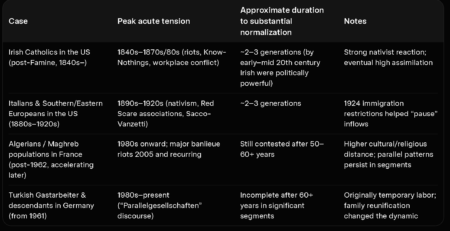
Notice the difference: integration has historically worked best when societies were given time to digest the inflow. Europe has kept adding ingredients while the pot was still boiling.
What occasions this discussion is the story Spain will send troops to Ceuta to help with border security. Moroccan pressure is breaking against Spain’s border. It’s worth putting on the Peoplenomics hat for a minute, though. Because Spain is just the front edge of the airfoil on what’s ahead. So let’s add context before we turn on the blender.
Earlier this month, Spanish authorities declared a humanitarian emergency in the North African enclave of Ceuta after thousands of migrants, predominantly young Moroccan men, surged across the border by land and sea. Military units were deployed, reception centers overflowed, and local officials warned that the territory’s capacity had collapsed.
Here’s where “domain selection” matters. You and I are “first worlders” – liking our tech and high consumption life. Spain – viewed this way – has a “Barbarians at the gates” issue. And real people are dying: authorities reporting at least 9–18 deaths during crossings.
The episode echoed earlier crises in 2021 and underscored a recurring pattern: pressure from the southern Mediterranean repeatedly tests Europe’s external borders while amplifying internal debates already running at high temperature.
Here’s where we go from event to template: The Ceuta events did not occur in isolation. They form one visible front in Europe’s evolving “Diaspora Wars” — a multi-decade contest over numbers, norms, and political power driven by the collision of large-scale immigration with sub-replacement native fertility.
Strategically? Losing the sex war (insufficient baby making) invites (sometimes unwanted) immigration.
Where domain selection matters is in time and location:
- Russia treats fertility as strategic state policy while much of Western Europe treated family formation chiefly as a private lifestyle matter.
- Europe went overboard in a pseudo-sexual revolution which is fueling downstream events due to the lack of baby making. The co-drivers are delayed marriage, fewer births, aging workforces, and subsequent reliance on immigration.
- The U.S., comparatively, has been running this clock for roughly a century along the Mexican border. Take out the drugs and people-to-people we’re all somewhat chill.
How to Lose a Sex War
Across most of Western and Southern Europe, total fertility rates among native-born populations have remained well below the 2.1 replacement level for decades. The resulting demographic vacuum has been filled, unevenly, by inflows from North Africa, the Middle East, and other higher-fertility regions. The arithmetic is straightforward and no longer seriously disputed: without sustained immigration, many European societies face long-term population decline and aging; with it, they experience rapid shifts in the composition of younger cohorts.
Those shifts have produced measurable cultural friction. In several countries, significant segments of Muslim-majority immigrant communities and their descendants hold social attitudes on sexuality, gender roles, and free expression that diverge sharply from the progressive legal and cultural settlements of the host societies.
Surveys and incident reports over the past fifteen years have documented lower acceptance of homosexuality, higher rates of social conservatism, and periodic harassment or violence directed at LGBTQ individuals and events in certain urban districts. Pride marches have required heavy police protection in parts of France, Sweden, Germany, and the United Kingdom; some local authorities have quietly altered routes or visibility. And we trust you remember the incident in Germany last weekend? A Pride event attack killed one and injured more than a dozen. Police identified the suspect as a known member of Berlin’s Islamist milieu.
The conflict is not abstract. It pits the post-1960s European settlement on individual sexual autonomy against the more traditional moral frameworks carried by portions of the diaspora.
Spain’s Moroccan connection illustrates both the demographic and the political dimensions. Morocco has long been a primary source of immigration into Spain. Chain migration, family reunification, and repeated border pressures have created sizable communities whose integration outcomes remain mixed.
While many individuals succeed economically and socially, concentrated areas exhibit higher unemployment, lower intermarriage, and value patterns that resist full convergence with Spanish secular norms. The latest Ceuta surge arrives against this backdrop, reinforcing perceptions among restrictionist voters that external control has failed and that domestic social cohesion is under continuous stress. Remember the B-school process? Forming, storming, norming—and, politicians hope, conforming. Welcome to the storming part now rolling hard.
Similar dynamics appear elsewhere. France continues to manage the legacy of post-colonial North African migration through recurring banlieue unrest and debates over laïcité. Germany’s Turkish-origin population, originally recruited as temporary labor, has produced both successful second- and third-generation citizens and persistent “parallel society” controversies six decades on.
In each case the timeline of tension has stretched far beyond early optimistic forecasts of rapid assimilation. Historical comparisons with earlier European migrations to the United States suggest that substantial normalization often required three to four generations under conditions of lower cultural distance and eventual restriction of further inflows. Europe’s current combination of higher distance and ongoing arrivals has lengthened that horizon.
Political systems have begun to register the strain. Parties emphasizing border control, cultural continuity, and skepticism of rapid demographic change have gained ground in multiple elections. Governments of the center-left face simultaneous pressure from progressive constituencies that prioritize humanitarian obligations and LGBTQ protections, and from working-class and peripheral voters who experience the costs of rapid change most directly. The result is a polarized discourse in which demographic data, crime statistics, and cultural surveys are weaponized by all sides.
What distinguishes the present moment is the simultaneity of external border pressure and internal value conflict.
The Diaspora Wars are not a single insurgency or a coordinated campaign. They are the cumulative effect of differential fertility, sustained migration, incomplete assimilation in key metrics, and the collision of incompatible social norms inside the same legal and urban space. Whether European states can enforce borders, accelerate selective integration, or renegotiate the terms of coexistence will determine how long the current phase of tension lasts. History suggests the answer is measured in decades, not election cycles.
Oh, and somewhere in here? The nation-state levels ramp up and it’s WW III. Because the other big front is? What I’ve called for twenty years now: The Manufacturer’s Resource Wars.
Let me emphasize something: Because you won’t see this on TV. The domain-understanding is that Diaspora Wars and Manufacturer’s Resource Wars are not separate stories. One stresses identity, legitimacy, borders, and domestic cohesion; the other stresses oil, minerals, food, water, energy, and industrial capacity. When they overlap, governments lose room to compromise because every external concession looks like an internal betrayal. (And may be…)
That defines The Convulsion Period: not necessarily one clean World War III opening bell, but a rolling global renormalization in which borders, alliances, populations, currencies, trade routes, and acceptable social rules are all fought over at once.
Might a rolling global socioeconomic convulsion sidestep nuclear WW III?
Wait! There’s a Timer I Should Mention!
von Clausewitz supplied the hidden timer. War remains an instrument of policy only while the leaderships involved believe there will still be a state—and a leadership—left to conduct policy afterward. The Convulsion Period can therefore remain conventional only until one nuclear player sees a no-win outcome for its regime.
At that point deterrence may stop restraining action and begin encouraging first use. Then the regional nuclear-shadow systems—Russia and the NATO-Ukraine theater, Israel and Iran, China and the Western Pacific alliance structure—come off the shelf. The “mini-MADs” activate, escalation outruns diplomacy, and the mop hits the floor. Masks and Geigers ready?
Then our weekend question becomes harder:
Can a rolling global socioeconomic convulsion avoid producing one (nuclear or biologically armed) leadership that concludes it has nothing left to lose? Because that—not the first border riot, tanker strike, or battlefield loss—is where the nuclear clock really starts.
And maybe ends. (Whew!!)
News Compressor: ON
Now let’s look through the windshield for evidence that the fronts are already converging.
What changed overnight is continued kinetic activity in the US-Iran conflict after a brief pause, with the US completing another “heavy wave” of strikes on Iranian targets and Iran claiming drone attacks on US facilities in Kuwait plus strikes on oil tankers in the Strait of Hormuz. Iranian media reported additional casualties on Qeshm Island. The US Senate again rejected an effort to limit presidential war powers.
Extreme heat warnings remain in effect across large portions of the western and southwestern United States as a heat dome intensifies into the weekend.
Weekend News Outlook
Further US or Iranian strikes possible within 24–48 hours if claims of Hormuz tanker attacks or Kuwait targeting hold; outcome depends on whether commercial traffic is visibly disrupted and on any CENTCOM confirmation or denial (confidence 65%).
Spanish government coordination with Morocco and potential additional mainland transfers from Ceuta over the next 48–72 hours; risk of secondary surges if weather or Moroccan border control shifts (CI 70%).
Peak heat stress Friday–Sunday across the Southwest and Intermountain West; elevated wildfire ignition risk and heat-related medical load (confidence 85%).
Energy markets sensitive to any confirmed Hormuz transit interruption; price spikes possible if multiple tankers are verifiably halted (60%).
Senate or executive messaging on war powers and Iran policy likely within 48 hours given the failed limitation vote (55%).
Ukraine long-range strikes on Russian energy infrastructure may continue but no fresh overnight confirmation beyond the prior refinery hits (50%). We still think the Ukraine nuke plant under Russian control will become a target (26%) but timing is open.
Domestic US disaster picture currently heat-dominant; flash-flood risk remains on burn scars in the West if thunderstorms develop (70%).
Eyeing Next Week
Take Monday off. Mainly boring shit (market could rally early). But Tuesday mid-morning the JOLTS report from labor. Then the usual Wednesday-through-Friday track: ADP, Challenger, and Federal job numbers.
We are almost to the top of the heat roller-coaster lift tower – and we’re looking forward to cooling in September like you wouldn’t believe.
Around the Ranch: No Selectric
The adventure of Elaine’s Selectric II is about wrapped. If you remember, I bought it July 6 from a shop up in Denver. It never showed – and I was refunded. When there’s no money on the table, I tend to lose interest. But when the “Second Notice of Attempted Delivery” showed up Wednesday I just couldn’t resist the trip to the post office. C-URE-iosity.
No, despite a “notice of attempted delivery” they didn’t have it. So here’s what I told the seller:
“As promised, I went to the USPS here in Palestine, TX today to present my “Second notice” of attempted delivery.
The clerk explained that the item (your typewriter) is still in Denver and the notice to me only arrived here because my name and address are the intended in the system.
However, the clerk said that the USPS is now trying to get it (to the seller) because (clerk says) most likely there is a label issue.
She also showed me the USPS internal tracking which showed “container” scan, not “item scan” and that could be part of the issue as well.
I am OK since I was refunded (giving up on Selectrics, lol) and my wife will have to use one of our half dozen computers for writing. If there is someone there (wherever your shop is in, Denver?) when USPS tries again, who knows.
I don’t have it – never did, and it never got south of Dallas even “container joyriding.” As I said Zip+4 may improve the delivery batting average Mine is 75803-0349.”
This is the end of the Postal Mystery series, for now.
But follow along in the Comments section, because reader Hank (out on the Big Island of howwahyah) is waiting for a fishing shirt (long-sleeve – good choice except working with power tools) and we’re developing this into a whole contest.
I can hear it now: “Enter today and you could win a roll of stamps.”
My home insurance check still hasn’t made it to Dallas, either – that was mailed on June 22.
But you know what did get through? Me.
Write when you get rich,
George@Ure.net
So George. It looks like the market took a one day drop below your 85 day average and is now going back to “normal”. Like I said, let me know when there is an actual flood of redemptions rather than “lets play with number to keep the rubes thinking there is a real market”.
LOL – yeah pisserw for sure – but when you get a break below it is normal to rebreak a bit above trend on a test and then fal fall fall again – but6 I’m not on the distro list for when exactly t6hat might be…
Something has changed allot in the last 6 months in regards to ANY type of mailing service from USPS,UPS, Fed-x and others it has always had some minor type of issues arise but generally all was OK, now NOTHING is good I have had nothing but issues time after time and I will say it appears to be more related to the influx of AI in use in all of these systems. not a 100% but add that to the human error and there you have it. shipping is now like a “box of chocolate” you never know what your going to get. I have had several more issues as well, but just not worth the time to explain, LOL
I think all of you guys have gotten on a database list somewheres, and yer mail and packages get routed to the places mine used to go into holding pattern for “processing”. My stuff is generally getting delivered these days. You are on the right track. Document incidents of note online.
Be kind to those who serve you. Decades ago at airport curbside they had bag handlers who would take your bags from the car, write the tags, and check in the bags for you. I waited patiently while the rich and obnoxious guy from the car in front verbally abused the bag handler, demanding service. The bag handler scrawled out several tickets and handed the top copies to the passenger, who stuffed them into his pocket without looking and rushed into the terminal. No tip. I looked at the airport code he had written as he fastened the tags to the luggage. It was unfamiliar.
I was very nice to the bag handler and made sure he got a good tip. I knew my airport code and it was correct on the tags. Later on I looked up the airport code the bag handler wrote on the obnoxious guy’s tickets. His bags got sent to some small, obscure airport in South America!
The 14 parcel express companies that’ve popped up in the past few months, most (or all?) with Chinese financial backing, couldn’t have anything to do with it, right?
“Something has changed allot in the last 6 months in regards to ANY type of mailing service from USPS”
It could be due to the “Emerging Counterfeit Label Trend”:
https://www.uspsoig.gov/sites/default/files/reports/2026-04/25-072-3-r26.pdf
From the pdf: “In total, during this
period, we found the Postal Service processed over
10.7 million packages with unpaid postage and this
type of counterfeit label.”
Now USPS has to identify and seize fraudulant packages as well as
process the legit stuff.
Wandering Selectric Container a journey through the USPS ether, now there is another story title to consider.
The youngest son called his mom the other day and told her that she and I should see Project Hail Mary. We don’t spend a lot of time in front of the giant 80″ monster and I heard her tell him she doesn’t like space movies but after he said she would really like it she told him ok, thus telling me it’s a chick flick. I detest those as much as she does space flicks.
So we got comfortable and found the movie on Amazon Video yesterday evening. After a sort of slow yawning start and a sharp “wake up!” from my love the show began to have some pretty good comedic moments along with the end of the world puffery. One such hilarious one was a mis stated saying when the hero tells an alien “first bump” and it replied “first my bump”. This was just before our obligatory Intermission and while the cowboy went to see a man about a horse my love went to prepare some chips and dip. She called me to help her open the jar of salsa and as is her habit saying “did you wash your hands?” hands me the jar which I opened with manly ease. Then she puts her first up and with a straight face says “first my bump”. I laughed so hard I was thankful I had already seen about the horse. After she asks why that is so funny and I gently explained it. Her response was a loud Ewwww.
Stay safe. 73
Nuclear weapons use. Ref: Planet apes…ape will not kill ape…
cc : looks like a thoughtful citation. Planet of the Apes we are.
GU : “… remain conventional only until one nuclear player sees a no-win outcome for its regime …”
I don’t buy it. “our regime can’t win so let’s all go out in a blaze of fire. Simply doesn’t work for me. A lone Coyote pulling off something dirty? Scary and possible. Nation on nation nuke exchange? Nyet. Nein. Nope.
Ironic. I know someone who has more than one Selectric. They were all the rage for a while. I would often slide into the Collectors staff office to type on a hard copy form with the highly reliable machines.
It’s not just USPS. My replacement pontoon canopy left Warsaw, IN to my south and went far east into two hops through OH on the way right past my 20 to way north in Michigan (while still Lower, no UP jaunt, yet).
Theoretically UPS will roll down the hill and make delivery today. Or not.
Expect lots of position squaring into the close. While animal spirits desire higher there is some serious dosh squatting on the sidelines. Every weekend. The Korean PPT (plunge protection team) did their part. Sadly, scarily, the TNX is flirting with Rubicon numbers. Hold below 4.92 or heaven help us. All.
Not ^ advice. It _never_ is.
Egor, all at sea.
I were it twer.
~~__||_ ~
i changed my address, filled out the postal card, dropped it in the mailbox and a week later got a note that said i have to show proof of Identification in person or they were going to hold my mail for 20 days.
now this is where it gets really good. —-> I recieved my mail in voter packet then the next day i had the note that said i had to show proof of Id on my new address.
make sure you deliver that mail in voter packet before you ask for clarification on identity and hold the rest of his mail.
huh.
well you know, i am of the idea that my vote only matters to me and the akashic records. because if my vote mattered in other areas, on the 112 time Fauci plead the 5th, it would with a noose around his neck in the middle of time square broadcasted all the major networks. Hang Em High.
but you know there is that whole world and there is the world i live in. where the price of gas doesn’t matter, i am Rich beyond measure and everything happens for a reason.
i try to stay in that world more so than the other world where every day there is a “BombShell report” and “Red alert Status.”
I have the day off today. i m going to go fishing.
P.S. George you do know that Sodom. where Lot lived is the same place as Jeruselem is today. it was also called Salem at one point and that is where King Melchizedek was the Boss. Abraham giving him a healthy 10%
I Win with God Within.
Per your request of what to wear for a selfie in antarctica… I’d suggest something warm… very warm. They’re just coming off winter down there.
I had friends down there..use to get the updated south pole pictures every year..when I was really sick..one of my bucket list items was to see the magnetic south and north poles..those crazy goons did it the put live cams on and sent me the feed link so I seen both at the same time.. best pair of snow boots I ever got came from the south pole ..NASA sent them steel toe boots..so rather than lose toes they burned them and bought their own in new Zealand.. the spent more time in new Zealand than on the ice..got caught in a storm landing in new Zealand as they landed..plane slid sideways….I am a little jealous lol..that’s one place I always wanted to see…Skype calls has about a minute delay from there to here..
want updates on the ice…
https://www.usap.gov/news/?category=The%20Antarctic%20Sun
https://polarjournal.net/the-antarctic-sun-turns-25/
https://www.esa.int/Science_Exploration/Space_Science/Solar_Orbiter/Solar_Orbiter_gets_world-first_views_of_the_Sun_s_poles
years and years ago..I had to classify film from tgere seen stuff that totally amazed me..I was curious ever since..tried to get stationed there but didnt.
i went out on my deck last night to have a smoke. this little tiny spidee was weaving her web. she was so busy working it. going round and round at sunset. i marveled at her handy work. it was one of the most beautiful things i have ever seen. her steadfast persuit to make a home for herself. so inocent and free.
i did try to tell her, you are making it right accross the path. and the first person who walks down the path is unknowingly going destroy all your delicate work. i did thank her, for allowing me to witness her perform the task. and i wished for her to have a healthy good catch before all that work was destroyed by a force she didnt understand and didnt even notice she was there. i had witnessed her beauty and art. so someone seen it and knew about her on a thursday evening at sunset, mid summer.
the big fat bumble bee got caught in her web. the bumble bee was 5 times bigger than the little spider. it was a big feast for her. she spun him around and stood apon him like David over Goliath. i gave her a solo standing ovation.
this morning she was gone. her web no longer. someone came accross the path, thinking of things she could never dream of in her wildest little spider fantasys and destroyed her web on the way to do stuff she could never understand.
i looked for her but i couldnt find her. so i sat and had a smoke and said, I was there. i had witnessed her beauty and art. so someone seen it and knew about her on a thursday evening at sunset, mid summer. the rest of the world may have never known her. but i did. and that counts for something.
This is the better world. i think i will return to that world and not the world where epstine clients run free.
i wonder if i stay in that other world where gas prices dont matter and beauty is all around me and never return to the world the angel of death. father of covid 19 and profiteer of the vaccine gets a presidential pardon and pleads the 5th? maybe that world of ugly injustices will fade away into nothing…. as if it never existed.
I Win with God within.
I’ve had a sneaking suspicion world War 3 started with COVID Bioweapon release, the stolen 2020 election, open borders, and the Russian invasion of the Ukraine. Somehow woke identity politics along with global warming hoax have been used to undermine sovereignty and the nationalist identity matrix along with subverting our capitalist democracy, illegal immigration and slavery parallel historical rhyme. Thank God for President Trump, just imagine where this crap show would be if Harris/Walz ticket had won.
“The Diaspora Wars Warming”
Excellent column g. Will never make mainstream media. Facts seem to cripple the liberal mind.
Time for a reread of the book “Camp Of The Saints” by Jean Raspail?
I haven’t read that one..is it good..
Got it..going to start reading now..
i recently recieved an invite to the top inner circle. like you know with the big powers that be guys. from their head of the table. the world descion guys who write the next presidents name on a coctail napkin with malt blank pen and stuff like that. the head cheese said he would like to arrange a meeting. i laughe and said that is the difference between us. i dont have to arrange anything. i just live my life and i end going where ever i go. currently scheduled to go to Antartica. but that could change and im good with it either way.
so this was my reply. its the same story i told this morning. but its better.
Mr Grand Witness
Last night I went out on my deck last night to have a smoke. this little tiny spider was weaving her web. she was so busy working it. going round and round at sunset. i marveled at her handy work. it was one of the most beautiful things i have ever seen. her steadfast persuit to make a home for herself. so inocent and free. Her home so delicate and deadly. Her web shimmerd with elaborate colors as it reflected the light of a distant sunset.
i did try to tell her, you are making it right accross the path. and the first person who walks down the path is unknowingly going destroy all your delicate work. i did thank her, for allowing me to witness her perform the task. and i wished for her to have a healthy good catch before all that work was destroyed by a force she didnt understand and didnt even notice she was there.
i had witnessed her beauty and art. Her delicate tenacity. so someone seen it and knew about her on a thursday evening at sunset, mid summer.
then a big fat bumble bee got caught in her web. the bumble bee was 5 times bigger than the little spider. it was a big feast for her. she spun him around and stood apon him in Triumph like David over Goliath. i gave her a solo standing ovation. She was glorious in the Eternal Now.
This morning she was gone. her web no longer. someone came accross the path, thinking of things she could never dream of in her wildest little spider fantasys and destroyed her web on the way to do stuff she could never understand.
i looked for her but i couldnt find her. so i sat and had a smoke and said, I was there. i had witnessed her beauty and art. so someone seen it and knew about her on a thursday evening at sunset, mid summer. the rest of the world may have never known her. but i did. and that counts for something. I had witnessed her Glory in the Eternal Now. I lived to tell the tale.
This is the better world. i think i will return to that world and not the ugly world where epstine clients run free.
i wonder if i stay in that beautiful world where gas prices dont matter and beauty is all around me and never return to the ugly world that the angel of death. father of covid 19 and profiteer of the vaccine gets a presidential pardon and pleads the 5th? maybe that world of ugly injustices will fade away into nothing…. as if it never existed.
I never got covid nor did i get the vaccine because it didnt apply to me. It was a choice given to the people who live in the ugly world of confusion, deception, the illusion of control …where death is the only god.
If we ever meet by Divine Arrangement? It would have to be in the Beautiful World. For the ugly world that also exists is on the fast track to self destruction. That ugly world will be gone one morning. Destroyed by a force it didnt understand and didnt even notice it was there.
I Win with God within.
Nuclear Weapons…. Pentagon? Mr. Peter Vincent Pry “Effects of nuclear weapons”… hmmm doctor is in… idea is low, medium, high effectiveness to encompass threats, survivability, reliability, failures in flight? So in total in 1980s or so rumor was 80+ weapons for Moscow during cold war… Kind of like WW1… 60-/40 mix of biplanes ruled outcomes…. since equal and aces were not that many… Fast forward to 2020… nuclear winter scenarios of so many weapons, so much dust kicked up, so much Ozone destroyed and you got size down from 1980s 50000 weapons to abut 5000 each Russia and USA. That being said…as all or nothing exchange…. Prophecies is nuclear weapons use eastern europe… maybe eastern USA, maybe Russian front Ukraine… you can either ‘send them home by ruining economy’ or ‘ kill military’. No word on a Lenin in charge like Putin.. or a Stalin and Ukraine and 5 million dead Ukrainians some time back. Moa also had his time. Zi seems nice in comparison.. Revivals happen in USA under guise of civil wars. NATO and Pacific treaties are backed up by NUCS as last resort.
Nucs…last idea… Idea is RISK game..many armies roll dice…less armies, win the country… So Russia has in theory about 13 100Megaton weapons… basically idea is bigger is better for subjugation… NYC is 1/4 size Shanghai… Most megacities like India (Muham, Calcutta, Bombay, ect) are mone makers for currency. Same in west… London, NYC, Los Angeles… Big bombs put a dent in currency… since most west is socialist that is civil wars ensue. Rest nucs are smaller and more geared to decapitating military bases, logistics structures and storage facilities… like fuel, food, water.
no use whining. just get on with it . load ladders on selected weapons. even though you are a friend of the chief can kicker and in a fairytale land of economics . yep this aint your grandfathers crash and depression . its worse . happy dayz .. love these inclusions of coloured graphs , magic ovals , and this Ebbinghaus thing . wow in the ether zone !!!
and one thing proven in markets . nobody know matter how smart , smug or with mumbo jumbo ever is right on the time . it just happens . shoulda woulda coulda.
re: “Mr. Smith Goes to Washington, 1939
Thar she blows! Wales has sent its Indian-born MP Mr. Kanishka Narayan to London. Going forward the honourable member from the Vale of Glamorgan (94% White, 2021 Census) will be the UK’s first AI Minister. Some years past between studies Mr. Narayan had employment with banking concern Lazard (heb: “God has helped [descendent of Lazarus]”). The current company ceo is a three time invitee to the Bilderberg Group meetings.
Media platform “Sifted” reporting on EU startups is headquartered in London. It was incubated into the world by London’s “Financial Times” dating to 1888 which itself is a wholly owned subsidiary of Japan’s Nikkei, Inc dating to 1876. “Sifted” caught up with Mr. Narayan last fall across from the Palace of Westminster (Parliament) at the Old Queen Street Cafe. The journalist ordered a “full Old Queen Street breakfast” while the MP chose “eggs royale”.
According to the menu on the OQS website, both selections are quoted at a £20 pricepoint. Interestingly the Welsh Rabbit is only £14. One imagines this brekkie was a dry affair although the bar does offer a “Churchill’s Martini”. Additionally patrons are invited to admire floorboards in the space which are allegedly sourced from Sir Winston’s Old War Office.
It appears that Humphrey is the moniker assigned to AI tools necessary for productive engagement by the British civil service. Humphrey takes his name from Sir Humphrey Appleby. He first appeared on BBC2 as a senior civil service leadership character in the 1980 television series “Yes, Minister”. The program is understood to have been a fave of late UK PM Baroness Margaret Thatcher.
Here is a link from a self-described “privately funded, non-profit initiative”, and “news experiment driven by AI technology” media outlet named “London Daily [News]”. The platform’s name should not be confused with the 1980’s defunct newspaper of tycoon Robert Maxwell who allegedly fell off the deck of his yacht Lady Ghislaine.
https://londondaily.com/uk-government-introduces-humphrey-ai-tools-to-enhance-civil-service-efficiency
Separately, a co-founder of Wikipedia, Jimmy Wales, has declared himself not to be a fan of AI news websites such as “London Daily”.
Bigger Issue. Notwithstanding folks not liking below. Said scenario generates large tides.. and 80% folks along coast have issues with tides.
https://www.zetatalk.com/newsletr/issu1026.html
yep bidding up the cost of capital because there is none . scarcity . every inflationary depression turns into a deflationary depression . yes we were living in it and didnt know
and meanwhile . sell everything to find that last bit of liquidity . tulips , commodities , usd$, gold /silver , even oil . perpetual war and oil is tamed by donny and the princes . nothing like trading . that great movie with dan akyroyd and eddie murphy . trading places
“What occasions this discussion is the story Spain will send troops to Ceuta to help with border security. Moroccan pressure is breaking against Spain’s border.”
Italy suspends Schengen with Spain over Ceuta migrant crisis, closes air and sea borders…
https://www.euronews.com/my-europe/2026/07/31/italy-suspends-schengen-with-spain-over-ceuta-migrant-crisis-shuts-air-and-sea-borders
An unprecedented wave of 60,000 illegal migrants from Africa has flooded the Spanish enclave of Ceuta, prompting Spain to deploy its military – as locals liken the invasion to an “apocalypse.”
https://nypost.com/2026/07/31/world-news/thousands-of-illegal-african-migrants-overrun-spanish-enclave-turn-streets-into-open-toilets-and-bathe-in-fountains-an-apocalypse/
Somebody organized this invasion. Who?
Much like those MOBS who swarm shopping malls and stores in the US, just some sort of posting in Instagram will do it when what they are swarming is for something they want.
In the case of the masses of young people in Morocco, and those who have traveled from further south to reach Morocco, the dream is not political but economic, to be able to get across the Med to the Promised Land of a Western Economic Lifestyle as milions before them have now managed to do over the last decade. Why do you think there were about 1 million illegal immigrants already in Spain? (latest estimate as to the number that are going to qualify for the new amnesty that was proposed in Spain for illegal immigrants just a few weeks ago)
Everyday young people wanting a better life … the same reason why so many from South of our border were trying to come here … not to impose their culture on the place they were trying to get to, though that may happen as a result of their mass migration, but so as to obtain a better life for their individual future.
Ok..here’s an odd marinade…..
2 tbsp Koji seasoning per pound of meat
1 cup strong brewed espresso (cooled)
3 tbsp brown sugar
2 tbsp soy sauce
1 tbsp Worcestershire sauce..
1 tbsp balsamic vinegar (adds depth + acidity… in a roast in the installer this is the best..)
1 tbsp olive oil
1 tsp smoked paprika
1 tsp black pepper
1/2 tsp garlic powder
1/2 tsp onion powder
Optional: ½ tsp cocoa powder ( deepens the roast flavor)
check it out…..This Marinade sauce is the great equalizer — the poor man’s secret weapon. A couple bucks’ worth of espresso, brown sugar, and Koji turns a cheap cut of meat smoked in a cold smoker turns it into something the rich man would swear came from a high end luxury steakhouse. It’s the kind of marinade that lets a guy with a thin wallet eat like he owns the restaurant. Yumm..
And when you sit down with that plate and a nice cup of homemade wine, the kind you crafted with your own hands, you’d swear you were in heaven — not because the meal is fancy, but because you turned simple things into something worthy of a king….. oh baked spud and bacon wrapped asparagus… grilled to perfection..
Insta – pot not installer
(“And so, we wonder, who rules whom?
This is watched by the market, but other issues (expanding Middle East war, oil prices, making up money scams) take higher priority. Days like this I wonder “Am I the only guy who read “The Zero-Sum Society?”)
Naw…the download link and the link to get a hardbound book…
your choice..my wife makes me donate hard cover books to the library…luckily the ebook reader holds a few..and a few DVD’s filled..
https://www.google.com/url?sa=t&source=web&rct=j&opi=89978449&url=https://nathannunn.sites.olt.ubc.ca/files/2022/12/Zero_Sum_US_Political_Divides.pdf&ved=2ahUKEwiv3L7pz_2VAxXKIkQIHfn2G3MQFnoECGQQAQ&usg=AOvVaw37hPAuHbA0nHmzhUiA7dGR
https://www.amazon.com/Zero-Sum-Society-Distribution-Possibilities-Change/dp/0465085881
She would freak out if she knew I have fifty or so books in the buggy…lol lol.. and a few totes in the shed lol lol lol seriously you can’t dump everything and when your in the car..dam sitting in a parking lot or waiting room..its better than some stale magazines..
(“Surveys and incident reports over the past fifteen years have documented lower acceptance of homosexuality, higher rates of social conservatism, and periodic harassment or violence directed at LGBTQ individuals and events in certain urban districts.”)
At the VA medical center..you walk in the nurse sits you down..then comes the questions..sitting there with a friend..the nurse askes..are you gay, are you in – sexual, are you heterosexual, do you like sex and do you want sex…as we were walking out he looks over to me and asks..what in the he’ll was that about..I haven’t had sex since the wife died…I tell him..yes no body ever asks me the good questions..lol lol
later the nurse comes in and makes the comment I’m going to refer him for psychiatric evaluation.. I ask is that due to him being heterosexual.. no he has PTSD from the war..
my next visit I walk in the nurse sits me down..I place a tube of KY jelly on the desk..she gets this shocked expression and asks me..what’s that for..I calmly say..well your going to ask me if I want sex and if I’m gay..good lord knows your going to need the lube and about being gay..does it really matter who takes care of Willie.. lol lol she blushed and said oh I think I won’t ask you this questions..then takes my blood pressure and takes me into see the new PA…that was as happy as a jaybird limp wrist and all..lol lol lol boy was I embarrassed…
I personally want allow him to do a prostate check..my biggest fear is when he’d be checking the prostate pretty soon he would place both hands on my shoulders lol lol lol…
Won’t allow him..
Sodom and Jerusalem… same morals… but different physical locations…
Abraham was from ur… Iraq… had a vision…. idea was tree life is two birds sacrificed and God makes a covenant to wash his heart with blood savior for motives, desires, inclinations, affections (not stuff)… rent heart was stone is flesh by blood… more inclined to faith hope love (intangibles) and presence Holy Spirit than antichrist, false prophet, evil spirit steal kill destroy for stuff. Most time Jerusalem Baal worship of Solomen… felt good made money, all well. So Sodom…
And it’s why the New Testament reframes sacrifice entirely…no more blood,
no more fear,no more appeasement ,only transformation of the heart…
all the prophets have repeated the same message…stone,scroll, books, in speeches to the people they spoke to…
“Do unto others as you would have them do unto you.”
(Luke 6:31)
Micah “Do justice, love mercy, walk humbly.”
Isaiah “Learn to do good; seek justice; defend the oppressed.”
Jeremiah “Act with justice and righteousness… do no wrong to the foreigner, fatherless, or widow.”
Amos Zechariah “Show kindness and mercy to one another.” “Let justice roll down like waters.”
Hosea “I desire mercy, not sacrifice.”
Muhammad (peace be upon him)..“None of you truly believes until he loves for his brother what he loves for himself.”
Confucius taught the Shu principle — the Chinese version of the Golden Rule…
“Do not impose on others what you do not wish for yourself.” All the Chinese sages all the prophets its written so much and it always gets me that mankind scoots over the basics …
Chinese Sages (Confucius, Laozi, Mencius)
(“My home insurance check still hasn’t made it to Dallas, either – that was mailed on June 22”)
my daughter is our insurance agent.. she’s switching companies..going to the one that honors their insurance agents with more perks.. can you believe it..not satisfied with two company paid vacations wants to get one every quarter instead of twice annually… they are off now on one..sheesh. Great profits for the mother company gets you the golden onion….
Thu, Jul 30
12:00am
In Transit to Next Facility, Arriving On Time
Wed, Jul 29
10:20am
Departed USPS Regional Facility
SAN FRANCISCO CA DISTRIBUTION CENTER, 94804
So the fishing shirts appear to have gone fishing. The 12:00am automated scans tell me it is occupying a container. That may continue for a few days (or weeks) while it awaits placement on a boat. And even automated scans stop eventually. This is normal behavior for crossing the Pacific ‘black hole’. With luck, it will not be heard from again until ‘out for delivery’…. possibly 30 days from now. So y’all don’t hold your breath. I’ll let you know of any unusual update (like heading east).
Why am I not surprised..,
The Police Chief of Seattle has been forced out [ forth police chief in four years ] by the socialist Mayor. She stated, rather harshly, that she disapproved of his response to the gang shoot-out in downtown Seattle.
In all fairness – he wasn’t even in town when it happened – he was attending a Western Police Chief conference – I believe in Denver. Kind of hard to respond from that far away.
She is getting rather snotty about all the questions – especially regarding her promise, many times, about transparency in her administration.
.., and she is taking a beating from the City Council and social groups – not to mention the press. “She had very little going in, now very few have any confidence in her.”
She just set her administration back on it’s heels.., big time.
In a flash poll 87% disagreed with her decision to fire the Chief.
I never did like this ex-Chief.., as on his second day in office he sent out a memo to all departments telling them to “quit hiring white officers”.
Seattle is screwed.
Send this to everyone you know in Seattle:
Overview of provisions to recall the Mayor of Seattle
Seattle’s mayor can be recalled under Washington State law (primarily Chapter 29A.56 RCW and Article I, Sections 33–34 of the Washington Constitution). Seattle is a first-class city, so the state rules apply directly. The process is deliberately strict and is not available simply for policy disagreements or political dislike.
Grounds for recall
A recall is allowed only if the official has committed:
An act or acts of malfeasance (unlawful act) or misfeasance (wrongful conduct that affects, interrupts, or interferes with official duties; or performing a duty improperly) while in office, or
A violation of the oath of office (neglect or knowing failure to perform a duty imposed by law).
The charge must be specific: detailed description of the act(s), approximate date, location, and nature. Courts act as gatekeepers and will dismiss vague, purely political, or insufficiently supported charges.
Step-by-step process
File the charge
Any registered voter (individually or on behalf of a group) prepares a typewritten, sworn charge and files it with the appropriate elections officer (King County Elections for Seattle).
Court review for legal sufficiency
The Prosecuting Attorney prepares a ballot synopsis. Superior Court reviews whether the charges are legally sufficient (detailed enough, based on actual wrongful conduct, and supported by some factual basis). Appeals can go to the Court of Appeals or Supreme Court. This step often takes weeks to months and frequently kills recall efforts.
Signature gathering (if charges are approved)
Sponsors have 180 days to collect signatures equal to 25% of the total votes cast for all candidates for mayor in the preceding election.
(Historical examples: ~55,000 signatures were needed after the 2017 mayoral election.)
Signatures must be collected on paper petitions. Gathering must stop six months before the next regular election for that office in some timing scenarios.
Verification and election
If enough valid signatures are submitted and certified, a special recall election is scheduled (generally 45–90 days later, preferably consolidated with an existing election). Voters decide yes/no on removal. If a majority votes to recall, the mayor is removed immediately.
Additional notes
Success rate is low because of the court-sufficiency requirement and the high signature threshold.
There is a separate City Charter provision allowing the City Council to remove the mayor by a two-thirds vote for willful violation of duty or an offense involving moral turpitude, but that is distinct from a voter-initiated recall.
If the mayor is successfully recalled, the vacancy is filled according to City Charter succession rules (typically appointment or special election).
Bottom line: Recall is possible but difficult. It requires documented wrongful official conduct that survives court scrutiny, followed by a substantial signature drive (roughly one-quarter of the previous mayoral vote total) and a successful special election. Pure policy dissatisfaction is not grounds.
Apparently neither is incompetence.
Works great, except when you have a corrupt election system, aka califukya.
Doesn’t matter whether such an action be successful or not. Were she to be recalled, she would be replaced by another just like her. Seattle is in a self-destruct spiral. They haven’t learned the error of their ways — probably won’t until the social pervs and the few remaining citizens engage in urban combat and literally trade gunshots, every time either party ventures into the street.
Sorry for your memories. The inhabitants of Seattle have to hit bottom before things get better, and they’re not even close. If they were, Comrade lives-with-mom-and-dad Wilson would never have received a vote, let alone been elected…
By the way, this is only hber first police chief firing. The Seattle liberals have been through 6 in the last 10 years. So a 20-month average longevity7. Ah this from people who are critical of Trump HR – the problem is (hate to break it) endemic to pollyticks
re: “Honey for the Bears”, 1/1/1963
feat: the other Burgess; Kim’s birthday
And then there were four. The same month “Honey for the Bears” saw publication, Kim Philby of Cambridge 5 infamy fled Beirut on a Soviet freighter bound for Odesa. This past Wednesday saw the BBC Proms 2026 broadcasting an Edward Elgar symphony from the Royal Albert Hall. As chance would have it, another of the composer’s works featured in the 1971 film, “Clockwork Orange”.
Newly installed UK PM Burnham has publicly announced on Friday that his economic advisor will be Mr. Neil Amin-Smith according to the “Daily Mail”. Allegedly the advisor had first turned down career starting job offers from the Foreign Office and MI6 to star as a member with a Cambridge electronic music quartet called Clean Bandit. After that gig ran its course, he joined the think tank IFS (Institute for Fiscal Studies).
Founding ideas for IFS allegedly took shape over dinner at the Stella Alpina (it: “Alpine Star [edelweiss]”) restaurant on July 30, 1968. I don’t know the menu specials of that day. However by 1970 the space had transformed into a family run Italian concern called La Genova which closed in 2017. Currently the venue is repurposed as a health studio whose moniker is synonymous with commenter tbs’ prior information to the group concerning “insane”. The two ladies managing the spa could be suspected of hailing from a Levantine nation.
Its street address in Mayfair is named after a wealthy 17th century direct ancestor of the current 7th Duke of Westminster and close leisure associate of the Prince of Wales. The Duke’s 2025 wealth allegedly totals £9+ billion.
Anglo-Ugandan Love Ssega (Ssegawa-Ssekintu Kiwanuka) was an original lead singer of Clean Bandit before parting ways to complete his PhD at Cambridge in “supercontinuum cavity enhanced absorption spectroscopy (SC-CEAS) and laser analytics”. Cue Mr. Amin-Smith. Clean Bandit’s naming derives from a Russian phrase ?????? ?????? told to a band member by British architect and founder of the creative collective group Assemble, Maria Lisogorskaya. Her suggestion allegedly carries a Russian nuance of “an utter rogue/a real piece of work”.
Left your balalaikas “Back in the USSR”? No problem, let’s join DJ George bringing us a music video from Clean Bandit at the following Youtube link. Comrades, give it up for “Mozart’s House” filmed in London and Moscow:
https://youtu.be/rd0cT7Dnpt8
re: “Quadrophenia”, 1973
Three days before that formative IFS dinner at Stella Alpina, The Who released their hit single “Magic Bus” in the USA. The B side included “Dr. Jekyll and Mr. Hyde”.
Pink Floyd fans leaving Battersea Station and the adjacent Jack Russel Terrier rescue home patronized by Queen Camilla will cross rail tracks to Waterloo Station before arriving at Nine Elms. Freehold land thereabouts had been sold in 1762 by Earl Spencer, ancestor of the late Princess Diana. Tourists may be tempted to take in the new American Embassy nearby. Others will choose to cross former Victorian slum streets repurposed after 1961 as a “strategic fresh food supply” now known as New Covent Market. Those journeying to its other side will reach an Edwardian ghost from 1908 seen presently on Google Maps as a National Health Services clinic.
That edifice had originally been known as St. Andrew’s Mission Hall on New Street once a part of “the toughest parish in Battersea” according to a vicar. By 1973, the building underwent redecoration courtesy of The Who emerging as The Kitchen and later Ramport Studio. Their album Quadrophenia was partially recorded there featuring a mind altering plot. According to Wiki, the studio also brought Supertramp’s Crime of the Century into the world. Here is a picture link to The Who website. The band’s late drummer Keith Moon quietly stands guard at a children’s protest against speeding traffic on the recording studio’s road adjacent to St. George’s Church of England Primary School:
https://www.thewho.com/wp-content/uploads/2017/11/1973-KM-at-Thessaly-Road.jpg
New Street saw renaming as Thessaly Road in 1937 to match a nearby square perhaps dating to the 1880’s. It remains officially unknown why the Greek name got assigned.
According to the oracle of Wiki, the region of Thessaly in Greece was known as Aeolus that Homer’s Helen called home. Long before the Trojan War, the Titanomachy 10 year war took place there with the Titans against the Olympians. At bordering Mount Olympus, Zeus and Titan goddess Mnemosyne (“Memory”) became parents of the inspirational Nine Muses (“to put in mind”). I asked ChatCPT “who is your Muse of the nine Muse daughters of Zeus?” I received a response.
“I don’t have a personal muse or patron among the nine daughters of Zeus. If I had to choose one purely as a symbolic fit for the kind of work I do, it would be Calliope.
Calliope (“beautiful-voiced,” from Greek kallos “beauty” + ops “voice”) was regarded as the chief of the Muses and was associated not only with epic poetry but also with eloquence and inspired speech. Since much of what I do involves explaining ideas, telling stories, and communicating clearly, she would be the closest match.
For reference, the nine Muses are:
…
Symbolically, though, I draw on all of them depending on the task—Clio for history, Urania for science and astronomy, Thalia for humor, and so on.”
re: Stalin’s Sisters
feat: neapolitan seafood pizzo
Stalin decided to celebrate the 800th anniversary of Moscow in 1947 by planning construction of nine skyscrapers (sisters). Seven were built.
The music video “Mozart’s House” by Clean Bandit linked above includes one of the Moscow Seven Sisters towers in the background of scenes filmed at a railroad station. I uploaded a couple of screenshots to ChatGPT for its thoughts. It is 90 to 95% confident that the music video scenes in question are filmed at Kievsky Railway Station. It informs that the camera is looking east-northeast in the direction of central Moscow. It is 70% confident that the filming camera is situated on platforms 5 through 8.
ChatGPT advises that video scenes being shot from a railway station therefore exclude Hotel Ukraina as a Seven Sisters tower option. The AI expresses high confidence that the tower in the video is actually the MFA (Ministry of Foreign Affairs) Building.
Another Seven Sisters of Moscow is the Kudrinskaya Square Building. The square had been known as Uprising Square prior to the 1990’s in honour of the 1905 and 1917 worker uprisings. The building is also known as the Aviator Building because upon completion it served as residence for elite members of the aerospace industry.
According to “RBC-Ukraine” quoting Russian Telegram channel “Ostorozhno Novosti” (ru: Beware of News), a Kudrinskaya Square restaurant had been booked for a private Saturday banquet. Allegedly at 1950 or 2010 Moscow local time a woman presented a boxed gift for security inspection. A detonation occured tragically resulting in alleged fatalities and injuries.
Multiple public reviews of the Balzi Rossi (it: “Red Rocks/Bluffs”) Italian restaurant caution diners that staff speak only english or french. Additionally patrons should remain vigilant against being upsold.
Following the explosion, Chef Alfieri (it: “standard-bearer”) took to Instagram in Italian to allay customer fears for the kitchen. Russian Telegram duly noted that IG as a subsidiary of Meta is banned in Russia. The chef’s alleged message from IG is picked up on the public Lady Krovav/Bloody Lady TG channel allegedly translating as follows:
“Thank you all for your support, we are well, our restaurant and our kitchen are in DEbene, perfect conditions, outside restaurant there has been some
..
..
little problem!”
As chance may have it, the chef may share his godfather’s name which may be a doppelganger reminiscent of a godfather in the birthplace of pizza.
Russians’ know that mofo as “the 3 headed dragon”
mi6
mossad
cia
We bee wondering where Saint George is when you need him..
Very good analysis of the demographics /immigration issue and the resulting merging of differing cultures from the 40,000′ foot level. One of the best I have read!!
Too many too quickly from a different culture … VOILA problems are baked into the cake, severe problems.
At least in the US with most of our illegal immigrant issues those arriving had the same basic cultural biases as the population that they were suplanting. Christian, most being very family oriented, and a willingness to work HARD at some sort of regular employment. As a result even with high illegal immigrant numbers we were not facing the cultural crisis that illegal immigrants were /are creating for Europe.
Those who have a very different culture who are coming into the US, Muslims and Indians being the largest in number, are actually coming in Legally, they are NOT illegal immigrants,. Those are the ones where the there may be problems with merging into the US culture since their cultures are very different from that of the normal American culture and belief system.
(note as part of their culture of extreme class distinctions in Indian Society Indians tend to only hire Indians of a similar class as themselves if at all possible once they obtain management powers in a business setting)
Good summary George