
This could be a decisive day for a very simple reason: In our 1929 Replay model, we have reached a point where the market looks ready to crash or climb.
OK, a safe emergency landing is still possible, but directional pressures are building. Yes, it can keep us waiting. Markets (in theory) could “circle the field” forever.
Here’s the problem in a nutshell—and you can thank the $40/year Peoplenomics.com subscribers for making the ongoing tracking worthwhile:
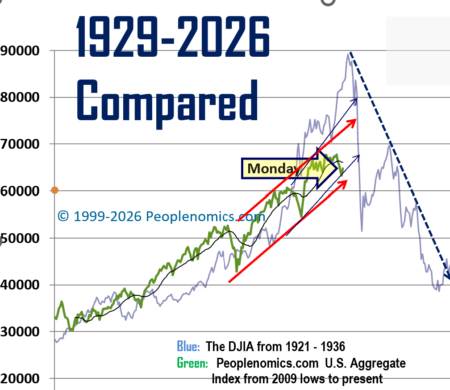
Let’s call out what you’re looking at:
- The dark blue trace lays out the run-up and subsequent rundown of 1929.
- The green trace shows our modern Aggregate Index waveform.
- The arrow marked “Monday” shows approximately where the Aggregate closed Monday.
- And, if you squint, you’ll see the 17-week moving average—the weekly counterpart to our 85-day average—which looks to be rolling over this week if we finish Friday around present levels.
That last qualification matters. This is a weekly chart. Tuesday doesn’t get to sign Friday’s report card. Plenty of Claymores between now and then.
Our really deep study of 1929 doesn’t guarantee a repeat. The model gives us a comparison to watch. A waveform – a previous signal. The market still has to do the work.
Oh—and none of this is trading advice. Because the world is crazy. Or hadn’t you noticed?
Which Way Does the Future Roll?
We do a lot of research on Peoplenomics that we don’t just give away. I don’t need another economic credential, and the world’s supply of ridicule seems adequate without further contributions.
Mostly, I’d like to get on with winning Life. If you don’t need to work, have a great wife, good life, why mess with success? Take the win for a longer spin.
PN subscribers have recently had some papers dealing with the three states of the future: the possibilities ahead of us, how they interact, and what finally turns one of them into the present.
For this chart, the labels are simple enough:
Higher. Lower. Muddling through.
The difficulty is that an economic number doesn’t arrive with its market meaning stapled to it.
We hinted to subscribers last week that a “buy the rumor” move was possible ahead of today’s CPI report. Did +1,104 on the Dow qualify? What deserves a little more attention is why CPI, considered as an isolate, may tell us less than people expect about what happens next.
The number matters. So does what traders expect, because of what they already bought, or how much borrowed conviction (and Other People’s Money – OPM) they carried into the announcement.
Next PowerPoint Slide….
Higher than Expected: A hot inflation reading could push expectations toward tighter Fed policy—or a longer wait for relief. That can lean against stocks.
But now the crosscurrents start. Renewed inflation fears might attract money to gold, silver, and other hard assets. Higher interest-rate expectations or a stronger dollar could pull the other way. Brent brings its own supply-and-demand baggage. And ammo shipments.
One number. Many competing trades. Everybody claiming the market has confirmed their brilliance.
Lower than Expected: A cooler reading could encourage hopes for easier policy and give stocks something to celebrate.
Then comes the less festive question: Why is inflation cooling? No money to fund the AI spending mania? We’ve been counting paid AI users for months. The rocks are not only in sight, but the bow is already on them now.
Improving supply conditions would be welcome. Weakening demand would carry a different message for corporate earnings, oil, industrial commodities, and farmers. This last group deserves a longer discussion, but only if you like regular meals.
Less inflation anxiety could reduce one reason to own them; lower rate expectations could strengthen another.
The headline gives you the number. You still have to figure out what moved underneath it.
Muddle-Through: This may be the most nerve-wracking outcome of all.
In this model, CPI comes in close enough to expectations that neither side gets a decisive argument. Traders rearrange their explanations, television fills the remaining airtime, and the market goes sideways while everyone waits for something else to happen.
There’s a useful electronics concept here: settling time. After a disturbance, a circuit may need time to settle into its new condition.
Markets have their own version of this. Unfortunately, you can’t always tell whether the oscillations are dying down, or something is about to let the smoke out. My consigliere’s hand goes up and reminds “Full oil price diffusion can take 60 months when you go through the whole product stack, inventory, and ripples.”
On this possibility? The market postpones the crash-or-climb decision while charging rent on everybody’s nerves. Well, except those of us on the sidelines for a while.
View from the Cheap Seats
Based on Monday’s close the chart reveals an uncomfortable junction. A little green in the early futures doesn’t settle the question. Neither would a little red. What matters is whether a move holds—and where the week finishes.
Since our exit signal at the 85-day moving average, we’ve been long gone from this POS market. That leaves us free to watch with studied disinterest. Well, financial disinterest. Intellectually, it’s hard to walk past a chart like this without slowing down. Maybe pausing long enough for a wine.
OK – Cue this morning’s Entertainment!
CPI Day
Read ’em and sleep or weep – your call:
The Consumer Price Index for All Urban Consumers (CPI-U) increased 0.4 percent on a seasonally adjusted basis in October after rising 0.6 percent in September, the U.S. Bureau of Labor Statistics reported today.
The index for shelter rose 0.3 percent in October, accounting for over thirty percent of the monthly all items increase. The food index increased 0.5 percent in October, as the food at home index rose 0.4 percent and the food away from home index increased 0.5 percent. The index for energy increased 0.7 percent over the month following a 5.2-percent increase in September.
The index for all items less food and energy rose 0.3 percent in October, as it did in September and August. Indexes that increased over the month include recreation, medical care, motor vehicle insurance, household furnishings and operations, and education. Conversely, the index for used cars and trucks and the index for communication were among the small number of major indexes that decreased in October.
After the number? Muddle-Through by the look of it.
We did notice the Year-on-Year All-Items index was not displaying – maybe the gov’t/Fed is tiring of looking stupid being off with targets? Hard telling.
But here’s how you “hide the sausage.”

A Word About Gambling, Investing, and Time Horizons
That’s one of two topics on Peoplenomics tomorrow, along with our latest Time Machine Research Work Plans.
Yes, it’s real: twenty-odd pages on where to push that beach ball next. Apparently, one uncertain future wasn’t enough to keep me occupied.
There’s a connection, though. Whether you’re studying markets or trying to understand time, it helps to know what your model actually says—and what you’ve merely talked yourself into believing.
An investor can explain the holding period, the reason for owning something, and what would invalidate the decision.
A gambler may have a wonderfully detailed explanation, too. Listen for whether it changes after every losing hand.
So even with CPI in hand, there’s one more interview to conduct.
Check with the person in the mirror:
“Well, are you an investor or a gambler, punk?”
News Compressor: ON
Now that markets have had their turn on open mic Tuesday, it’s time to reinforce the concept that the world has now been crazy since 1920, or so.
1. Ukraine: Peace Talks With the Shelling Still On.
Russia, Ukraine and the United States begin negotiations in Abu Dhabi, their first direct talks in nine months. The G7 is meeting separately in Paris, with European governments concerned about being excluded from decisions affecting their security. Meanwhile, Russian attacks continue against Ukraine’s electrical grid. Diplomacy advancing; warfare continuing.
Honestly, we’re perplexed by the stupidity of the U.S. & Russia not demanding Ukraine do its own peace talks. It’s a lot like when grown-up parents get to loggerheads when it’s really about two kids fighting. Real talks would feature Ukraine and the EU on one side, Russia on the other, and Trump practicing STFU lessons. OK – none of it likely, but we can dream.
2. Iran: The Trigger Finger Gets a Rest.
Trump says additional strikes against Iran can wait following appeals from regional governments. Unfortunately, the Strait of Hormuz remains dangerous, American blockade enforcement continues, and Iranian military supply networks have demonstrated considerable ability to work around sanctions. Slowly de-escalating, but hardly peaceful. And we’re only one episodic outburst from nukes. The only question remains who goes over the brink first.
3. Britain: Your Government Would Like You to Stockpile.
The UK’s new Be Ready campaign urges households to maintain three days of food, water, medication and emergency supplies. Officials cite extreme weather, cyberattacks, pandemics and potential hostile-state action. When governments start teaching people to prepare for infrastructure failure, perhaps the infrastructure deserves a closer look. Preparedness increasing.
Someone knows something. We’ve got analytics running. We’ll let you know. Are the wars a sideshow to keep us from finding out? The mind reels, but that could be the coffee.
4. AI: The Political Honeymoon Is Ending.
“Honey, I shot the hype.” Following Democratic midterm gains, Silicon Valley executives are reconsidering their close alignment with the Trump administration. I’m trying to figure out how this crowd got a handle on future trillions with that kind of brainpower.
Inside Pages
France: Authorities are confronting a cyberattack against freezer infrastructure reportedly attributed to Iran. Hybrid-war concerns increasing. Iran has a (frozen?) “steak” in French arms shipments?
North Korea: Defector assessments increasingly identify Kim Jong Un’s daughter as a possible successor, although no formal succession announcement has been confirmed. Succession speculation growing. Is Kim planning a time-out for Weight-Watchers?
Bangladesh: Prosecutors warn that former Prime Minister Sheikh Hasina faces execution if she returns. New meanings to “punch her ticket?”
United Nations: Washington is preparing to skip its Human Rights Council review, an unprecedented move for the United States. International institutional friction increasing.
We think Trump got this one spot-on. Plenty of non-elected government want their “free money” back. But from the U.S.? We have a deep and abiding Constitutional issue with government collecting (tax) money and giving it to non-government units. Bolsters our wondering if the Courts can read.
Pentagon: Defense Secretary Pete Hegseth faces renewed scrutiny and is preparing a rare press conference. Political pressure increasing.
China: Its enormous export surplus demonstrates that international dependence on Chinese manufacturing remains substantial despite years of economic decoupling rhetoric. This column is one of the few things (hot air) not made in China. And here’s more hot air:
Climate: COP31 opens in Turkey amid disagreements over fossil fuels, climate financing and implementation of previous commitments. Negotiations continuing. Which is all bullshit until China turns down its coal burners. Waste of Time – again, actual parties at the table is BS.
OTH: The Next 96 Hours
96 hours: Watch whether military, political and infrastructure pressures reinforce one another during the November 10–13 OTH window. Odds: 55%. We are into another future-scanning “shock window” today through the weekend.
The emerging theme isn’t simply war. It’s the increasing vulnerability of the civilian systems supporting ordinary life: electricity, communications, shipping, food distribution and political institutions.
For Now: Civilization is still open for business. Management would prefer everyone bring their own flashlight. OK and six months – or more – of everything.
Around the Ranch: Walking Pad In
Semi-retirement is working. Oh, sure, ham radio tower still needs work, but that will come.
In the meantime, a walking pad that has been buried out in the shop for more than a year finally made it into my office and now works.
Today, the standup desk, wireless keyboard and mouse will join it. Tomorrow a BT microphone for dictation.
After a 20-minute “mosey” on the walking pad, the BP settled in 124/61 HR 75.
Looks like I might be able to make it to “Reporting the End of the World – Live” after all.
Write when – you know the drill…
George@Ure.net
The Proofing Monster — 9.7/10
1. Actual proofreading corrections
| Location | Original | Correction |
|---|---|---|
| Opening | “Markets (in theory) could ‘circle the field’ forever.” | “Markets (in theory) could ‘circle the field’ forever.” — Fine as written. |
| Market discussion | “Next PowerPoint Slide….” | “Next PowerPoint Slide…” — Remove one period. |
| Settling time | “My consigliere’s hand goes up and reminds ‘Full oil price diffusion…’” | “My consigliere’s hand goes up and reminds us, ‘Full oil price diffusion…’” |
| Ukraine | “when grown-up parents get to loggerheads” | “when grown-up parents come to loggerheads” or “get into a dispute” |
| UN | “Plenty of non-elected government want their ‘free money’ back.” | “Plenty of non-elected governments want their ‘free money’ back.” — Only if you mean governments rather than government personnel. |
| Ranch | “standup desk” | “stand-up desk” — Standard adjectival spelling. |
The loggerheads issue: The idiom normally takes come to loggerheads, be at loggerheads, or get into a dispute. Your construction is understandable, but “get to loggerheads” is less conventional. If intentional, leave it.
Ure: See how I like wine no later than 4 PM now?