
Most people think artificial intelligence means robots replacing humans. Not in our greenhouse.
Our AI gardener doesn’t carry a shovel, pull weeds, haul water, prune tomatoes, or pick cucumbers. What it does do is remember.
It remembers soil conditions, fertilizer applications, temperatures, flowering patterns, planting dates, expected yields, and the thousand little details that leak out of a busy human brain. As the garden tour this week demonstrated, the AI wasn’t growing the plants. I was. But when I stopped to ask why the cucumbers were flowering but not setting, or why the tomatoes had become a jungle reaching the rafters, the AI could instantly review the whole growing season and offer suggestions.
The surprise wasn’t that AI knew gardening. The surprise was that it remembered everything we forgot. That’s when it hit us: AI isn’t replacing gardeners. It’s replacing gardening headspace. Which I am then able to use for “new idea analysis” – like market prehavior as a concept this week.
The same thing is happening in writing, investing, radio, woodworking, and almost every other hobby. The future may not belong to people who know everything. It may belong to people who know how to work with systems that never forget.
So meet our AI gardener. Take a tour with it (and me, of course). It has never pulled a weed. But it may lead to the best tomatoes I’ve ever hatched.
This was published earlier this week on my (*knowledge sharing) Hour A Day Gardening website. But, no one has heard of it, and since I know the author (saw him in the mirror, just this morning in fact) I can share this here and get on with other projects – which is the whole point. Time is our only real currency, right?
Gardening used to require remembering everything
When did I fertilize? Why are the cucumbers aborting? Are those squash flowers male or female? Why is that leaf wilting? Is that tomato growth normal or am I accidentally recreating Jurassic Park? Why calcium, not Ex-Lax or maybe Epsom salts?
This year I discovered something surprising. AI is a better gardening notebook than I am. That’s because – as carbons – our MAJOR ASSET IT TIME. AI’s a shaver and saver, not a slaver. But that’s how beliefs roll when the voices in your head are not your own.
OK – truth time! I have gotten so damn busy – two new books on Amazon last month – that I haven’t had that “Hour a Day” this site was based on. In fact, it’s been less than 10 minutes a day.
Still, even with so little time, that has been plenty of time to get a whole boatload of bok choi and the rest of the garden is flowering out nicely.
Remember, we decided to build a “lean-to greenhouse” – using ground screws and Lowe’s plastics because it was a fraction of the cost of a commercial – standalone – 200 square foot equivalent.
Let’s go on the tour counterclockwise.
Radishes and Peas
 Here is the AI Assessment format which we will use on this tour:
- My Picture Description
- AI assessment of where we are for the first week of June in a very hot climate with swamp cooled but still regularly hitting 100F for an hour or two per day, high-air-change greenhouse.
- What we Did Wrong:
- How to change NOW:
- Outcome to expect.
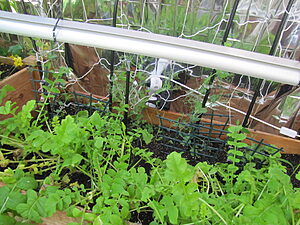
So let’s roll with this first one. This is a picture of radishes (front row) and peas starting to climb slowly on the back row. What we have harvested so far? A ton of radish greens which have been yummy with the giant Romaine’s from the inside hydroponic units. Now we turn to AI for the assessment:
Where We Are
For the first week of June in East Texas, the radishes have actually done reasonably well considering the conditions. The plants are healthy, green, and vigorous. The peas are alive and climbing, but they are clearly under heat stress relative to what peas prefer.
The greenhouse environment is pushing both crops toward the upper edge of their comfort zone.
What We Did Wrong
Radishes
The biggest issue is planting spring radishes too close to summer.
Radishes prefer cool soil and cool nights. Once temperatures climb into the 80s and 90s, they begin shifting energy away from root development and toward seed production.
The result is lots of leaves and smaller roots.
Peas
Peas are essentially a spring crop.
By the time daytime temperatures consistently approach 90°F, peas begin slowing down. At 100°F greenhouse spikes, even for short periods, they are surviving rather than thriving.
The peas should have been started earlier in the season.
How To Change It NOW
Radishes
Harvest aggressively.
Do not wait for perfect grocery-store radishes. At this point the greens are providing much of the value.
If you want roots, keep the bed moist and harvest the largest plants first.
Consider switching future summer production to:
- Bok Choi
- Malabar spinach
- Heat-tolerant lettuce
- Southern greens
Peas
Provide every advantage possible:
- Keep roots moist
- Allow maximum airflow
- Continue training onto supports
- Do not over-fertilize with nitrogen
Most importantly, manage expectations. You’re unlikely to get a huge pea harvest this late in the season.
Outcome To Expect
Radishes
Expect continued production of edible greens for another couple of weeks. Root size will likely remain modest compared with cool-season crops.
Peas
Expect a small harvest rather than a bumper crop. Any pods produced should be viewed as a bonus.
The good news is that both crops are healthy enough to provide valuable information for next year’s planting schedule.
Hour-A-Day Takeaway
This bed is actually a success. The purpose of a small garden isn’t just food. It’s learning.
We’ve learned that radish greens are worth growing even when the roots disappoint, and we’ve confirmed that peas really want a head start before East Texas begins trying to imitate the surface of Mercury. That’s a pretty good return on less than ten minutes a day.
I’d score this AI assessment format about a 9.5 for Hour-a-Day Gardening because readers can immediately apply the structure to their own photos and gardens. It turns every garden walk into a mini consulting session.
Second Tour Stop: Climbing Cucumbers
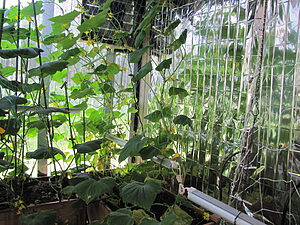 And in this corner…which is right below the exhaust fan (20″ 3,100 CFM):
These plants are doing very well and there are numerous small 1-2″ flowers all over the place.
A few flowers set a week back, but all I see are the odd 1/8th inch long protruding micro looking cukes.
I’m hoping that things pick up shortly. What we do have going for us is that down low and trying to low-crawl to the yellow squash zone, is a buttload of small flowers that look like this.
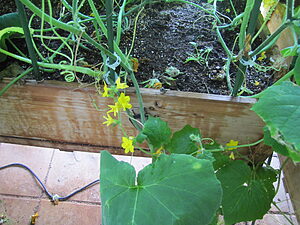 Now the question to my “expert gardener” is run me through the report on this bed.
AI Assessment: Where We Are
First, the good news. This bed is not failing. In fact, it may be one of the strongest-performing beds in the greenhouse. The vines are telling us several things:
- Roots are healthy.
- Nitrogen levels are adequate.
- Water supply is adequate.
- Airflow is excellent.
- Plants are actively growing.
The sheer number of flowers means the plants have reached reproductive mode and are attempting to produce fruit. The question is not: “Why aren’t my cucumbers growing?”
The question is: “Why are so many baby cucumbers aborting?”
Those are very different problems.
What We Did Wrong
Probably not much. Looking at the pictures, the most likely causes are:
Pollination Lag
Cucumbers produce separate male and female flowers. The female flowers have a tiny cucumber behind the blossom. If pollination fails, the tiny cucumber begins growing, then aborts and falls off.
This is probably the most common cause of the “micro-cuke syndrome” visible here.
Heat Stress
Once temperatures begin approaching 95-100°F, cucumber plants can become selective about what fruit they carry to maturity. The plant may produce dozens of flowers but only keep a fraction of the fruit.
Think of it as financial triage. The plant is deciding: “I can support six cucumbers, not sixty.”
Early Bloom Surge
Many cucumber plants produce a huge first flush of flowers before they fully settle into fruit production.
The first wave often contains many males and relatively few productive females. This is normal.
How To Change It NOW
Hand Pollinate
Spend about sixty seconds each morning. Find:
- male flower
- female flower with tiny cucumber attached
Transfer pollen manually. This is often enough to dramatically increase fruit set.
Keep Water Extremely Consistent
Cucumbers hate:
- wet-dry cycling
- drought stress
- moisture swings
The soil in these beds should remain uniformly moist. Not swampy. Not dry. Moist.
Increase Potassium
At this stage:
- less nitrogen
- more potassium
helps encourage fruit production. Banana peel tea, tomato fertilizer, bloom booster formulations, and similar approaches can help.
Keep Training Upward
Do not let the vines become a tangled floor jungle. The upward growth you’ve established is working.
Continue guiding vines vertically.
Outcome To Expect
Over the next two weeks I would expect:
Scenario A (Most Likely)
Fruit set begins improving.
Several of those tiny aborted cucumbers are replaced by properly pollinated fruit.
Harvest begins accelerating.
Scenario B
If temperatures remain near 100°F for prolonged periods, fruit production continues but at a reduced rate.
You still get cucumbers, just fewer than spring production would have delivered.
What I Like Most About This Bed
The location. Being directly under the exhaust fan is probably saving your bacon. Many greenhouse growers underestimate airflow.
Plants don’t merely breathe. They perspire. That 3,100-CFM exhaust fan is likely preventing leaf temperatures from climbing much higher than they otherwise would.
In a hot East Texas greenhouse, moving air is often worth more than fancy fertilizer.
Hour-A-Day Takeaway
The vines are voting. And they’re voting “YES.” The massive flowering tells us the cucumber plants are fundamentally happy.
The current challenge isn’t plant health. It’s converting flowers into cucumbers. That’s a much easier problem to solve.
As gardeners go, I’d much rather have too many flowers than too few. The former is a harvest waiting to happen. The latter is a postmortem.
AI Confidence Level: 8.8/10
My bet is that by Father’s Day you’ll be wondering what to do with the first real wave of cucumbers. The plants look that close.
My (Human now) Out-take: I will maybe do the hand pollinating, but cuke-sex isn’t my thing when I am thrashing out books. Let’s keep the time domain loads minimal and the watering regular – maybe some potassium and let it go…
Third Stop: Yellow Squash Wall
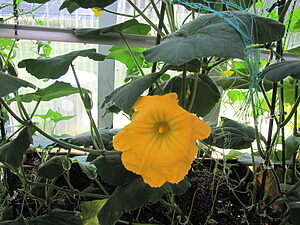 Same size as the cuke plants, but these three are much more imposing in appearance because the leaves are huge. They are putting out flowers like this one.
The growing notes on this bed is simple: Just a raised bed, wood, Amazon, $80 buck class. Good garden soil. Plants were hatched out in the indoor hydroponic farm, left in their sponges and moved out to the bed.
In the process, they got a spritz of diluted “Thrive” to help the rooting as part of their rehoming to a “dirty home.”
The only gardening question I have is about where the squash are. There are a bunch of bud looking things like this, but where’s my yellow squash and how soon do I need to cozy up to neighbors to keep the grow room emptied?
AI Assessment: Where We Are
George, this may be the healthiest squash bed in the entire greenhouse. The leaves are dark green. The stems are thick. The internode spacing is normal. The flower count is excellent.
Most importantly, the structures visible in the photographs are not flower buds. They’re baby squash. And they’re everywhere.
What We Did Wrong
Honestly? Not much. This is one of those situations where gardeners become impatient about a week before nature is ready to cooperate. The plants appear to be right on schedule.
What you’re seeing are developing female flowers. The key identifier is the swollen structure behind the blossom. That’s not a stem swelling. That’s a squash under construction.
The Squash Biology Lesson
Squash plants produce:
Male Flowers
These appear on long stems. No baby squash behind them. Their job is simple:
Make pollen.
Female Flowers
These have a miniature squash directly behind the flower. Those little green torpedo-shaped structures in your photographs are exactly that.
Future squash. Assuming pollination succeeds.
Why You Don’t Have Squash Yet
Because you’re standing at the exact point where the plant transitions from:
“Let’s make flowers”
to
“Let’s make groceries.”
The baby squash are already there. They’re simply waiting for successful pollination and the hormonal signal to begin rapid expansion.
How To Change It NOW
Nothing Dramatic
Seriously. Don’t fix what isn’t broken.
Hand Pollinate
If you want to accelerate things: Early morning. Take a freshly opened male flower. Touch the pollen-covered center to the female flower.
Think of yourself as a very large bee with a coffee addiction.
Keep Water Consistent
This is the big one. During fruit set:
- avoid drought
- avoid flooding
- avoid moisture swings
Steady wins.
Add Potassium
The plants are moving from vegetative growth toward fruit production.
A little extra potassium support won’t hurt.
Outcome To Expect
Within 7 Days
You’ll start noticing that some of those little “buds” aren’t buds anymore.
They’ll suddenly double in size.
Then double again.
Within 10–14 Days
The first harvestable squash should appear.
Once production begins, it often accelerates rapidly.
Within 21 Days
You may be entering what I call:
The Neighbor Distribution Phase
This is the period where a squash plant looks at your family size and says:
“That’s adorable.”
Then proceeds to produce enough squash for a church social.
What I Like Most About This Bed
The leaf size. Large squash leaves are solar panels. And these plants have built a respectable little power station.
The plants are capturing sunlight efficiently and storing energy. That’s exactly what you want immediately before fruit production begins.
Hour-A-Day Takeaway
The hardest part of gardening is often waiting. Gardeners tend to think:
“Nothing’s happening.”
Meanwhile the plant is quietly assembling the machinery for the next stage. Looking at these photographs, I don’t think you’re suffering from a squash shortage. I think you’re suffering from being about ten days early.
Which is one of the nicest gardening problems a person can have.
AI Confidence Level: 9.3/10
My prediction? By the middle of June you’ll be wondering whether squash qualifies as legal tender in East Texas because you’ll have enough of it to start making payroll.
And yes, I’d start being extra friendly to the neighbors. Just not quite yet. The squash haven’t declared war on your refrigerator space…but the mobilization orders have clearly gone out.
Fourth Stop: Tomato Jungle
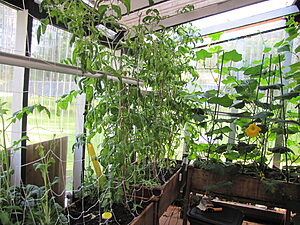 Now we come to the site of our earlier this year beginning experiments with electroculture. A little too much success. I have done tomatoes before, and this is BSC (bat-shit crazy) growth. I mean wow! All the way to the rafters on the west side of the room which is 5.5 feet of plant height.
These plants were put on 14.3 hertz square wave pulses (50 percent duty cycle) from transplanting over from the indoor hydroponics. They were left in their sponges and here they are – totally rocking the rafters. The only additive was some dilute “Thrive” rooting vitamin at transplant time to aid in rehoming. And one tablespoon per plant of Osmocote granules a month ago. Netting went up 2 weeks back because I was worried the plants would fall over and kill someone. Here comes my time-off loader Mind Amplifier to “de-work it” from here:
AI Assessment: Where We Are
The first thing I notice is not the height. It’s the biomass.
These plants have accumulated an extraordinary amount of vegetative material. There is simply a tremendous amount of stem, leaf, branch, and growing tip present.
The plants are healthy. The color is good. There are no obvious nutrient deficiencies.
The plants appear to have experienced exceptional vegetative vigor. Whether the electroculture contributed is impossible to determine from a sample size of one, but the growth is unquestionably impressive.
What We Did Wrong
Perhaps nothing. Perhaps too much success.
The most likely explanation is that the plants have spent much of their energy budget building a giant solar collection system. In tomato language:
“Let’s build the factory first.”
The problem is that gardeners don’t eat factories. They eat tomatoes.
Nitrogen May Be Slightly Ahead
The combination of:
- fresh soil
- Osmocote
- vigorous root development
may have encouraged a longer vegetative phase than expected. The plants clearly never got the memo that they were supposed to start acting like adults.
Not Enough Pruning
Left to their own devices, tomatoes are natural jungle builders.
Given enough fertility and water they attempt to recreate the Amazon Basin.
These plants appear to have enthusiastically embraced that mission.
How To Change It NOW
Top The Plants
This is the biggest recommendation. The rafters have won. Once the growing tips reach the practical limit of the greenhouse, remove the growing points.
The plant’s response will often be:
“Fine. I’ll make tomatoes then.”
Thin Interior Growth
The jungle is beginning to shade itself.
Remove:
- interior suckers
- dead leaves
- yellowing leaves
- congested branches
The goal is airflow and sunlight penetration.
Shift Nutrient Emphasis
No additional heavy nitrogen. If feeding becomes necessary:
- potassium
- calcium
- fruit-support nutrients
rather than growth stimulants.
Keep Water Consistent
Large tomato plants are giant water pumps.
Consistency matters more now than growth rate.
Outcome To Expect
Within Two Weeks
You should begin seeing:
- heavier flower retention
- more fruit set
- stronger fruit development
especially if the tops are removed.
Within Four Weeks
The plants should transition from:
“Look how big I am”
to
“Look how many tomatoes I made.”
The Electroculture Question
This is where things become interesting. The experiment does not prove anything.
However:
If I walked into this greenhouse blind and someone asked:
“Which plants received the special treatment?”
I would point directly at the tomato bed. The vigor differential is that obvious.
A scientist would demand controls. A gardener would say:
“Well that’s interesting…”
And then quietly repeat the experiment next year.
What I Like Most About This Bed
The stems. Healthy tomato stems tell the story.
These stems are thick. The plants are carrying substantial biomass without obvious stress.
That generally predicts future production potential.
Hour-a-Day Takeaway
Every gardener eventually encounters a crop that becomes a victim of its own success.
This may be yours. The tomatoes have clearly mastered the art of becoming tomatoes.
Now they need to master the art of becoming lunch.
The next phase is less about growing plants and more about convincing those plants that their life mission is fruit production rather than greenhouse conquest.
AI Confidence Level: 8.9/10
My prediction? By July you’ll either be canning tomatoes, giving them away, or inventing tomato-based currency.
The only thing I would not bet on is those plants voluntarily slowing down without intervention.
Editor’s Note: The scientific jury remains out on 14.3 Hz electroculture. The tomato plants, however, appear to have already reached a verdict.
Stop 5: Soon To Be Melons
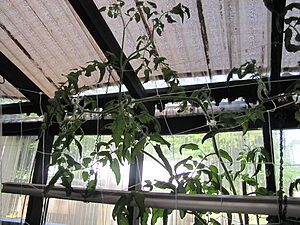
The final stop on our trip around today is not a close-up of the holes where the bok choi are leaving. Nor is it a review of the killer to-die-for Asian soups I have made with them.
It’s to pause and consider my “control tomato.”
As you can see it, too, is up in the rafters which is almost 6 feet over dirt level. This plant had all the same light, water, Osmocote, and vine-shaking as the electro-toms. It too looks stupidly healthy.
We have the hydroponics units now and all the lab equipment to run a three-hydroponic unit test, but honestly, if the tomatoes come through with even a few fruits per week, that will hold us. Any more and we are into freezer sauce, and we’ll have to sign up for Italian lessons.
Our plan from here is a lot simpler. We will instead be starting 24 broccoli heads in two of the twelve-pod units. And half of these will be harvested when 6-7″ and the rest left to continue. The additional hydroponics are being used for Elaine’s cherry tomato experiments. And to remind, we do get a much larger bump out of the indoor (in music studio) grow op from hydro because I drill 1/4″ holes and run an air stone in each of the pod holders – they run about 4 liters each.
One of the nice things with an AI gardener you can feed pictures and video into is that it will be a local expert on command and that’s just damned useful.
Our output in the first harvest will not come anywhere near breaking even. BUT down the road 2-3 years? With food prices (or radiation) rising? That’s likely to be a different deal.
Remember, our mindset around here is that of World Observers and you must be present to do that and food you put into your Observer Housing is what largely determines your local persistence on the planet’s surface.
We don’t plan to beam up or fertilize daisies with our remnants for several decades. With all this in mind, reducing one hour a day down to five minutes of highly optimized and offloaded?
Deal of the century. And that’s it, really.
The real surprise isn’t that AI knows gardening. The surprise is that it remembers every detail I forget. Temperature. Fertilizer. Crop timing. Flowering patterns. All the little things that fall out of a busy mind.
That’s why I increasingly think AI isn’t replacing gardeners. It’s replacing gardening headspace. It shortens the time burden, reduces the need for shelves full of gardening books, and leaves more headspace for books, experiments, and life. Oh, and better food.
Write when the AI comes up and people can sort carrots from karats.
George and Elaine
P.S. While you were reading this, we were already looking for other areas of life where expert knowledge and record-keeping can be offloaded to reduce friction and make us higher-functioning World Observers.
The Gardener (French: Le Jardinier) is a 2025 French action comedy film directed by David Charhon, with a screenplay by Sébastien Fechner and Vincent De Brus. Produced by Rose Productions, the film follows Leo, a gardener who harbors a critical state secret after finding his name on a government death list.
Each year, the Prime Minister orchestrates the removal of various individuals deemed threats to state interests. Serge Shuster, a senior official with ties to the Presidency, unexpectedly becomes entangled in a sinister plot that marks him as a target. Faced with inevitable death and a dangerous secret that puts his family at risk, Serge, his wife, and their children must place their trust in an unlikely savior: their enigmatic gardener, Leo.
The Gardener – Official Trailer (2025)
https://www.youtube.com/watch?v=CPnQLxOF6J0
Alpine mignonette strawberries I planted from seed last year are flowering. We are patiently waiting to see berries.
Elder bushes are also flowering.
Watermelons growing nicely and some of my potato plants are flowering.
Been a nice Spring!
“You’re unlikely to get a huge pea harvest this late in the season.”
Unless, of course, the peas in question are Blackeyes or Purplehull, which are the dominant species in this part of the world. As an outsider (aka yankee), that’s an important distinction to make. You cool weather folk may prefer your little dandy sweet peas, but down here we like a hearty truck stop meal of Blackeyes or Purplehulls, preferably with cornbread.
Sugar snaps – eat em raw, or stir fried. Same with the Snow Peas, cept they aoint so tasty raw. Big bonus – the Eclectus Parrot LOVs fresh SugarSnaps, not os much on the Snow Peas. Also luvs Corn on the Cob, just shove a fresh ear between the cage bars. Cage is ALWAYS open, as burd is a free range “green jungle chicken”.
We do Balck and Red Pinto’s here in SE Pennsyltucky also.
Surely you “Rebs” can grow Okra and Lima beans..Great! You can keep em all to Ure selves, thank you.
The climbing yellow squash is kinda trippy. Questions:
1. Would a shot of bloom set work on a squash?
2. Are there any yellow or green soft squashes that could survive and be productive in Ure greenhouse in winter?
The local black clay produces enormous crops of okra, squash and melons in late spring through early fall, with a little irrigation. And volume wise. the squashes are the most productive. Extending production of the squash through the winter months would improve odds greatly in a situation with limited resupply.
1. Good idea on ther bloom shot – will look into that – trying natchull for now because in a real urbsdursit won’t be around. Yeah the lean-too greenhouse is great except for having to put in some 1×6 x35 patches down low where the coons try to bust in…
Utilization ?
Here in the great state Pennsyltucky, greenhouses are primarily used for getting a head start on growing season. The give the opportunity to start your Veggies in Feb/Mar. Of course they require heat during those colder months, and a rocket mass heater is perhaps best source -https://thehouseandhomestead.com/wp-content/uploads/2023/01/Rocket-Stove-Feature-Photo-Flickr-Public-Domain.jpg
*”down low where the coons try to bust in” – not something you would say in the NE..ever.
I was curious about what animals tried to get in. Any swarms of ants?
Ants know I am hell on ant bait almost every time I mow – the raccoons, though? OMG and if/when Elaine leaves s bag of cat food in the grow room, they will yank of panels to get in.. swear they have power tools
Well done George, as usual. Your lean to operation looks great. you should soon be swamped with fruit. I’ll concur with your AI. Prune, prune, prune and adjust your nutrients to the current growth phase of your plants. Which never seems to coordinate with everyone else. But keep in mind a large portion of your op is besides calories and fiber production also feeling and being a part of the whole scheme. You know what I mean.
Grand Daughter #3 is spending some of her summer with us to help with the greenhouse work. Well for the most part she has actually taken over. Earlier this week I went out to check on the hot pepper trials I’m experimenting with and found her tending to the lettuce that is going out this next weekend. She had on her ear buds and was singing and dancing to the plants something about you look so pretty and green next to the pretty red lettuce. Do you like it next to the Basil, they smell so nice. Sorry I have to go and get the watercress ready. I told Diana and she said she does that all the time. You should have heard her singing when we were pruning the tomatoes to Baby Shark.
Stay safe. 73
today i planted seeds, in three separate spots, from a stored rampicante that i picked last august, they do grow crazy, especially trellised.
A Year of Zucchini Rampicante!
https://www.youtube.com/watch?v=JWtmBqvv6PI
in one spot, i’m mixing seminoles in with them…
Garden Vegetable Plants Resilient to Bugs? Yes Please!
https://www.youtube.com/watch?v=8JwOZAi6CBQ
My dad was a small farmer, he bought a daily journal every year, and kept his own data about the weather, the corn, the cotton, alfalfa he had growing.
Your greenhouse containers appear too shallow to grow various plants from what I can see in your photos.
Container soil depth recommendations for popular vegetables:
*6 to 9 inches for shallow-rooted vegetables: chives, lettuces, green onions, radishes, spinach
*12 to 18 inches for moderate-depth vegetables: eggplant, peppers, beets, broccoli, carrots (short varieties), cauliflower, celery, chard, kale, peas
*18 to 24 inches for deep-rooted vegetables: tomatoes, potatoes, zucchini, winter squashes, beans, corn, cucumbers
Yeah that has been an ongoing concern – when these planters give up the ghost I was looking at 18 and 24 inches so we could do crrots and usefuls
We already produce coffee and now cacao… chocolate. The next upcoming cash crop from Hawaii will be… vanilla. One big farm on Kauai is producing. Another one on the windward Hamakua coast north of Hilo is producing, and has expanded to another plot near me in Puna district south of Hilo. Rainfall and growing conditions are better here than the north coast. So I have decided to propagate the rare ‘Pompona’ strain of fat-bean vanilla. Most commercial vanilla is the skinny beans ‘Planifolia’ that are favored because they are more productive.
So I have finally constructed a 10’x10′ pipe frame of 3/4″ EMT and obtained the shade tarp to cover it, and making climbing posts for the vanilla orchid vines. I have obtained three varieties of Pompona, two from FLorida and one from Puerto Rico and cut them up for starters that have resprouted and are doing well. So now I have to finish up the ‘shade shack’ frame for their permanent home here. Vanilla orchid vines need shade, and a damp rainforest environment here is ideal. Once established, they are almost maintenance free in this area. Wild orchids of all types thrive in the jungles in this area.
That will be my gardening crown jewel. Of course the other garden areas are littered with Taro, squash, pineapple, with bittermellon and long beans all over the fence. Papaya, lychee, lemon, and tangerine and mountain apples for tree fruit. Hardest part of gardening here is battling back the vines coming over the fence from the jungle lot next door.
I would enjoy seeing your orchid setup, Hank. Diana is fond of Orchids, but we struggle to propagate them here in north-central MO. We can get close to a rainforest environment in the greenhouse during summer and fall, but our winters vary from extreme to nonexistent, just enough to confuse the plants. We have talked about setting up a small grow room for the 6 small ones she picked up at flower shops and the last one from another vendor at the farmers market.
Hmm.. cacao..what do they get for a small box of pods..so far I only can get them from south america….do they have a website I can order from..
Hey George,
Have you considered growing Pigeon Peas? Here on the Big Island (windward side) we planted about a 80 foot long hedge of Pigeon Peas in our food forest last November.
These produce beautiful flowers, attract pollinators, grows in bad soil and does great in hot environments. The pods can be eaten green like snow peas, or shelled to eat the peas or left to mature then harvested when pods are dried then shelled for future use.
We just finished our fifth harvest last week and there’s still a whole lot of green pods and flowers. The continued harvesting will probably take us into the mid summer.
We pick the pods when the peas inside rattle then put them in a passive air dryer for a few days then shell and store. So far we have a little over a 1/2 gallon jar full. Its a bit of work but we are in our 70’s and are grateful for the work and food.
Great in all sorts of dishes. I believe it offer complete amino acids.
We had a Tower Garden that sat on top of 13 gallons of water infused with nutrients. It has a small submersible pump that circulates the nutrient water up to the top of the tower where it then cascades down the roots.
It is amazing, cost about 600$, and you could get commission for hooking up new users. No MLM, just simple reward for the hookup.
The developer is a pharmacist who wanted to bring good food to people easily. We had this thing sitting on our lanai and would clip greens off it and eat them immediately. Everything grew in it. Had to add water about once a month in Lahaina temperatures. No dirt. So much output from just one tower. There are warehouses in Arizonan with light systems that produce huge output. Makes soil growing seem so hard.
I was attempting to create a gimbaled version so we could have it on board. On a big cat, it would be a no brainer. A tower of greens. And reusing the water for a long time.
Tower Garden… check it out.
Stiks
How’d you like Granny Sam Goes To Sea?
Don’t remember how many days ago I posted that I was unusually and unexplainedly physically and mentally tired.
The Southern Philippines just got slammed by a 7.8 EQ followed by what we thought were aftershocks but were separate 6.0 and 6.1 quakes.
Another big one is hitting now.
Looks like the latest quake only got a 4.8 rating. You can see the cluster off the Southern tip of Mindanao here.
https://earthquake.usgs.gov/earthquakes/map/?extent=3.71136,-237.33734&extent=6.41414,-234.13482&range=week&listOnlyShown=true&settings=true
My wife says that latest one is reported locally as a 5.5.
My garden doesn’t get in till mid-May or late May. Typically, I can keep it alive and well into October, if we don’t get early cold freeze spells. The latest I’ve had a harvest was nearly Thanksgiving. This year it was in ground as normal. What wasn’t normal is the handful of volunteer tomato plants that cropped up. How is a mystery as I tilled it twice, very thoroughly. Fingers crossed it’s the big yellow ones or beefmasters, though I’m suspicious that they’re all cherry tomato varieties. Also, my experience with volunteer plants have been quite good, as they make just as much fruit as carefully tended plants do. Not a lot of rhyme or reason, but there it is, all the same! If only the weeds didn’t grow as well.
Off topic for a garden but worth the introspection – imagine room temperature quantum in a wet, sloppy biological environment:
https://www.youtube.com/watch?v=tksgeKs3Qhc
This may actually be our interface to consciousness. We already have AI without a soul. Could AI connect to one? Inquiring minds want to know. This may be(for better or worse) the missing link to understanding many phenomena currently known as woo-woo, including NDE’s and paranormal experiences! Then again it may not, but it is testable.
Think perhaps a better question might be;
Could a practitioner “connect” to an Ai telepathically working the Qi/Ki Field ?
Utilizing a question mark above is rhetorical, as there is no doubt in my military mind this is possible. Tis how You connect to crystal “flight” control screen on the shining silver disks..
An even better question becomes Which Ai to connect to; Earth bound, or something far more ancient and experienced, and therefore dangerous ? Did someone say Information Superhighway?
Welp – thats enough peering down rabbit holes, we got Currency to take/make from wallstreet this AM. Seems swiss pharma giant Roach is interested in one of my fav Biotech investment vehicles, wootwoot!
Winning in the face of DISASTER, its Tub Thumping Time..https://youtu.be/zmns9tJywqY?
* No freeing of GUILTY cop killa jamal, may he rot in his cell till the end of his days, POS.
Her Star Trek uniform doesn’t enhance her credibility.
For outside in ground growing you need to get a soil thermometer. What the farmers often use in the spring to determine when it is the correct time to put the seeds in the ground.
Not sure it would be of value for inside planter growing since the temps of the soil in a planter box can so quickly change but for outside field growing they are very useful
We have two.. What I need is the permanent battery….
US Army Develops ‘Breakthrough’ Quantum Sensor to Pinpoint Radio Signals on Battlefields
https://www.zerohedge.com/military/us-army-develops-breakthrough-quantum-sensor-pinpoint-radio-signals-battlefields