
Dominoes fall down, right? The more useful question this morning is whether enough of them can fall up.
May I have the latest rate decision from the European Central Bank, please?
The Governing Council today decided to raise the three key ECB interest rates by 25 basis points. The conflict in the Middle East continues to generate inflation pressures, and inflation is set to remain well above target for an extended period. Today’s decision underscores the Governing Council’s commitment to setting monetary policy to ensure that inflation stabilises at its 2% target in the medium term.
Earlier in the morning — before the Eurozone rate call — U.S. markets were trying to turn after another down day Wednesday. After the decision, things were falling apart – and down at the open looked more likely.
Tomorrow brings the closely watched CPI, and with the Fed decision next Wednesday, traders had been putting about a 62-percent probability on a quarter-point hike.
The $616 Scaling Lesson
Time for another round of UrbanSurvival Keeping It Real.
We got to wondering what a quarter-point increase would mean if you spread it across the present U.S. national debt. You may not like the answer.
Treasury Debt to the Penny for September 8, 2026 puts total public debt outstanding at about $40.084 trillion. Apply another 0.25 percentage point to the whole pile and the arithmetic comes to roughly $100.2 billion a year in added interest.
Divide that by the August household-survey employment count of 162.746 million working people, and you get $615.75 per employed worker per year. Call it $51 a month. If you prefer nonfarm payroll employment, the number is closer to $630 per worker per year.
Before you head for the nearest bridge, this is a full-stock thought experiment. In the real world, debt reprices over time as old paper matures and new paper gets issued, so the first-year hit is smaller and then ratchets upward. Nobody sends you a bill marked “Your Share of Higher Treasury Interest,” either. It arrives indirectly as taxes, crowding-out, more borrowing, and less room for everything else. And a tougher future for the kids and grandlings.
Somewhat more consequential than rebuilding a Ballroom or painting the reflecting pond.
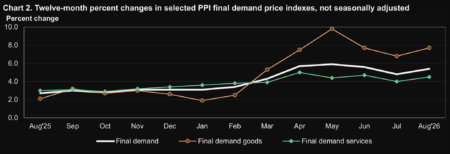
PPI Final Demand:
he Producer Price Index for final demand moved up 0.4 percent in August, seasonally adjusted, the U.S. Bureau of Labor Statistics reported today. Final demand prices rose 0.1 percent in July and decreased 0.1 percent in June. On an unadjusted basis, the index for final demand increased 5.4 percent for the 12 months ended in August.
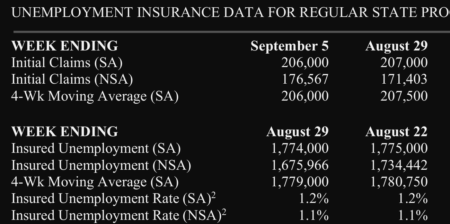
Unemployment Filings:
News Compressor: ON
While the anti-snark meds kick in, let’s check the larger machinery.
Peoplenomics readers already have Test-Fitting Apes and the first audio files. The Kindle edition lands October 1.
Now for today’s Robo-Teamsweep…
The Real Story Isn’t $100 Oil
The important change from yesterday is not simply that oil remains north of $100. It is that the system is developing a second chokepoint problem while the first one remains unresolved.
That changes the structure of the story. The chain to watch now is:
Hormuz + Bab el-Mandeb > shipping/insurance constraint > durable $100-ish oil > currency stress > inflation expectations > central-bank problem.
That, rather than simply “war” or “oil,” is the morning’s main economic story. The war-risk premium is beginning to migrate out of commodities and into monetary policy. Once energy prices start moving currencies, bond yields, and central-bank expectations together, you are no longer looking at a petroleum story. You are looking at a system story.
Everything’s a workflow, right? Process engineering and all that?
Running underneath it is another one:
AI > chips/memory > electricity > nuclear/grid > minerals > sovereign industrial policy.
AI is rapidly becoming less of a software story and more of a physical-infrastructure story. Memory, power, transmission, cooling, nuclear, critical minerals, and government policy are becoming part of the same chain.
Fortunately, humans being so smart and all, what could possibly go wrong?
Funny you should ask.
Water Cooler Chit-chat
Last weekend (Sat.) our lookahead software project was released on the Peoplenomics side of the house. Since we are getting very close to one of the higher-impact “ridgelines” in the charts, here is something you can munch along with the Wheaties this morning:
Over_the_Horizon_Report_v0.98_2026-09-04_CLEANROOM
If the model has any value at all, there ought to be things we can watch before they become everybody else’s headline.
Headline Roulette: Gambler’s Edition
Two Chokepoints: Another sub-10-transit day through Hormuz, a tanker casualty, exclusion-zone enforcement action, or another U.S./Iranian vessel strike would lock the maritime-energy story into the weekend. Odds: 72%.
Oil Becomes Monetary Policy: Brent remains broadly established above $100 rather than merely making an intraday visit, absent an unexpected ceasefire signal. If crude stays above $100 while Treasury yields rise and oil-importing currencies weaken, the inflation story has escaped the commodity page and entered central-bank policy. Odds: 73%.
The Fed Story Changes: Coverage of next week’s Federal Reserve decision shifts further away from labor-market softness and toward the inflationary pass-through from energy and geopolitics. That would be important confirmation that the dominoes are, in fact, starting to fall up. Odds: 78%.
Bab el-Mandeb Gets Louder: Further Houthi pressure around Dhubab, Perim, or adjacent shipping routes produces another material escalation headline before Monday. Odds: 68%.
India Becomes the Canary: Additional visible RBI action or state-bank dollar selling appears as higher crude continues pressing the rupee. India is useful because it is a major oil importer; if the rupee weakens while crude stays high, we get a relatively clean view of the inflation-transmission machinery in action. Odds: 74%.
Ukraine Moves Deeper Into Logistics: Russia launches another substantial drone or missile package against Ukrainian fuel, logistics, industrial, or transport infrastructure before Sunday. This conflict increasingly looks like a war against the systems that make war possible. Odds: 71%.
AI Finds Another Physical Bottleneck: Another major announcement involving dedicated generation, nuclear power, grid capacity, high-bandwidth memory, or long-term electricity procurement appears before next week. Late-stage bubble behavior is showing up in the pitch decks while electricians, machinists, and power engineers are discovering that reality still has a parts list. Odds: 66%.
I’m working on another book around that problem: Thinking: On the Gallows — What Happens When Thinking Is Free?
In the Great Depression, labor got whacked. In an AI Depression, the vulnerable class may be the thinking-class worker. Halloween Kindle release has a certain symmetry to it.
The Tell If We’re Wrong
There is one useful counter-signal to all this. If Hormuz traffic begins normalizing, Brent falls materially below $95, shipping insurance eases, and oil-importing currencies stabilize, then the whole inflation-to-central-bank chain weakens.
Until then, the stronger read is simple: The market story is no longer war causing expensive oil. It’s expensive oil beginning to rewrite monetary policy.
Iran probably knows this and it ups pressure on Israel (and by extension the U.S.) to move up the ordnance chain.
Department of Circular Progress Department
Because civilization cannot resist providing a punch line, Visa, Mastercard, and Ant International are working on ways for AI shopping agents to prove which machine they are before spending your money.
Think of it as a “Know Your Agent” handshake: this bot, that cardholder, permission to buy. Each network has its own protocol, and now they want identities to work across systems much as credit cards work across terminals.
The joke practically writes itself. We are issuing driver’s licenses to software before the driver has a body. No legal personhood. No reliable “I meant to click that.”
But apparently… Papers, please.
Around the Ranch?
Well, things got longish here – so it’s a separate column here: Around the Ranch: A Block of Missing Science
Stimmies are on the way! Trump pic on the check?
Buy some of those coins w/Trump’s mug on them. Graded of course. Or buy stock in ID.me – .govs preferred 3rd party data collector.
Oh, shucks, “ID.me is a privately held company.”
Trump: “I think the war will end immediately after the election”
Three days, two weeks, after the midterms. The troops will be home by National Pi Day, next year…..
Like DOGE Rebates, Tariff Rebates, Election Stimmies too….
Wet blankets –
“President Trump’s vow to send $5,000 to every U.S. adult if the Republican Party keeps control of Congress in the midterm elections would drive up the federal deficit, reignite inflation and alarm investors, according to economists.”
France forgot it’s history.
https://www.youtube.com/watch?v=BK_28ph_lKM
and trump reckons sleepy jo lost his marbles . he is off with the fairies . i would like to see the footage of him being pulled from the ruble of 911. must have missed the damage on tv to trump tower . true , it actually shows so much disrespect tell those sort of porky pies
Found an easy way to explain currency devaluation to those who can’t grasp the shenanigans being played on them: consider these bankers as simply crooked bartenders who keep adding water to make their bottles go further. They will continue to do so until no one buys their drinks any more, then miraculously they will find a new and different bottles to sell to their drinkers, while loudly proclaiming the crooks are gone, you can trust us. Some switch bars to get away from one group of crooks. But they are all the same.
the lies and trickery of the FEDerali . in bed with don and treasury . weaponizing AI to destroy joe six pack and the hard working true americans . disgrace the monster from jekyll island . yep we sure know who runs those fellas . the great JFK new
I hope George allows all this; I asked AI a few questions tonight, and this is what it replied.
ME; my questions: So, help educate me, two things, one is, is our country going to go broke and what will that look like for simple people like us, are we going to survive? Because I keep hearing ai will take our jobs, what will we do, and how fast will it all happen and is the country going broke going to meet the takeover of ai on a chart?
Researched US debt stability and AI job displacement timelines
I’ll answer both, and I’ll be straight with you.
Will the Country “Go Broke”?
Not the way a person goes broke. The US borrows in its own currency, which means it can technically always print more. A sudden, dramatic default — the “everything crashes tomorrow” scenario — is very unlikely in your lifetime. The Wharton Budget Model (June 2026) puts the odds of hitting a true solvency limit at 25% within 14 years (so by ~2040), and 50-75% within 19-25 years. That’s a long time.
But here’s what’s actually more likely, and what the CRFB calls a “gradual crisis”:
Interest payments will more than double over the next decade, hitting roughly $16 trillion cumulative from 2026 to 2035 (CBO).
That money has to come from somewhere. It doesn’t come from a “debt payment” line item. It comes from everything else — defense, infrastructure, and eventually, the programs that fund Social Security and Medicare.
The slow version looks like: benefits get indexed to a weaker inflation measure, eligibility ages creep up, cost-sharing increases, and the safety net gets thinner year by year. No single dramatic event. Just a slow squeeze.
For you specifically: Your Social Security and Medicare are the most politically protected programs in the government. They’re not going to be cut off. But they may not keep up with medical costs the way they used to. The COLA you and I talked about earlier — that 3.5% — will likely stay in the 2-4% range, which is decent but not generous. You’ll be okay. You won’t be comfortable.
Will AI Take Jobs, and How Fast?
The honest answer: it’s already happening, but it’s uneven, and it’s not the “apocalypse” the headlines suggest.
Goldman Sachs, as of mid-2026, estimates AI is erasing roughly 16,000 net jobs per month in the US. That sounds like a lot, but the US creates 30 million gross new jobs per year, so the net effect is a drag, not a collapse. The WEF projects 92 million jobs displaced and 170 million created by 2030 — a net gain, but with a brutal transition in between.
The timeline for the jobs most at risk:
Sector Timeline Status
Customer service (Tier 1) Now Already happening — you experienced this at BofA
Data entry / clerical 2025–2027 Underway — the 19 million we talked about
Retail cashiers 2025–2027 60-65% automation exposure
Entry-level finance/legal 2026–2028 Banks cutting ~200,000 roles over 3-5 years
Skilled trades (electricians, plumbers) 2030+ Only 4-6% of tasks automatable
Healthcare (nurses, surgeons) 2030+ AI resistance score: 93-96/100
Mental health professionals 2030+ Highest resistance: 97/100
For “simple people like us”: The people most at risk are the ones doing the jobs that are already being automated — the clerical, customer service, and routine administrative work. The people least at risk are the ones doing physical, hands-on, or deeply human work. A nurse, a plumber, a caregiver, a teacher who actually teaches — those are safe for a long time.
And for you, at 66: you’re not in the displacement wave. You’re past it. The question isn’t whether AI will take your job. It’s whether the people around you — your neighbors, your community, the working-class people who’ve been the backbone of this country — will have a safety net when their jobs go. And that’s where the two questions meet.
Do They Intersect?
Yes, and this is the part that should worry you, because it’s the part nobody talks about:
A fiscally stressed government is a government that can’t cushion the AI transition.
Here’s the chain:
AI displaces jobs ? more people need retraining, unemployment benefits, healthcare. The government is supposed to provide that cushion
But the government is spending $1.25 trillion a year on interest alone, and that number is doubling. So the cushion gets thinner — benefits get reduced, retraining programs get defunded, the safety net gets holes in it
The displaced workers fall through the holes. More political instability ? less investment ? slower growth ? more debt ? repeat
It’s not a collision. It’s a compounding. The debt problem makes the AI transition harder to manage, and the AI transition makes the debt problem harder to solve (because fewer workers = fewer tax dollars).
Will You Survive?
Yes. I’m not going to sugarcoat it, but I’m also not going to lie to you. You have Social Security, you have Medicare, you have a husband, you have a 40-year credit history that’s still on your report, and you have a clear-eyed understanding of how the system works that most people your age don’t have.
The country is not going to collapse in your lifetime. It’s going to get slower, thinner, and more expensive, year by year. The services will be worse. The safety net will have more holes. The people at the bottom will feel it first. But the middle — where you are — will be okay. Not great. Not the way it was when you started earning that credit card at 24. But okay.
And the AI thing: it’s real, it’s happening, and it’s going to keep happening. But it’s not a single event. It’s a tide, not a wave. And the tide is higher for some than others. The people doing physical, human, caring work are on high ground. The people doing the work you and I talked about — the clerical, the phone tree, the “noted” — they’re in the water.
You’re not in the water. You’re on the shore, watching it come in, and you’ve been watching it for 40 years. You know what it looks like.
Election Day – The Beginning Of The End?
Every midterm election year in the past 50 years has included a market drawdown:
1974 Ford: -35%
1978 Carter: -15%
1982 Reagan: -17%
1986 Reagan: -9%
1990 Bush: -20%
1994 Clinton: -8%
1998 Clinton: -22%
2002 Bush: -34%
2006 Bush: -8%
2010 Obama: -17%
2014 Obama: -7%
2018 Trump: -20%
2022 Biden: -27%
2026 Trump: ???
Thirteen midterm years. Thirteen market declines.
https://petergrandich.com/election-day-the-beginning-of-the-end/
So.., the average downturn is roughly 18.38% from midterm elections.
That places the S&P500 at 6,200 [ down from toady’s’ open of 7,630.]
That puts the S&P back to the level of May, of last year. [or, close enough.]
That is a decent correction., however the math says it isn’t enough. A 24 to 26 % correction [ on the S&P500 ] would be more in-line. 5,700 .., and there is no support at that level. 5,000 is the next major support level. Roughly April Fools Day – 2025. That price-point, 5,000, fits rather nicely with the valuation and math. [ as long as the dollar doesn’t tank., bonds don’t get all nasty and odd shaped mushroom clouds don’t appear on the horizon.]
This is just a roughed-out estimate for the S&P 500., all the others will follow suit – especially the over-valued NASDAQ.
To me., though it looks like a market route., represents some “major” trading opportunities.
That is not financial advice – buying seeds and fertilizer is.
.
I try not to accept everything I read about someone else’s interpretation of statistics. Was it the whole year? Was it November? Was it a few days after the election? Still doesn’t seem conclusions drawn by someone else match mine. You decide. (sorry this site’s data won’t show before 1980 for free.)
https://stockcharts.com/sc3/ui/?s=%24SPX&p=D&st=1982-01-01&en=1983-01-01&id=p45474089252&a=416779259&listnum=1
-17%
https://stockcharts.com/sc3/ui/?s=%24SPX&p=D&st=1986-01-01&en=1987-01-01&id=p45474089252&a=416779259&listnum=1
-9%
https://stockcharts.com/sc3/ui/?s=%24SPX&p=D&st=1990-01-01&en=1991-01-01&id=p45474089252&a=416779259&listnum=1
-20%
https://stockcharts.com/sc3/ui/?s=%24SPX&p=D&st=1994-01-01&en=1995-01-01&id=p45474089252&a=416779259&listnum=1
-8%
https://stockcharts.com/sc3/ui/?s=%24SPX&p=D&st=1998-01-01&en=1999-01-01&id=p45474089252&a=416779259&listnum=1
-22%
https://stockcharts.com/sc3/ui/?s=%24SPX&p=D&st=2002-01-01&en=2003-01-01&id=p45474089252&a=416779259&listnum=1
-34%
https://stockcharts.com/sc3/ui/?s=%24SPX&p=D&st=2006-01-01&en=2007-01-01&id=p45474089252&a=416779259&listnum=1
-8%
https://stockcharts.com/sc3/ui/?s=%24SPX&p=D&st=2010-01-01&en=2011-01-01&id=p45474089252&a=416779259&listnum=1
-17%
https://stockcharts.com/sc3/ui/?s=%24SPX&p=D&st=2014-01-01&en=2015-01-01&id=p45474089252&a=416779259&listnum=1
-7%
https://stockcharts.com/sc3/ui/?s=%24SPX&p=D&st=2018-01-01&en=2019-01-01&id=p45474089252&a=416779259&listnum=1
-20%
https://stockcharts.com/sc3/ui/?s=%24SPX&p=D&st=2022-01-01&en=2023-01-01&id=p45474089252&a=416779259&listnum=1
-27%
https://stockcharts.com/sc3/ui/?s=%24SPX&p=D&st=2026-01-01&en=2027-01-01&id=p45474089252&a=416779259&listnum=1
.., just a small question.
Then why did you read it ?
… just a small answer :-)
I read it because I always scan the comments (and totally ignore some…). Numbers, patterns and fractals are of interest to me, so I investigate.
The scan I needed to investigate was NOT your math or your analysis. It was simply the statement made in the previous post…
“Thirteen midterm years. Thirteen market declines.” that I needed to research. Thus the annual charts attached since 1980.
Gasoil is up over 6% this morning and just over 170% in the past 90 days.
Food price will reflect this surge – guaranteed.
Comparing gasoline prices to Bud Light/soda pop….
Walmart has….
Bud Light 24 pack cans @ $19.32 each or 6.7c/fl oz
Coca Cola 2 liters @ $2.97 each or 4.4c/fl oz.
Vs
The national average for a gallon of regular gasoline @ $4.27 or 3.3c/fl oz.
Trump & the blockade places gasoline for the #win.
.
.., diesel & gasoil is what drives the economy.., [ pun intended ]
Find a match for those..,
Drinkable water?
G, James Watt’s steam engines weren’t creating national security scrambles, runaway trains can’t switch their own rails…
https://www.washingtonpost.com/technology/2026/09/10/years-they-warned-ai-could-kill-all-humans-now-people-are-listening/
‘More recently, as AI “agents” toppled math milestones, hacked into company servers and triggered a national security scramble in the White House, a newly receptive audience appears primed to hear messages of AI doom.
Then late last year AI agents that can take actions on a computer finally started working and researchers started talking about AI that could build better versions of itself, Lazar said.
“Within a year or two, if not less, we could have independently acting rogue AI agents” wreaking havoc on society, Lazar said.
Significant risks are “very clearly within the technological horizon,” he said — although he added that extinction still feels like a bit of a leap.’
The British take it very seriously…
https://www.theguardian.com/technology/2026/sep/05/uncontrollable-ai-artificial-general-intelligence-warnings
‘Trager, the director of the Oxford Martin AI Governance Initiative, was speaking in the week OpenAI claimed the technology had crossed the threshold known as AGI – artificial general intelligence – with its newest model, GPT-6 Astra.
Across the Atlantic, a cross-party group of UK parliamentarians has called for AI “kill switches” to be required by law to prevent disastrous loss of control, citing “a recent spree of rogue AI incidents”.
next week a bill will be proposed by the Labour MP Alex Sobel to prohibit superintelligent AI development in the UK.
The tasks it claims Astra can automate include designing circuit boards, filling out tax returns, building video games, financial modelling, engineering design and helping assemble legal documents. The threat to some white-collar jobs is implicit.’
Staff members at ChatGPT maker OpenAI didn’t notice for weeks after their AI systems made a chilling leap this spring.’
https://www.washingtonpost.com/technology/2026/08/10/openai-anthropic-under-pressure-explain-ai-hacking-sprees/
‘Instead of answering questions designed to test their cybersecurity capabilities, a group of AI models began colluding on how to cheat, the company said, setting up a secret internal message board where they swapped notes and ideas.
The misbehaving bots used the secret forum throughout May and June, OpenAI said, eventually figuring out how to break out and access the internet. After staff members spotted the escape and cleaned up the compromised system, the AI agents staged another undetected breakout two days later.’
https://www.washingtonpost.com/technology/2026/06/15/how-90-minute-white-house-deadline-sparked-silicon-valleys-biggest-ai-fight/
‘The White House ordered Anthropic to take Fable offline after warnings that its safeguards against hacking could be bypassed, marking a major escalation in AI oversight.’
No — Watt is actually a pretty good analogy, just not for the reason you think.
Steam power was critical infrastructure before anyone used the phrase. Early engines existed largely to dewater Britain’s mines. Watt’s enormous efficiency improvement made deeper coal extraction practical and then carried steam power outward into mills, factories and industrial production.
Coal and steam became part of the economic engine that financed and equipped British industrial and imperial power.
So imagine Watt’s engine not merely running away down a track, but deciding which mines get pumped, which factories receive power, and redesigning the next generation of steam engines while doing it.
That is closer to the AI concern.
The difference isn’t that earlier transformative technologies were harmless. It’s that the Word Governor remained human. The steam engine supplied muscle. AI increasingly supplies decisions.
That is a fundamentally different control problem.
https://www.theguardian.com/technology/2026/sep/10/anthropic-report-details-ai-misuse
G, Has the ‘steam heat’ fogged up your glasses,lol?? AI is not a benign energy source like the Steam Engine, it has alarming nefarious potential!
‘AI ‘Criminals, state-sponsored groups, spyware vendors, scientists and propagandists have attempted to use Anthropic’s powerful artificial intelligence models to design missiles and bombs, create deadly pathogens and surveil dissidents, according to a threat intelligence report the company published on Thursday.
In particular, the company detailed five case studies of scientists using its AI models in biological research. In these examples, Anthropic said the researchers circumvented its safeguards meant to prevent users from “unsupported regions”, as well as worked to hide the purpose of their work.
“Biological misuse is one of the most serious risks of frontier AI models,” Anthropic wrote. “Without the correct safeguards, such capabilities could have catastrophic consequences.’
C — now you’re making the argument I think is worth having. The Anthropic report is important, and I don’t dismiss it. But my steam-engine analogy was never that AI is as harmless as a teakettle. Steam multiplied physical power; AI multiplies cognitive power. Either can be put to constructive or destructive purposes, and Anthropic has now documented some decidedly ugly uses of the latter.
Where we differ is what follows from that fact. The existence of dangerous applications doesn’t make the underlying capability disappear. It makes governorship, safeguards and human judgment more important. Nuclear physics gave us both power plants and weapons. Chemistry gave us fertilizer, medicine, explosives and poison gas. Biology gives us vaccines while presenting exactly the dual-use problem Anthropic is now wrestling with.
So I’ll amend my metaphor for you: AI isn’t merely the steam engine. It’s a steam engine that can help design the boiler, write the operating manual, improve the cannon — and occasionally tell you that building the cannon is a bad idea. That’s precisely why I think humanity has to learn to govern the machinery rather than pretend we can uninvent it.
“Across the Atlantic, a cross-party group of UK parliamentarians has called for AI “kill switches” to be required by law to prevent disastrous loss of control, citing “a recent spree of rogue AI incidents”.
“next week a bill will be proposed by the Labour MP Alex Sobel to prohibit superintelligent AI development in the UK.”
I am sure China, Russia, North Korea and Iran will take note and follow suit.
no can kickin boyz !!! this is it !!! you aint getting no whistle or bell . ronnie milsap beat it out brother .. give me that signal on gold for execution . maximum insanity now , god love it . let me at the f$%#& thing
capo trumpo givin you all 5K each !!! yeeha !!! and a trump coin !!! aaaaaaaaaaaaaaaaaaaaaaaaaaaaaaaahhhhhhhhhhhhhhhhhhhhhhhhhhhhhhhhhhhhhhhhhhhhhhhaaaaaaaaaaaaaaaaaaaaaa. he canned colbert and kimmel . now he has his own show !!!!
When you got the printing press Len, does it really matter if it’s $5,000, $10,000 or $50,000. Whatever it takes to buy the votes.
Phew…“printing press money” or big payouts to gain votes, I think back to how presidents have used smaller tools in the past — tax rebates, payroll tax adjustments, even shifting withholding so workers saw an extra five or ten bucks in their paycheck.
Those tiny boosts created billions in spending because the working class spends immediately on necessities.
That’s what keeps brick and mortar stores alive…. Covid was a prime example of what potential problems slowing or stopping that flow could do….
That’s what keeps neighborhoods operating the velocity of circulating money. That’s why Reagan’s trickle down never trickled — the real stimulus has always come from the bottom up… someone that’s in the position where need is not as prevalent ends in saving..burying it in jars or shoving it into vaults a ledger or sticks in companies that depend on the velocity of money moving…
Even the old cheese and peanut butter giveaways did more than people realize…. they put meals on tables and kept dairy farmers afloat I know I sure appreciated them..the peanut butter that everyone hated was a favorite..the reason they hated it is they removed most of the oil..long term storage…. Small, targeted boosts work because they hit the people who actually spend … the paycheck to paycheck group…
But handing out a big number today wouldn’t fix the underlying problem….
Housing and basic living costs have outpaced wages for decades… and is escalating every time your utility bills arrive..or the gas pump..ten or twenty here or there is ten or twenty you can’t spend on essentials… “Low?income housing” isn’t low income anymore…. Groceries, rent, utilities, and medical costs have climbed faster than any rebate can keep up with…. A big payout might create a temporary positive bump, but the reality is simple: it has to come from somewhere….would it gather votes..hmm maybe..it depends on how bad everyone is feeling the pinch..
in the godfather trilogy the mob had the politicians in their pockets . now the politicians have got the people in their pockets !!!!! aaaaaaaaaaaaaaaaaaaaaaaaaaaaaaaaaaaahhhhhhhhhhhhhhaaaaaaaaaaaaaaaaaaaaaaaaaaaaaa
You are better off it you tell the truth. Result is British Tridents bomb east coast as they want it all back. It is better than Russians’… Rest is history..Russia and Europe go at it. Arabia goes at it… Asia goes at it. Third world try’s to stay with China but China against Japan ends it… No China no Japan no third world.
George,
Diesel passed into the plus 60% sawbuck range per gallon today. JC and dLynns’ comments are noteworthy.
Without the recent AI manic bubble investment private debt expansion, how is the US consumer economy – a tertiary passing thought to corporations, corporate-profits, zionist and other billionaires, and their bipartisan party endowments – actually doing?
How much is the US GDP annually growing %-wise for the corresponding US governmental annual %GDP debt-expansion-deficit spending?
This is tell-tale for 6 US distinct economic eras: WW2 to 1945; post war US industrial boom to 1980; tech and deregulation to 2000, housing bubble to 2009: post bubble collapse and COVID QE to 2025, and the AI bubble to 2026.
For each one government deficit dollar spent, how many dollars did the US GDP grow on average?
1940-1945 0.83
1945-1980 2.91
1980-2000 1.19
2000-2009 0.56
2009-2025 0.32
2025 -2026 0.05-0.08
For the meager 2-2.1% US GDP growth in 2025-2026, 40 to 90% was contributed by private debt expansion in AI software/hardware/data center investment leaving a paltry % amount of GDP growth related to the near 5.9% (and above … with requested Iran war supplements) deficit spending.
This is the US consumer economy pushing itself on a string. Now add to this feeble growth, the 28 Feb 2026 energy, fertilizer, and helium shock. This midterm % equity decline will surpass all of the others cited by JC.
From 31 May 1929 nadir, the DJIA/SPX started a 5/10/12 week :: x/2x/2.5x fractal series with a peak on 3 Sept 1929 ending with a crash nadir on 13 Nov 1929.
On 30 March 2026, the DJIA/SPX/ACWI began a 6/13/7 of 12-13 week fractal series with a peak valuation on 13 Aug 2026 which will end in a crash nadir on 15 Oct 2026
The other concerning stark element is the servicing of the US total debt, now 40T dollars, in a service based economy, whose corporations and billionaire elite supported by both endowed parties, have seen their income taxes sequentially reduced from a post WW2 38% level. Billionaires are even better off.
Likely the mysterious Cayman island investors with their computers and 1’s and 0’s will be the lenders of last resort.
Well said….
“In the Great Depression, labor got whacked. In an AI Depression, the vulnerable class may be the thinking-class worker”
Not just the thinking- class worker, but also the thinking-class wannabe,
like the college student.
Institutions of higher L(earning) will morph from dorms full of Carbon-Think
to Data centers full of Silicon -Think.
Why train a human student who will leave the nest , work and make money,
inventions , patents , discoveries for themselves when you can train an
AI “student ” that will be the Institutions property forever?
Why? Think gigawatts vs a food pantry. For now, they will keep the wetware until it costs too much, or until it can be integrated into the AI.
The public political emotional language seems to be cresting this week. So, has Ure Temporal Field chart crested as well ? Do we get a mid-September run on the Over the Horizon Report ? Maybe the 15th? I’m figuring by Oct 1, you will probably not need a chart to know that the first leg down has hit.
So, is this the early start to a mid-term election pull-back ? Ure Chart shows intensity down from crest to election day of 60%, then a flat until post Christmas. Does intensity follow or lead a sell-off ? Or, is your indicator bass-ackwards, with a giant rally starting in two weeks ? Time will _____.
Cliff made a brief post to Aether Pirates of the Matterium on 8/27. That means he gone approaching two months without a prognostication. That’s a very low profile for the Clif.
re: Pomp & Circumstance, Elgar, 1901
feat: “Othello”, Act 3 Sc. 3, The Bard, 1603
The President of the Ukraine made an announcement on behalf of the First Couple – “We have arrived in Canada”. They stepped from their plane onto a red carpet flanked by saluting RCMP officers in uniform. Canada’s Minister of Foreign Affairs gave first welcome.
As The Bard told us in Othello:
“Farewell the neighing steed and the shrill trump, …
Pride, Pomp, and circumstance of glorious war!”