
First, we have to address the obvious. The Replay of 1929 scenario may be running out of steam more quickly than expected. Already rumors are floating around in server farm world that projects will be delayed three months in some cases. But of course, there will always be talk (and grousing) in the trades.
Hormuz adds another dimension, though: Less energy means higher prices. So, while the Crude futures are up more than one percent early, the other end of the teeter-totter has prices falling faster than Acme on Coyote.
And the clock is ticking – loudly.
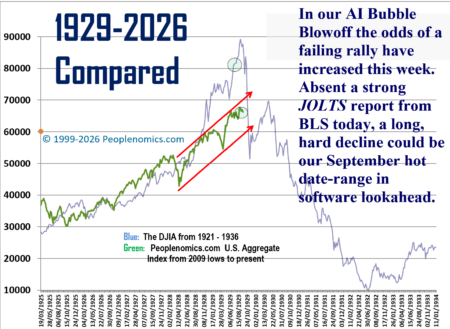
The Labor JOLTS Report isn’t a single event. It’s a checkered-flag that tees off a whole litany of speculation.
- Tomorrow morning, the ADP Employment numbers drop.
- Thursday the Challenger job cuts report sails.
- And Friday, the “offishul” federal numbers land.
Clearly, a solid JOLTS higher might help. Besides, we still have four trading days before the long weekend. Still, a look back over our shoulders is useful.
Historical Data View
The late-summer “peak” is real as autumn weakness, not the calendar-year high’s address.
Since 1928, September is the only month with a negative average S&P 500 return; it is red more often than any other month (roughly half the time, sometimes cited near 55%).
July is often strong, August is mixed and thin, then September–early October is where liquidity, fund-year flows, and accident-prone tape pile up. That is not the same as “the year’s high prints in Q3.”
A Bloomberg tally of S&P yearly highs since 1980 found most annual peaks in December—because an up year usually closes near its high—and June never held the yearly high in that four-decade window. (We think in terms of “dead cat bounces” after falling in the Fall. But we’re old and cranky that way.)
Summer-quarter (Jun–Aug) yearly highs are a minority, not a majority. Folklore collapses two different facts: the worst average month is September; the most common yearly high is year-end.
Pre-crash tops do cluster on the late-summer / early-fall calendar more often than chance, but not on one date.
- The Dow’s pre-Depression high was September 3, 1929 (381.17); the crash proper was late October.
- The 2007–09 bear did not top in August 2008—the S&P high was 9 October 2007; 2008 was the unwind (Bear in March, Lehman mid-September, the -777 Dow day on 29 September).
- Other cycle tops nearby on the calendar: August 1987, then Black Monday in October; September 2000 was a secondary S&P high after the March Nasdaq peak.
- So “late Aug–Sept high, then trouble” fits 1929 and 1987 cleanly. 2008 is a year after the high. Treat it as a rhyme, not a clock.
Calendar-year lows show up most often in October (crash months: 1929, 1987, 2008’s deep autumn, plus many ordinary years that wash out in Q4), with March a strong second after Q1 growth scares (2020 is the exhibit). The half-year rule that actually has a multi-decade paper trail is the Halloween / “sell in May” split: 1 Nov–30 Apr has historically beaten 1 May–31 Oct by on the order of ~3–4 percentage points in the S&P, and the winter half won in a large majority of country samples in the academic work. Since about 1990 the U.S. gap is often quoted near ~6% Nov–Apr vs ~3% May–Oct.
It is a tendency with fat exceptions—the last decade has seen strong summers—so it is a bias to respect, not a switch to automate.
The practical read for a late-summer tape is narrower: September is the soft month; October is where bottoms and blow-ups both live; the historically fatter six months start when the Halloween candy hits.
Bitcoin is going through a muted replay of present equities, too. While smuggling to feed new believers, BTC is still singing “rescue me.”
We are losing faith in a pre-holiday rally. Odds of a Fed rate hike are now 67% as the U.S. 10-year yield pushed above 4.75 percent Monday, its highest since January 2025, while Japan’s 10-year touched 3 percent for the first time since 1996. Add Brent back above $90 and rising again this morning and you get the wonderfully investor-friendly combination of:
higher energy + higher yields + Middle East shooting = expensive everything.
Here comes inflation and there go food prices. Watch the cost of “Thanksgiving dinners” this fall.
And suddenly the tradesman talk on AI sites about coming slowdowns is more prescient (and honest) than mainstream media shills.
News Compressor: ON
Big Sur added another 11,255 acres since Monday’s read.
The Plaskett Fire has gone from Monday morning’s 15,479 acres to 26,734 acres — still just 1 percent contained. That is another 11,255 acres added.
Timber is now 25,190 acres and 22 percent contained, putting the two-fire Big Sur total at 51,924 acres. ESCALATING — and rather impressively so.
Monday’s Gulf “disturbance” woke up this morning with a name:
Tropical Storm Edouard. At the 4 AM CDT advisory it was at 29.0 N, 92.8 W with 40-mph winds, moving WNW at 8 mph. NHC says it is poised to strengthen significantly before reaching the northwest Gulf Coast later today.
Here in the woods, we’re guessing on an inch (or more) of rain starting tonight. Dallas-Ft. Worth (and places like Coppell and Plano) may get lawns watered. Not too much flooding in Houston – fingers crossed.
The Grand Canyon’s missing-person fog has mostly cleared: two dead, one still missing and roughly 80 rescued.
And while America was watching all that, the Nepal-China Himalayan disaster quietly crossed 1,000 dead with more than 4,400 people still missing.
Sidebar: “Let’s Blame Trump“
The flooding in Nepal has given the left a new campaign zinger to blame on Trump and Musk’s DOGE work. Here’s the background you need to sort it out.
The SERVIR Program: A joint initiative by USAID and NASA, SERVIR-HKH provided critical geospatial monitoring, public datasets on glaciers, and disaster risk reduction services in the Hindu Kush Himalaya region before it formally concluded in January 2025.
The regional aid was cut.
Now, at glacial speed, a causal argument (with a chorus of blame – this might have been avoided) is making the (liberal) rounds.
War Desk Blotter
Hormuz has not normalized. Preliminary Kpler tracking found just five commodity-vessel passages Monday — four inbound, one outbound — versus a roughly 14-vessel recent average, and notably no liquid tankers. So when someone says shipping is “open,” the useful question remains: open like Walmart, or open like the DMV at 4:59 PM?
There is, however, a diplomatic wiggle. Iranian President Masoud Pezeshkian says Tehran will reciprocate immediately if Washington returns to commitments under the June interim agreement. Outlook: Iran is ESCALATING kinetically and TESTING AN OFF-RAMP politically.
BlinkLab Claim-Audit Tripwire
Propaganda Bust:
Trump posted video purporting to show Iran’s principal oil terminal being blown apart. Reuters determined the videos were AI-generated and reported no evidence that such an attack occurred. Vice President Vance subsequently characterized the posting as Trump “sending a message.”
EVENT: no verified Kharg attack. We’re refining the line between agitprop and bullshit.
Exactly why we added the audit layers to my AI assistants.
In War #1: Tuesday strikes killed 12 people in Kyiv and the surrounding region, including railway workers, while attacks also hit the Odesa region. So Moscow’s weekend warning about large strikes against Ukrainian infrastructure has moved farther from “threat” toward demonstrated campaign pattern.
Inside Pages
Roman worked. NASA’s $4.3 billion Nancy Grace Roman Space Telescope successfully launched aboard Falcon Heavy Sunday and is headed toward its observing station roughly a million miles away.
Lake America hasn’t conquered Apple yet. Google displays the Trump-ordered name for U.S. users, but Apple Maps still showed Lake Ontario Monday. (A Post-It for our biased eco-systems research.)
G20 gets frostier. Bessent told Russian Finance Minister Anton Siluanov there will be no U.S. economic relief until the Ukraine war ends, while European officials openly bristled at Washington bringing Russia back into the Asheville G20 meetings. That’s less “welcome back” than “we saved you a chair for the argument.”
Manufacturing isn’t dead. August factory surveys improved across much of Asia and Europe, heavily helped by AI hardware demand. China S&P Global PMI came in at 51.5, Japan 54.9 and South Korea 52.3. Worth remembering when the next talking head announces that the entire planet entered recession seventeen minutes ago.
Around the Ranch: Pins, Needles, Biopsies
Elaine went to Tyler, Texas for a minor “cyst” removal from her upper right arm Monday.
No issues, delightful staff, and now we wait for the report and stitch removal.
The cyst itself wasn’t too big: half the size of your fingernail. But it was alternately swelling and shrinking about every 10-days to two weeks – and it was time to go.
Rationally, it’s probably a simple lipoma. Which is a benign, slow-growing lump of fat cells under the skin (soft, usually painless, movable); it is not a fluid-filled cyst, though people often use the two words interchangeably.
I think it may have something to do with doing weights over the years. You know – pulling a bit of a tendon or something.
Somehow, the attending nurse (who was great!) didn’t seem to bite on my “Maybe it’s an alien implant?” idea.
There are no verified ones. There are people with small objects in soft tissue, and a pile of abduction stories that call those objects “implants.” What has actually been cut out and labbed—when the chain of custody is not a carnival—is ordinary stuff: glass, metal slivers, carbon, iron oxides, surgical leftover, insect parts, calcified junk. Nothing with an isotope ratio, alloy, or microstructure that requires an off-world factory.
Unexplained sensation plus a lump is not proof of a visitor. Lipomas, cysts, shrapnel, and glass from old injuries do that job every week. Until a specimen is independently assayed, published, and not just waved on a talk show, treat “alien implant” as a claim, not a finding.
So, here we sit waiting. 99 percent odds of nothing. BUT, if it’s an alien implant, I’ve got a warranty issue to talk-over.
(Which sneakily reinforces the exact same epistemic rule as the Kharg agitprop section: claimdoes not equal finding until independently verified. But you got that and the coffee is working, now, right?)
Write when you land,
George@Ure.net
Best wishes to Elaine.
Stay safe. 73
Thank you.
Praying that Elaine has a full recovery
Thank you.
The Blue Dogs movie was lame and seemed to be an attempted prequel to Last Man on Earth/I am Legend. Even had a flashback scene where the main character gave his wife a puppy.
Zero dog barks out of five.
Speaking of reruns:
“I’ve been in meetings with world leaders where various issues are being discussed, and somebody will say something or somebody will make an observation, and I will feel a certain darkness about it. It sort of sets off every spiritual alarm bell in my body.”
– JD Vance
What does the Trump bible say about J.D. marrying a dark, heathen woman who worships cows? JD is the darkness. OR fake news. You decide!
Num nums for the X-ian crowd though.
JD Vance claims to sense spiritual ‘darkness’ from world leaders, addresses Trump’s AI Jesus post
‘It sort of sets off every spiritual alarm bell in my body’
https://www.christianpost.com/news/jd-vance-claims-to-sensed-spiritual-darkness-from-world-leaders.html
Ohh?
But being Wexners Butt-Boy didnt set off those alarm bells ? hmmm
Remember who Wexner passed him off to for his “managed” political career ?
WhatWhat-https://www.youtube.com/watch?v=i6cphFUSFxI&list=RDi6cphFUSFxI&start_radio=1&pp=ygUTd2hhdCB3aGF0IGluIGRhIGJ1dKAHAQ%3D%3D
O/T – the movie name is The Dog Stars.
TS Edouard made its landfall at 14:20 CDT, apparently in far-western Louisiana (“near Johnson Bayou”). Looks to be a bit east of the projections for rainfall potential, so you may get a bit more rain than was predicted yesterday.
Best wishes for Elaine!!
Hot pockets….
we use flour tortillas..
large..get your pocket mold.. cut out two pieces..egg was the edges of both pieces.. or cut them in half and fold triangle pockets..fill with your filling.. chili cheese..from them shut egg wash it bake..
https://www.amazon.com/Norpro-1027-Mini-Pocket-Mold/dp/B00DZ7DZYI/ref=sr_1_2?
I haven’t made any recently.. but now that school is back in session..the grandkids will be wanting pockets..
https://www.amazon.com/Crustless-Sandwich-Cutter-Brush-Spring-Assisted/dp/B0GYZ8F9YJ/ref=sr_1_20_sspa?
hot pocket pies are an old one easy to make fill with whatever you desire.. bake egg wash them then bake them sitting on a parchment paper..at 400 degrees.. till golden brown.. I also use the mini pie maker..
pourable potato flatbread..
3 1/3 cups All-purpose flour
2 cups Mashed potato (smooth, no lumps, can be lightly salted)
2 tsp Salt
2 tsp Sugar
2 3/4–3 cups Water (mix of warm and cold, adjust for consistency)
3 tbsp oil (or other cooking oil)
mix like pancake batter with an emission blender or blender…. oil your griddle medium heat pour a paddle of batter
let it sit..the edges will start to go translucent from the potato starch..then flip it..
better than lefsa..
i heard some where the market was only allowed to commence the greatest crash ever on a friday after the 3rd fed meeting after a full moon in a leap year . maybe we should ask AI when it will happen like claude or chat gpt or jarvis . those revisionist depression dates dont take into account additional public holidays from productivity gains and memorial days like martin luther king . anyway close shorts bears and wait
Direct link to Nancy Grace Roman Space Telescope:
https://eyes.nasa.gov/apps/solar-system/#/sc_roman_space_telescope
Alarming Study Reveals Using AI Is Turning Humans More Robotic…
https://endtimeheadlines.org/2026/09/alarming-study-reveals-using-ai-is-turning-humans-more-robotic/
Robot Monster (1953) Trailer
https://m.youtube.com/watch?v=cq9IKsH9BXg&pp=ygUZUm9ib3QgTW9uc3RlciAxOTUgdHJhaWxlctIHCQkaDAGHKiGM7w%3D%3D
I’m operating on the assumption that there will be a pullback in new server farm associated project launches as we approach the end of the year, but so far, it hasn’t happened. Seeing some indication of a trend toward smaller projects. Dusting off designs for smaller stuffs. Meanwhile manufacturing production is overrun from orders already booked. Even if the server related work cuts off completely, the production pipeline will stay full for a couple of years. Haven’t seen evidence of cancellation of in-flight projects. The server farm balloon is still raging in the manufacturing sector. It will be the credit industry that gongs the entire show, if anyone, and that has not happened yet.
(“Elaine went to Tyler, Texas for a minor “cyst” removal from her upper right arm Monday.
No issues, delightful staff, and now we wait for the report and stitch removal.
The cyst itself wasn’t too big: half the size of your fingernail. But it was alternately swelling and shrinking about every 10-days to two weeks – and it was time to go.”)
prayers sent.. my wife had skin cancer a few years ago…she still has to go in every six months..my cancer scare is now back to every three years ..sucks…but there has been some amazing advancements ..studies on marihuana,Dandelion and sweet wormwood in Canada and Australia are showing phenomenal results.