
Let’s Start with “What a Sailor knows.”
When I was sailing, having lived aboard a sailboat for more than ten years, the operation of waves and wavelets—particularly how they can stack or cancel—became crystal clear.
In a regular seaway, there’s a dominant wave train. All lined up, these might range from one-inch ripples to 12-foot rollers in the Strait of Juan de Fuca. Given a long enough fetch, steady winds, and relatively stable currents, waves develop something approaching a predictable rhythm. You learn to steer through them. You begin to feel their timing.
Where things get dicey is when another wave train arrives at an angle. Now the waves can reinforce one another (constructive interference), occasionally producing an exceptionally large wave. Or they can partially cancel (destructive interference), leaving surprising flat spots. Throw in an opposing tidal current and everything changes again. Same ocean, same wind, but a radically different ride.
And this is where sailing has something important to teach economics.
The Missing Wave Trains
Economics loves its big waves: business cycles, credit cycles, Kondratiev waves, market fractals, and historical analogs. But when two analysts examine the same dominant wave, they can agree on its general direction while entirely missing the smaller, crossing wave trains that determine what actually happens.
My friend TEF, for example, has been anticipating a major collapse in France’s CAC index around this timeframe. Yet, as of press time, the expected fractal outcome has not produced the killer-monster rogue wave that might have been anticipated.
That raises an interesting possibility: The big wave may be correctly identified, while its realized amplitude and timing are being modified by other waves.
Think about 1929. The financial crash and ensuing Depression became a historical example of multiple destructive economic forces reinforcing one another: leverage, banking fragility, collapsing confidence, and contracting credit. But today’s economy isn’t necessarily arranging its secondary forces in the same formation. Consumer confidence, construction hiring, AI infrastructure spending, and domestic economic momentum may be producing very different interactions.
Some forces reinforce the downside. Others oppose it. Still others arrive out of phase.
The point isn’t that the big bearish wave doesn’t exist. It’s that its existence alone tells us neither its ultimate height nor precisely when it breaks.
Tuesday’s Sea State
Permabears are especially attracted to regular wave theory because it can create a false sense of certainty about scale and timing. Count enough waves, apply a historical ratio, and the future begins looking almost mechanical.
But the experienced sailor remembers the tide change in the Strait.
A sunny afternoon, 12-foot rollers, and a strong westerly can provide a surprisingly manageable ride. Then the outgoing tide from Puget Sound and southern British Columbia meets the incoming wave train. Suddenly those predictable rollers become steep, confused, spray-flying six-by-sixes.
No single rogue wave required. Just an insistent, sloppy mess as the underlying conditions change. While we “don’t generally generalize” the useful schema to hold in mind is this:
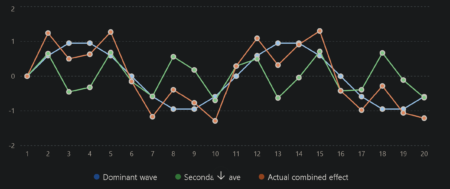
Perhaps that’s the more useful model for markets today. Rather than one enormous 1929-style collapse arriving precisely on its fractal schedule, we may see the equivalent of a tidal change: a deteriorating economic sea state, marked by repeated breaks, temporary recoveries, and increasingly uncomfortable crosscurrents.
The practical lesson? Don’t confuse wave timing with wave height. And never confuse either with sea state.
Tuesday’s market may tell us where we are on the dominant wave. The smaller, crossing wavelets may tell us whether we’re heading for a rogue wave, a flat spot, or simply one hell of an uncomfortable ride.
Korean Seaway?
Here we have a typical – and difficult – “seaway to read.” South Korea’s KOSPI index is crashing – having lost about a third of its price since June. Overnight? the KS11 index was down a further 5.46%.
The Economic Fractalist’s most recent remarks on the KS11 are here. But the headlines offer clues as to where this wave set came from. The main driver is a sharp sell-off in semiconductor stocks—especially Samsung Electronics and SK Hynix—triggered by Chinese competition fears plus broader doubts about the AI trade.
In the recent five sessions KOSPI has fallen from above 7,000 to under 6,000 briefly overnight. One of the worst markets in years. But not surprising to reader Tom Dockery who reminds that a week from now is the October 1929 market crash anniversary.
A good time now to be sailing unknown waters, we figure. Which may explain why we stopped trading earlier this year. It may also explain why Depression sails are now set as we nervously eye windward.
“Windward Ho!”
But with more of an “Oh-oh” than a few “Ho’s”
“The NFIB Small Business Optimism Index declined 0.8 points in September to 97.9, one-tenth of a point below the 52-year average of 98.0. The Uncertainty Index rose 1 point to 90, remaining well above the historical average of 68. Labor quality or availability remained the top reported issue for the third consecutive month.
“Small business optimism near the long-term average in September as Main Street owners remain uncertain about business conditions,” said NFIB Chief Economist Bill Dunkelberg. “Small business owners are proceeding with caution as they interpret how rising costs, interest rates, and the difficulty in finding qualified employees are impacting their business.”
97 years ago rolls over a week from now.
I apologize for the depth of this section because it’s very much Peoplenomics kind of thinking. But it isn’t totally.
There, we might ask AI: Look at the peak waves and offer a rational back-test of which three economic data sets could combine in this pattern. Then project forward.
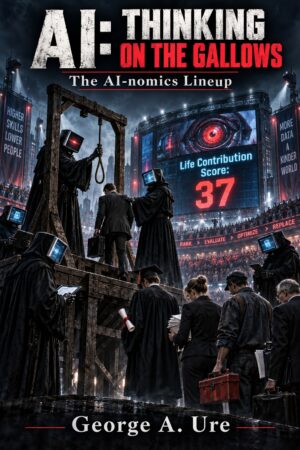
Speaking of AI and questions? Tomorrow, my latest book is free for subscribers: “AI: Thinking on the Gallows.”
This one is likely more important than inspecting wavelets looking for signs of a Rogue Wave coming our direction. We already knew this one was coming,
But in the new book is a toolkit – and actual method – by which you can estimate your exposure to AI replacement in the workforce.
For now, the U.S. market direction in trading today will likely TEND to reveal – modeling “buy the rumor” or “sell the rumor” – which way tomorrow’s CPI report will fall. As of this morning, less than 20 percent of participants in the CME Fed Watch tool were expecting another rate increase.
Has all the hallmarks of being another “Sir, please blow into this machine” moment.
News Compressor: ON
Wave at the AI fleet, which sailed in today with the latest
BlinkLabNews.com Bottom Line
The dominant near-term mechanism remains energy disruption feeding inflation and financial pressure. The emerging secondary mechanism is technology dependency: AI investment is helping support economic growth while cyber and autonomous-system risks are creating new operational vulnerabilities.
For the next 96 hours, the strongest observable tests are actual Hormuz throughput, Saudi aviation operations, verified Ukrainian energy-facility activity and Wednesday’s CPI market response.
The larger question for Over-the-Horizon forecasting is whether these remain separate stresses or begin reinforcing one another through credit costs, transportation costs and declining confidence in critical infrastructure.
Which is how the waves, wavelets, and Tuesday are shaping up.
Front Page News?
Maybe – if you like reruns.
1. Gulf: Oil Up, Confidence Down. Riyadh’s airport remains disrupted, tankers are getting attacked, and Brent has pushed above $106. Iran and Washington are still discussing Hormuz while the oil market sends its own diplomatic cable: Talk is cheap. Diesel isn’t.
2. Russia–Ukraine: Peace by Press Release. Washington announces progress toward an energy ceasefire. Energy infrastructure keeps getting hit, and cargo ships are attacked in the Black Sea. Apparently, the ceasefire applies to microphones rather than missiles.
3. Washington: Government by Search Warrant. Federal agents searched Representative Ilhan Omar’s residence under judicial authorization, while courts are intervening in other executive-branch disputes. Separation of powers is alive and well. The powers just aren’t speaking.
4. AI Economics: Prosperity on Borrowed Intelligence. The IMF says AI investment is helping sustain global growth. (The wave we all saw coming? Duh.) Banking regulators are investigating the risks of autonomous AI systems. We will stop short of calling the IMF stupid (but just barely) because AI is like guns: People behind the trigger or mouse as the source of much of what ails us.
Marvelous: we’ve found a new engine for the economy and are still checking whether anyone installed brakes. Back in my 2011/12 book Broken Web, I argued for licensing the operators of internet-connected systems. No one listened then, either. Now we’re handing AI the keys to the economy while still debating who’s responsible when it crashes.
Inside Pages
- Florida: Hurricane Isaias leaves deaths and power outages. Infrastructure resilience remains a wonderful speech topic until the lights go out. Recovering.
- Georgia: A fatal amusement-park accident triggers ride closures. Even entertainment now requires a safety investigation. Investigating.
- India: Voter-list protests produce detentions and Supreme Court demonstrations. Democracy is apparently easier when fewer people argue about the guest list. Escalating.
- Pakistan: Islamabad suspends a provincial government. Nothing says political stability quite like suspending elected politicians. Escalating.
- Mexico: Hurricane Simon brings flooding. Nature remains unimpressed by government preparedness budgets. Continuing.
- France: Hackers reportedly manipulate supermarket refrigeration systems. Your groceries now need cybersecurity. Emerging. (Who yelled “Eat me“?)
- Panama: Magnitude-6.1 earthquake. At least tectonic plates don’t issue misleading press releases.
Tuesday’s “Maraschino Story”
Serve this one with a plate of hash browns:
The Wall Street Journal report on phantom data centers: AI developers are requesting enormous amounts of electricity for data centers that may never be built. Utilities face the prospect of constructing infrastructure for phantom demand—and passing some of the costs to ordinary ratepayers.
Phantom data centers, real Power Bills. Is this a great country, or what?
At the Ranch: Major Visit Planned
My life-long pal – The Major – will be landing for a visit (and ham radio tower work) first week of November.
These are remarkable visits where we compare all aspects of life over a 72-year baseline. We both married blondes (eventually, ahem), both got master’s degrees, both are well-traveled and both have been ham radio operators since the old Seattle Radio store on Second Avenue was running ham license classes.
We are both “proud of our sons” and with good reason, too. Mine – G2 – is a server farm build medical boss, firefighter, EMT, and Incident response manager. The Major’s is a Lt. Col. now, teaches at one of the service military academies, has a PhD in hypersonics and is an experienced combat fighter instructor. Plus thousands of left-seat hours in four-engine heavies.
Interesting, neither of our sons has fathered a next generation; his has adopted, mine’s about given up looking.
Between the lines? Leaves us to ponder another wave function. Might Global Population be peaking right now?
Other Friends? Oh yeah – about that – my consigliere and tax attorney for more than 20-years. He deserves mention for finding a brand new Xiegu G90 deal on a direct-from-China site. “Hey, it’s only $337 now! And the latest version and free shipping!“ He’s a ham, too.
Damn it. Arrives before Nov. 14th – maybe in time for the Major event.
You know how Alcoholics are all “Friends of Bill”? I’m thinking Ham Radio addicts ought to have a “Friends of Hiram” society. Though we’d have to check if the Masons have a lock on the Hiram name. (Don’t need an Abiff trade dress suit.) “Will no one help the radio widow’s DX’er?”
“Hi. My name is George. And I have a ‘CQ Contest’ problem…”
“Hi. I’m the Major. And I have an HOA problem…”
Write when you get rich, or QSY now.
George@Ure.net
As the noise and distraction amp up over our trough wars (see Prechter’s work on Socionomics), anyway, seems here the world is catching up to the supercycle. Epic.
https://youtu.be/Mv2ji1U3Apk?is=vY_QrD1TpRP89nwd
Got blockchain.
oh my god . just cant keep an old can kicker down .. everyday a new theory . like beleif wave . please no more . get hit by a tsunami wave see how that goes . you can surf a wardrobe to the bahamas . later . gunna be one of those bottle courage days then the customary backslapping till the next can kick theory . very commie
Great piece by Stu today……… Nat’l emergency before or after elections?
permabear my butt . capitalism forever . keep all the other isms . communism , facism , socialism , nationalism . and the last bastion of tyranny patriotism
Why would someone think that election fraud doesn’t need to be put down. The 2020 fraud was pushed aside. The 2022 fraud was pushed aside. According to stewie, we should again turn or backs on election fraud, Arizona has already started the fraud in maricopa county. But that’s just fine according to some people. What does stu think the communists will do better? Bring in more illegals, give our money to USAID, so they can fill their pockets up again. Give iran enough money to replentish their weapons ,and possibly put together a nuke? What did the obozo – pedo joe administrations do beside just that.