
If you missed it, our most recent (free side) comparison with 1929 was posted on Thursday and you can find it here: Rut-Roh, Scooby.
The next useful thing on your financial/Urban survival scan should be the note from The Economic Fractalist which is here. Of course, since this is a kind of “financial world-ender” rolling in (Why do you think I announced retiring back in July, for crying out loud?) – you will want to read the fractal view of how the snowball can roll from here. His side is here.
The 1929 Rhyme – Riff & “Poof!“
There are many reasons to be taking our 25+ years of long wave econ writing seriously in here. Like it, or not, long waves in the economy are real but there’s no consensus on their cause. We’ve been trying to lock-it-down since the University of Colorado Long Waves discussion group when I was finishing my MBA – so before the Internet Bubble blowout of 2001.
Some of my colleagues (Mr/Dr. Lammert, for example) think fractals are predictive – and that case is warming up the bus to run over us going into year end. But from a raw stats perspective, it’s not that simple. (Not saying fractals are simple, either – I still get headaches form them!).
The more difficult problem is whether they are causative. Here’s why this matters:
- Some people (much smarter than me, which is most folks, lol) think the long wave is driven by changes in technology. In fairness, when you look at tech in American history, the rotary and steam press was a media change, the railroads can and (sort of) went. Then we had Ford’s assembly lines (now China’s big in manu.). Plus, we had the EBITDA lunacy of the Internet bubble, the semi-endogenous 1987 mini crash, and the NO Doc debacle. Sure – a;ll big slivers to fester.
- Other people like the self-arising within finance argument – these are the people who love cyclical interest rates and also a side of Mazurok-Ure currency debasement cycles (around 85-years) can be pasted here.
- No, claim still more – it’s populations and beliefs in collision and when regions are subsumed (like Europe changing hands after this second Battle of Tours and taking Englad too, then all the others in the region (and world) get nervous. This is especially interesting because of a generational offset from the massive Diaspora of 20 years ago…but I digress.
- Next you have to toss in th4e “seers.” Whole bunch of folks here.’ Some are brilliant scholars (G.A. Stewart of Nostradamus) while others are frontier data (High), the remote viewer (FFG, et all) and the astro-econ;s and even the psychically gifted like the Polish seer Jackowski. (Who is nuclear worried about immediate events pending.)
When you line ’em all up (and after tossing in my consigliere’s question for an astronomical link ()not astrology) it gets even more interesting.
For me, the job has been to report, not judge the contestants. What I do is notice. And when an echo comes along like the Guthrie kidnapping, I immediately picked up on the Lindbergh Baby echo.
As I wrote in Market Informatics Thursday – Limits of Calculus in February of this year:
Are We Replaying 1929 – Really?
You mean besides the:
- Guthrie as the replay of the Lindbergh baby kidnapping?
- Besides the market bubble?
- Besides Smoot-Hawley reincarnated as Trump?
- Besides Epstein as a replay of Teapot Dome?
- Besides Crypto filling the Charles Ponzi role?
And I guess we should mention the Drought this year – not as big as the Dust Bowl, but let’s see how the Ninos play out.
And don’t worry too much about the echo role of the Spanish Flu in 1918 which came a decade before the Great Crash. Because if we use an incept date of 2019 late, we are getting the calendar up that-way quickly.
Guthrie Still Bothers Me
Because at a personal level it was a confirmation of Shakespeare – that tide in the affairs of men stuff. We saw that turn February 5th of this year and wrote it up here: Job Cuts,. The Lindbergh Replay Lands, Digital Arrogance:L
“Now let’s talk dates.
The Lindbergh kidnapping unfolded in early 1932 and wasn’t fully resolved until 1936, spanning roughly four years from crime to legal closure, right through the darkest middle stretch of the Great Depression.
That matters, because these high-attention crimes don’t resolve quickly when they rhyme with long-wave stress; they linger, mutate, and stay in the public mind as the economy grinds through its own adjustment.
If the Guthrie case is a modern echo — not identical, but adjacent — then it suggests we may be looking at a multi-year social and economic digestion ahead, not a quick news-cycle blip. In other words, the calendar may be whispering that this phase has just begun, not that it’s about to wrap up.”
Tho Immediate Risk of Israel v. Iran
We are all mostly victims of history, but do keep an eye on the political winds that are changing in Israel and could (not saying they will) presage a nuclear exchange before our new Congress seats in early January.
Circle December 6 in pencil. Use a #2, or so, not an HBB. That’s when former Israeli military chief Gadi Eisenkot’s first crack at forming a government runs out. His party says it’ll talk unity with Likud, but it won’t split the prime minister’s job with Benjamin Netanyahu. If the talks go nowhere, Eisenkot’s people are prepared to put a minority government to a vote. He can also ask for two more weeks. Bibi stays on as caretaker until a successor takes office. So the date at the front edge of our December 6–10 Over-the-Horizon window is real enough. The moving van is another question.
What puts Iran on the same calendar? Netanyahu himself brought it up when the new Knesset was sworn in, warning that Tehran was trying to rebuild its nuclear program. And The Washington Post reports he’s been pressing for fresh strikes, with pushback from Israel’s top military commander. Some of Bibi’s rivals suspect a wartime crisis could help him hang on. They have an election result to defend, so weigh that suspicion accordingly. What bothers me is the overlap between a man who may be running out of time in office and a military decision he was already pushing before the votes were counted. A nuclear exchange is a much longer reach. But renewed fighting alone could give the oil market plenty to say about our nice, tidy 1929 chart.
And the worst part for last: Go study the Lammert Fractal work for that Dec. 6 date range. Again, in pencil – and maybe a #1 but still not an HBBB – but it’s all into rogue waves.
Now, does a Knesset vote cause a market fractal? Damned if I know. But if the oil market starts moving in that same December 6–10 window, we’ll have something more interesting to study than two circles on a calendar.
If we make it that far. Because now we’re out of cycling “tides of men” and more into breaking emotional rogue waves. Disney called it “Anything Can Happen Day.”
California Shakes
The L.A. area had a 4.2 near Commerce overnight:
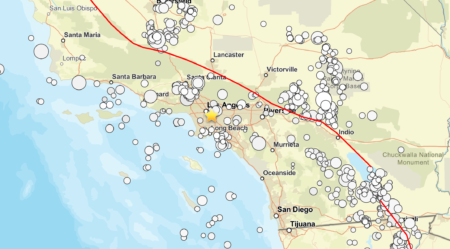
Wait! You mean?
Yes, even Commerce is shaky…
News Compressor: ON
Oil gets the first vote. At 5:45 this morning, Texas time, Brent was $91.45 a barrel, down 53 cents and headed for its third straight weekly decline. That’s with Houthi attacks on Riyadh and reports of tanker trouble in the Strait of Hormuz already on the wire. How come? Middle East exports are still strong. Which gives us a perfectly good observation to put beside that December 6–10 pencil marks: As of this morning, the barrels are getting through. If that changes, we’ll have a better reason to revisit the chart than two dates lining up.
The AI trade, on the other hand, already has a leak. Anthropic gained more than 17 percent in its Thursday market debut, then gave back nearly 7 percent in Friday’s premarket. Look at the split on my early futures screen: Nasdaq 100 down 1.75%, S&P down 0.46%, Russell 2000 off all of 0.06%, and the Dow actually up 0.13%. We noted months back that tech was leading the bubble and when it broke the downside could be higher than anyone forecast.
Would you carry a profitable short through Sunday night? That’s the China question for today. Coming out of Shenzhen, Trump was talking up progress on trade while Xi was warning Washington about Taiwan. A fellow who made his week shorting tech now has to decide how much of that profit he wants riding on the next translation from Mandarin. My lean is that some shorts buy back shares before the bell. But the bigger question is how much damage will be done before we get there?
Then the household gets a vote. Michigan’s final November consumer sentiment and inflation expectations readings are due at 9 a.m. here in the East Texas Outback, half an hour after stocks open. That gives us an opening reaction to last night’s news and a second look after Americans weigh in on what they expect things to cost. As for our own money? The 85-day moving-average flag has had us out for months. I can make a perfectly respectable case for shorts covering on Friday and still get through breakfast without buying a thing.
OK, back to work on our Peoplenomics Undertaker Course. With this many stocks dying, it should be a business to dig into.
Around the Ranch: Year-End Tax Sniping
Been trying to think like our “tax-advantaged” president a bit.
With the residential solar credit already gone (no 30% for systems installed in 2026), the main year-end tax moves left are the usual timing and status plays that lock in before December 31.
Marriage is one of the cleaner ones: if you and a honey tie the knot before the end of December 31, the IRS treats you as married for the entire year, so you can file jointly. That can lower the combined tax bill if one of you has lower income or more deductions, but it can also push you into a higher bracket or trigger the phase-down on the higher SALT cap if your combined AGI climbs past roughly $505,000. (You wish, right?)
Run the joint-versus-separate numbers before you decide; the status is all-or-nothing based on your marital status on New Year’s Eve.
Beyond that, the practical sniping is mostly about realizing or accelerating deductions and controlling income recognition. If your employer plans a bonus, see if they could cut the check after the first of the year…if you trust them. Otherwise, take the money and roll.
Tax-loss harvesting still works the old way—sell losers in taxable accounts by year-end to offset gains (and up to $3,000 of ordinary income), then watch the 30-day wash-sale window. The market is doing its dead-level best to make sure lots of losers are around to be weeded out.
Charitable giving has new 2026 wrinkles: non-itemizers can now deduct up to $1,000 ($2,000 joint) of cash gifts, while itemizers face a 0.5% of AGI floor, so bunching larger gifts into one year (or using a donor-advised fund) is more useful than spreading them. I’ve never claimed this one which means I can never take the Oval, huh?
The annual gift-tax exclusion is $19,000 per recipient ($38,000 if you split gifts), and it doesn’t carry over. If you have any filthy lucre sitting around, email me for a shjp-to.
Anyone 70½ or older can still do qualified charitable distributions from an IRA (up to $111,000) that count toward RMDs without hitting income. I’m still foggy on why a charitable out of an IRA.
Roth conversions and final 401(k) deferrals also need to be done by year-end if you want them on the 2026 return.
None of these are dramatic on their own, but stacking a couple of them is usually worth more than waiting until January.
This isn’t tax advice – we have an actual consigliere for the big questions.
Like What?
(Glad you asked).
So Peoplenomics is a simple SP and I have a call in to our tax guru because it’s (on paper) a real business. I’ve paid business taxes for years including sales tqx.
Which is why I am still considering another load of solar panels.
The 30% Residential Clean Energy Credit (IRC Section 25D) expired for expenditures made after December 31, 2025, under the One Big Beautiful Bill Act (signed July 4, 2025). There is no phase-down or extension in place. A homeowner who buys a system (cash or loan) and has it installed in 2026 gets zero federal credit.
What is still available
- Section 48E (commercial/business clean electricity investment credit): Still active. Qualifying solar (and some storage) projects can claim it if they began construction by July 4, 2026, or are placed in service by December 31, 2027. The July 4, 2026 begin-construction window has already closed, so new projects generally need to be running by the end of 2027.
- This credit is claimed by the business that owns the system (leases, PPAs, prepaid leases), not by the homeowner directly. Some of the value is usually passed through in lower payments.
- Energy storage has a somewhat longer runway in some cases.
Nothing significant for residential solar is scheduled to “run out in a month” (end of December 2026). The homeowner credit is already gone; the remaining commercial pathway has until the end of 2027 for placement in service.
So with no “simple” options to get some tax-advantaged additional power, my questions is what are the conditions to be considered a Section 48E (commercial/business clean electricity investment credit)?
I asked AI ikf a small sole prop would qualify:
Yes, a one-person publishing business can qualify. If I buy and own new solar equipment and use it to produce power for Peoplenomics, the business-use share can qualify for Section 48E. I can own it directly as a sole proprietor. For a qualifying installation (me, the home/business owner) under one megawatt AC (which leaves us a tiny little bit of headroom here at the ranch), the credit is generally 30 percent of the eligible business cost. LII / Legal Information Institute.
Now for the part that shrinks the grin. Say the qualifying addition costs $10,000 installed, and I can document that the publishing operation uses 20 percent of its output. That gives me $2,000 of eligible business cost and a $600 potential federal tax credit. The computer making Saturday’s ChartPack has a pretty good business case. The refrigerator keeping my Chardonnay cold has a considerably weaker one. LII / Legal Information Institute
If I bring back Shoptalk Sundays, I could get up to 100 percent consumption (A/C in the summer is still a money pit).
Since I’m talking about adding panels, the question for our consigliere is whether this particular expansion qualifies as new generating capacity and how much of its cost belongs to the business. I’d bring the old and proposed system ratings, the installer’s itemized quote, and enough meter or equipment-use data to explain where that 20 percent came from. I’d also ask the supplier for documentation on the federal sourcing rules that apply to projects begun in 2026. For a project starting now, the solar deadline is December 31, 2027, and the equipment has to be ready and available to generate power by then. A pallet in the barn on New Year’s Eve is still a pallet in the barn. LII / Legal Information Institute
Which gets me down to a question I can answer before the tax guy calls back: How many kilowatt-hours does it actually take to publish Peoplenomics? After 25-plus years of measuring what everybody else is doing, it appears I may have to put a meter on myself.
And you know, if I can find an integrated kwhr meter that goes with my tutu…
The grin came back when AI told me to think more presidentially – go for depreciation!
On my hypothetical $10,000 installation, 20 percent business use gives me $2,000 of eligible business cost. Subtract half the $600 credit and I’m down to $1,700 of depreciable basis. If the addition qualifies for 100 percent bonus depreciation, that’s a $1,700 first-year deduction. How much that saves me is where the consigliere earns his coffee.
Suppose I could document 100 percent business use for heating and cooling the shop. Free solar upgrade? Well… no.
Even if the project qualifies and I could substantiate 100% business use, the math on $10,000 is a $3,000 credit and an $8,500 deduction. At an illustrative 22% federal tax rate, assuming I could use both in full, that saves $4,870, leaving $5,130 of the cost. Heating and cooling the shop still counts only to the extent the use is genuinely business-related.
And if that deduction puts the business in the red…when’s that call coming in?
Hmm… With this kind of thinking, a tutu on and a kwhr meter attached, hell, I’d carry every state in the Union, too. Maybe I should think about the Oval a little more closely.
Write when you get rich (and can keep it),
George@ure.net
The AI Proofing Pooping Monster:
The AI Pooping Monster has reviewed the claim that a Knesset vote could cause a market fractal. It has requested a stool sample from both and will report back December 6–10. If the web’s still up.
On the tax question, the Monster asked what powered its review. “Shop solar,” said the writer, reaching for Schedule C. “And how much of my time was spent discussing your tutu?” The writer put Schedule C down.
The Monster has agreed to serve as Secretary of the Interior in the forthcoming Ure Administration. It has considerable experience with what goes on in there.