
Blame Engineering isn’t a featured sport in America, yet. But out here in the (peace and quiet of the) woods, the headline evidence piles up that the sport is expanding.
The working clip file runs from AP’s presidential buck-passing to CNN’s blame-the-messenger framing, POLITICO’s inheritance argument, and Carl Cannon’s reminder that Biden had his own rotation: transitory inflation, Putin, COVID, price-gouging.
Different jerseys. Same passing game. No touchdowns, just more running game kind of day ahead. Sorry, but big things in “the air game” can be troublesome.
Fuel prices? Blame the predecessor, Democrats, refineries, Ukraine. Affordability? Blame the messaging.
Housing, doctors, schools? The Canadian export version offers immigrants. Meanwhile, the data-center boom joins the American explanation menu.
Some of those factors have real economic effects. That’s precisely why this needs more thought than picking your favorite defendant.
The pattern isn’t confined to one party. It’s a “running game” – handoff: predecessor, messenger, foreign enemy, opposing states, technology, newcomers. Somewhere between the podium and your pocketbook, a complicated mechanism gets compressed into a convenient name.
Which is where our morning work begins. In our BlinkLab.
Blame Names du Jour
Guilfoyle: The White House PR and job screeners must be on holiday. The Wall Street Journal reports Kimberly Guilfoyle pressed a donor to send $100,000 toward her American Express balance before her ambassadorial confirmation hearing; her lawyer disputes the messages’ authenticity, and the donor says he didn’t make the payment. Another political distraction lands while household bills keep arriving. Will the “chain-gang” be called in to measure the play?
Fed Minutes: Wednesday’s release describes September’s unanimous quarter-point increase to a 3.75–4 percent target range, with reserve interest and primary credit rates also raised. Those changes took effect in September; the only fresh information is the discussion, including officials who considered policy insufficiently restrictive and worried that energy and AI-related demand could spread inflation. Who does their shopping? What the hell does “could spread” mean?
The minutes leave precious little room to pretend inflation has been beaten.
The Big Con behind the curtain: When you have a closed system – say Earth, for example – if you have a monetary system allowing interest, then long-term monetary debasement is a requirement. Now the only dispute is over “How much? How fast?”
Still there are perturbations in the interest driven decline of purchasing power (while no one talks about how inflation is required to raise wages…a longer rap…):
Brent: Oil’s overnight jump is feeding the grueling futures beat-down ahead of the open. The Economic Fractalist’s concern about a possible top on the sixth seems like a good view, but we’ll remain open to higher until a solid move under the 85 DMA materializes.
A fractal theory gets a hearing. Price gets the deciding vote. Timeframe is the three-Scotch question.
Still, we now have enough data globs to turn the…
News Compressor: ON
With the context menu set, let’s buzz through this.
Ahl Prices: (Say it in Permian-speak, Or ain’t’chall from around here?) “Ahl” eyes are on overseas shipping trouble meeting domestic weather trouble. Reuters reports roughly one-quarter of Gulf offshore oil production already shut in as Hurricane Isaias approaches, while attacks threaten tankers moving through Hormuz. Two supply problems are now leaning on the same fuel market.
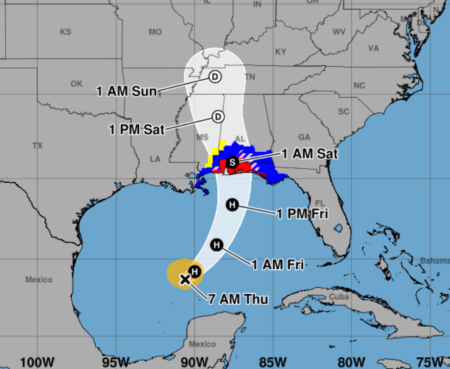 For Gulf Coast readers, the immediate issue is protecting people and property. NHC’s indexed early-morning update reported 80-mph winds and urged warning-area preparations to be completed today. Storm surge doesn’t care about carrier groups over “there.”
[We should fly Hank out to Gulfport, MS between his Hawaiian ‘canes.]
Diesel (not Vin) is where the economic plumbing gets interesting. EIA’s October outlook puts fourth-quarter Brent at $105 and reports September East Coast distillate inventories 32 percent below their seasonal five-year average. Its forecast inputs closed October first, before this week’s hurricane complications.
Follow that barrel downstream: trucks, farms, deliveries, construction, heating oil. Eventually, somebody hands the consumer a larger invoice and an explanation.
Then financing costs join the party. Wednesday’s ten-year Treasury yield briefly reached 5.36 percent; European banks were sliding this morning amid another bond selloff. More expensive fuel and more expensive money can squeeze the same business from opposite ends.
That doesn’t make every bearish story correct. Here’s why our higher case is still alive (but on O2): TSMC reported record quarterly revenue, up 50 percent year over year, while September U.S. ocean-container imports rose 10.3 percent, according to Descartes. AI demand and imported-goods activity remain substantial counterweights to an everything-is-collapsing sermon.
In the Ukraine war, AI is now a target: Yandex says a drone strike caused a fire and suspended operations at a Russian data hub. Cloud computing still lives somewhere, uses electricity, and can burn.
Health headlines also need sorting. Pennsylvania’s measles outbreak has passed 1,000 cases, while the CDC director describes the U.S. risk from the disputed Siberian plague case as extremely low. (Can we get that in writing, please?)
What Comes Next?
Mapping to Sunday: additional Gulf operational delays, Odds: 85%. Another oil upswing on storm, shipping, or military headlines, Odds: 75%. Equities struggling to sustain broad gains if oil and long yields climb together, Odds: 70%.
With big price pressure, an October Surprise looks like 50-50 Odds.
In the life of two “Test-fitting Apes” (Elaine and me), keeping topped up on scheduled deliveries before the weekend. And look for the Amazon Prime Big Deals to run the carrier gauntlet.
The Economics You Won’t Get Elsewhere
Normally, I’m something of a permabear. But there are two stories that “matter hugely” in here:
Amazon (Prime Big Deals ended overnight) does not publish gross merchandise sales.
We see a $26.4 billion sales figure is from Adobe Analytics for all U.S. online spending from June 23–26, Walmart and Target included, up 9.3% from $24.1 billion in the same window last year. Adobe switched to that all-retailer method in 2025, so it is not an Amazon-only number and is not comparable to older Amazon-only estimates. Amazon’s own line was only that the June event was its biggest ever. No dollars.
The closest Amazon-only read before the event was PMG’s marketplace model: U.S. Prime Day sales up 4–7% year over year, with discounts about 12% shallower. After the fact, PMG measured average discount depth on Amazon at 20.9%, versus 21.8% in 2025, and only 29.7% of items on sale. With inflation around 3.8%, the low end of that range is roughly flat in real terms.
But here’s the “hidden econ” dynamic. We are at a bottoming process in the economic Long ‘Wave. Sales – to consumers, when rates are coming down – can (and do) result in people delaying spending.
As you cross the bottom of long-term rates, the Consumer psychology can (and does) flip. People get off their wallets. The mood becomes (and is around you) sliding into the “Buy now before prices go higher” because interest rates are going up and with it, inflation.
People are spending now because a year from now, prices may be flat unaffordable.
Look: Interest makes monetary claims grow with time. Unless circulation and repayment schedules accommodate those claims, the system must expand its money supply or force somebody to absorb a loss.
There’s another reality: The debt clock shows today’s principal. It doesn’t show the decades of interest spending ahead: the Peterson Foundation’s summary of CBO projections puts that at $99 trillion over thirty years. That isn’t another $99 trillion owed today. It is the projected cost of carrying an expanding debt—and somebody must supply the money.
You and I are the “somebody.” The projected interest bill approaches $100 trillion over thirty years. Today’s roughly $40 trillion gross federal debt is the snapshot the pols use for show and tell. Carrying an expanding debt is the movie.
And this gets me to:
Around the Ranch: Two Plasma Cutters?
In the old farm shop (with old-school equipment like a line of CR-10 3D printers and a couple of small CNC machines with lasers), the only plasma rig I have needed and used has been a Lotos 4000D which has been really useful.
Why would I buy a second – a ‘no brand’1/2″ clean cut – plasma rig?
It was only $129.00 is why. Power tools at 43% off get me every time.
Ask me if a year from now I think you’ll be able to get a 1/2-inch clean cut for under $200 anywhere and now you’ll see the wisdom.
Remember what I said about how system interest requires inflation?
Some years back, I did some consulting for an outfit called CNC Manufacturing, Fast Quotes & Free CAD | eMachineShop. Company president Jim Lewis is a genius.
As a “thank you” I received a Jet 9 x 20 belt drive lathe complete with stand. At the time it was about maybe $600 if seriously shopped about.
Sitting down? (Always a good idea when reading Urban!)
What Jet sells now in that size is the belt-drive BDB-919, a 9×19, at about $3,945, plus a stand around $570.
Putting money into greenhouses, seed stocks, solar panels, and tooling just seems a lot more useful than…um…paper. But we’re old – and simple. We like to eat and don’t stand on pronouns. We do study values, though.
Yes, a picture of a Playboy or Playgirl centerfold may hold value better than fiat currency. And there’s a huge lesson about relative values (and motivation) in there somewhere.
Write when you get rich,
George@Ure.net