
Hard data first today, though market futures were already in the pits — options expiration, border politics, housing arithmetic, and another Fed data drop all lined up in the same morning traffic jam.
Retail sales and housing numbers gave us the first hint that the consumer is not wading in deeper now. Is the Viagra effect of consumer spending wearing off? That tees up this morning’s Housing Starts report just crossing:
Housing Starts
Privately-owned housing starts in June were at a seasonally adjusted annual rate of 1,427,000. This is 19.0 percent (±15.9 percent) above the revised May estimate of 1,199,000 and is 3.5 percent (±14.3 percent)* above the June 2025 rate of 1,379,000.
19% sounds like a blowout to the upside. But not so much when you look at the big picture:

Later, the Fed’s G.17 industrial production and capacity-utilization numbers will hint at whether consumer spending was anticipated or if there are inventory builds ahead.
Housing is the bigger story for the first cup, though. Let’s all pretend we can build a nation on building McMansions for one another. While, at the same time, the “secure border” begins reducing the flow of first-time homebuyers who help prop up demand for the upwardly mobile.
That doesn’t mean housing collapses tomorrow morning. It’s just a crack in the foundation.
That brings us to the political edge of the same problem: population flows, housing pressure, labor supply, service demand, and who gets to call “growth” when the numbers are being propped up by churn rather than prosperity.
Trump: Bordering On…
The credentialed left has been banging the drum over Trump’s latest border-security push, complete with supporting data and dire warnings about democracy, elections, and civil liberties.
“As one assessment puts it: “We judge that U.S. adversaries, including at a minimum Russia, China, Iran, and North Korea, as well as non-state groups, have the capability to compromise U.S. election infrastructure.”
Fair enough. Election infrastructure should be secure. So should the border. So should the financial system. So should the power grid. So should the voting rolls. The oddity is that the same people who will spend six hours hyperventilating over Russian bots will often spend six seconds waving away mass identity, housing, labor, and security consequences at the border.
Trump’s line, stripped of the carnival bark, is simple: if the house is on fire, call the fire department and take away the matches. We know — too simple. But sometimes simple is what remains after decades of policy (bullshit) fog lifts.
There are two broad camps on the open-border front. One camp genuinely believes borders are moral inconveniences and that national membership should dissolve into a kind of global pass-through lane. The other camp monetizes the inflow: cheaper labor, more renters, more customers, more political clients, more nonprofit grants, more institutional budget justification. Between the missionaries and the middlemen, the country is expected to keep smiling and paying.
Europe already ran the experiment at scale. The Schengen area — 29 countries with internal-border-free travel — was sold as a grand European dream of frictionless movement. For tourism and business travel, it had obvious appeal. But borderless ideals become harder to maintain when migration pressure, terrorism risk, overstays, fake papers, and crime networks begin using the same open channels as holidaymakers and truckers. Oops.
Now Europe is patching the dream with digital gates. The new Entry/Exit System registers biometrics — fingerprints and facial scans — for non-EU visitors, intended to track stays, combat overstays, and tighten the outer perimeter. ETIAS is another layer in the same direction. Meanwhile, several EU members have reintroduced or extended internal border checks, citing migration pressure, security, and terrorism risk. In plain English: the borderless dream is getting borders bolted back onto it.
That is the lesson. Open borders do not eliminate borders. They move them inward. They move them into neighborhoods, welfare offices, police departments (the Chinese set up their own in Canada!), hospitals, schools, housing markets, wage markets, and voting systems. The checkpoint does not vanish. It multiplies.
The left likes to call the visible growth “vibrancy.” More people, more spending, more demand, more GDP points, more paper motion. Under the waterline, the costs are harder to print in a liberal campaign brochure: housing stress, wage competition, cultural friction, overloaded courts, shadow employment, identity fraud, and police no-go-adjacent zones where the formal state has to ask permission from informal power.
Y’all have fun with that.
For anyone still riding the open-borders bandwagon, allow us to simplify the rhetoric: open borders are the civic equivalent of turning off your antivirus and dousing the firewall.
Yes, the machine will still run for a while. It may even seem faster without all those annoying security checks. But sooner or later, the payload arrives.
You live on Liberty Island – the lifestyle center of the universe. Open your eyes now. It’s under attack.
News Compressor On
Sans Trump? Weekend War is still the biggest risk forward to Monday:
Today’s verified changes are the wider Gulf/Syria strike pattern, collapse in Hormuz traffic, confirmed Texas fatalities and rescue scale, the semiconductor rout, widespread smoke, the lettuce-source identification and Fairlife production shutdown.
What changed overnight is continued U.S.-Iran military exchanges with additional strikes and enforcement of the naval blockade on Iranian ports, alongside persistent oil price volatility around the $84–86 range. U.S. Central Command reported further operations targeting Iranian coastal defenses, missile sites, and naval assets near the Strait of Hormuz and locations including Bandar Abbas and Qeshm Island. Iran claimed responses against regional targets and shipping, with the waterway’s status remaining contested and traffic reduced.
Domestically, wildfire smoke from Canadian and western U.S. fires affected air quality across the Midwest to East Coast, prompting health advisories to stay indoors.
Fairlife—the Coca-Cola-owned maker of ultra-filtered milk and Core Power protein drinks—temporarily suspended its U.S. production operations on July 16 after an outside party gained unauthorized access to systems connected with production.
No major new U.S. mass-casualty disasters (3+ deaths, line-of-duty, or major declarations) stood out overnight beyond ongoing heat/wildfire/flood risks noted earlier this week. The Texas Hill Country remains at flood risk…
News Forecast – Crash Risk
Peoplenomics subscriber note: Crash Risk Today and Monday
In Elliott wave terms, we can see in our 1929 replay work that the market seems to have had a top, then a wave 1 down, a complex wave 2 which may complete now:
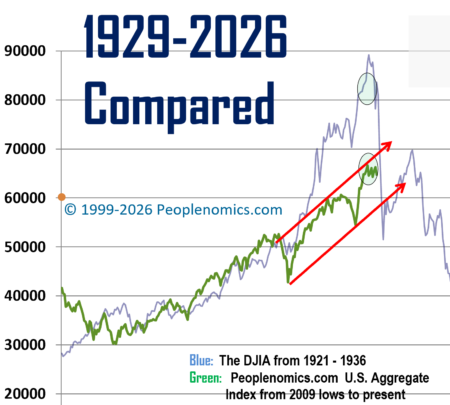
The risk tips if the Dow drops more than 500 today. Post-mortem on today’s action in tomorrow’s Peoplenomics ChartPack.
Refer to the long-term Reserve Liquidity notes from the NY Fed out today at Reserve Demand Elasticity. Timing may be ironic. We shall see.
12–96 Hour Outlook
U.S.-Iran strikes/blockade enforcement likely to continue short-term with potential for further shipping disruptions or retaliatory actions; oil supply risks and prices remain elevated, mattering for U.S. energy costs and inflation—outcome could shift on diplomacy or de-escalation signals (65%).
- Wildfire smoke and fire weather in the West/Midwest may worsen air quality and fire risk with heat/dry conditions; NWS hazards monitoring key (70%).
- Potential for scattered severe weather/flooding in vulnerable U.S. regions amid summer patterns (55%).
- Markets: Earnings season and Fed-related data flow could drive volatility; oil/geopolitics as overlay (75%).
- Ukraine/Russia: Ongoing strikes reported but no major overnight shifts noted in scan (60%).
- Broader supply chain: Hormuz tensions may delay or reroute energy/shipping, with U.S. consequences in fuel prices (68%).
Personal Action _NE-USA
Major wildfires, primarily in Canada and the western U.S., are sending dense smoke plumes eastward. Forecasters expect unhealthy air quality to spread into the Northeast this weekend, with officials in affected areas recommending masks for outdoor activities to reduce inhalation of fine particulate matter (PM2.5).
Why Masks Help Here
- Particulate Reduction: Well-fitted masks can filter a high percentage of airborne particles, significantly lowering exposure to wildfire smoke’s toxic mix of soot, chemicals, and irritants that aggravate asthma, heart/lung conditions, and general inflammation.
- Practical Edge for Seniors/Active Folks: At 77 and in good physical shape with regular outdoor work (mowing, brush hogging, etc.), even short exposures add up. Masks provide a simple, low-cost layer—especially useful during exercise or chores when breathing rate increases.
- For Improved Results: You may wish to go with an N100 mask, but the valved kind is our preference because it reduces exhale backpressure, making it more comfortable for extended wear or physical activity.
Limitations & Best Use: Masks don’t block gases like ozone or VOCs entirely, so combine with staying indoors during peak smoke, using HEPA air filters, and monitoring AirNow.gov or local alerts. Change masks if they get damp/dirty.
Bottom Line: Mask up for necessary outdoor time this weekend to protect respiratory health and keep your routine going without unnecessary setbacks. Check real-time AQI before heading out—better safe than dealing with flare-ups. Stay vigilant on the broader fire/smoke pattern as it evolves.
Around the Ranch: Lifelong Learning Curve
Very interesting invite showed up in my LinkedIn account today: An invite to apply for the Wharton CRO program. That’s Chief Revenue Officer.
Actually sounds like a good track, too: Because we have written a lot about low-level drivers of revenue change. Like the one coming when all this frenetic AI spending is actually spent and all the vendors have been paid. We sense huge risk – because by then global depression could be game-on – that there will not be enough money to pay for all the spending.
That’s useful from a long-term revenue standpoint, because it is a semi-definable risk most people never think through. I’m pretty sure it’s the kind of thing soft-pedaled in Silicon Valley pitch decks.
That Triggered Neurons Flow
I’m half-way through year 78 – the finish line comes in February. While it’s nice to be on a Wharton email list, it got me to thinking about when – as we age – it’s time to start changing emphasis.
The “soft learning curve” in life is simple to sketch out: We are born on a strange planet. By Age 5 or earlier we are in 100 percent learning absorption mode. By the time grad school is done, you’re in the Do Window of life. But even here, the learning curve doesn’t go to zero, or your income will drift thataway, too.
That, in turn, teed up a long-held belief. One that was central in my book Packing to Die – the Suitcase Between Your Ears.
At what point do we each “stop learning?”
Obviously, the correct answer is Never! Just yesterday, I learned that my 2021 Hessaire swamp cooler used a different fan motor than the 2019 (and earlier). Who knew, right?
But taxiing out onto the runway before take-off to the Great Hereafter, it occurred to me that knowing what year the fan model break happened is actual learning, but it’s likely to be a one-time use. I simply may not live long enough to need it again. (That could happen – the other evap cooler could lose a fan in the greenhouse, but the odds… OMG long, right?)
That means something personal (and maybe useful). As we get older, it becomes clear that the only “learning” we take with us is the “stuff between our ears.” And so, after what age do we stop collecting transient knowledge and begin collecting universal knowledge? I mean of the sort that is durable down at the soul level.
Filter: What kind of learning in Life will be useful over in “Next”?
I don’t know why, but the fan model-year might be one of those things I can now safely forget.
Speaking of Fans?
That IBM Selectric II I bought for Elaine is still in USPS’ private corner of hell. I told you about this in the Thursday column here.
Today we learn the computer-based butt-covering window has arrived. Being informed now that
Thu, Jul 16 12:00am In Transit to Next Facility, Arriving Late
This doesn’t mean it’s really out of Kansas. Because there’s no outbound scan from Kansas yet.
Wed, Jul 15 4:57am Arrived at USPS Facility OLATHE, KS 66061
This does provide us with a short-course on data ambiguity – “In Transit” is a wonderful pantload of lawyer-speak. (At this rate, I may have a good start on a new website idea: “Missing_Texas_Packages.com.” Which I would do, except I don’t know as I could handle that site becoming more popular than this one.)
eBay is considerably more honest. “Delivery is taking longer than expected.” Yah think?
I’m going out and look at that long runway again.
Write when you get something in the mail,
George@Ure.net
Yup, Mail sucks as far as valid info goes, I have a notice my pkg is being delivered today. but the actual is the label was just created and the pkg has NOT even left the shipper yet. The ONLY now-a-days that you CAN count on is that NOTHING can be counted on. LOL
USPS offers a service they call “Informed Delivery”. I call it Misinformed Non-delivery.
I actually live in Overland Park, KS – 5 minutes from Olathe and know where the post office is. Want me to go pick it up? LOL
-MidwestRob
I purchased an Honeywell Air Purifier to deal with the smoke. It works well. The smoke was so thick that Wednesday and yesterday the sky was yellow and the sun was orange.
For Gurdjieff, the decline and disappearance of civilizations is tied to the “disequilibrium between ‘knowing’ and ‘being'”: “In the history of humanity there are known many examples when entire civilizations have perished because knowledge outweighed being or being outweighed knowledge. Are we not in a world where knowing far surpasses being?
https://www.gurdjieff.org/nicolescu1.htm
Earthquake,
M 3.9 Experimental Explosion – 147 km ENE of Ponce Inlet, Florida,
M 7.3 – 48 km SW of Aquiles Serdán, Mexico,
and an after quake quake,
M 5.3 – 93 km SW of Puerto Madero, Mexico.
Maybe more than just the thick smoke making me so tired these last couple days.
Trump is a scammer.
“Wake up, will you, pal? If you’re not inside, you are outside, okay?”
– Gordon Gekko
Trump Media to sell high-speed access to president’s social media posts
“The Trump family’s media company is offering high-frequency trading firms paid early access to the president’s market-moving Truth Social posts, delivering them milliseconds before the public sees them.
Trump Media & Technology Group announced the launch of Truth API on Thursday, a data feed providing real-time access to posts from the platform’s highest-ranking accounts. Interim chief executive Kevin McGurn said selling near-instant access to the president’s posts advances the company’s strategy to monetize its proprietary assets.
The commercial appeal is clear. Trump’s posts on everything from the Iran war to U.S. stocks have repeatedly whipsawed financial markets, adding or erasing billions in value as algorithmic trading systems react instantly to his announcements. High-frequency trading firms already spend millions annually on infrastructure and data licensing to gain microscopic speed advantages, and TMTG noted that firms tracking influential Truth posts have until now relied on manual monitoring. “
News You Can Use
Please dont ever say you were not warned about covert19 vaxx, that was designed to reduce world populations.
Better than the Herpes Simplex Virus, mrna vaxx is the gift that truly Never Stops Giving…unless of course youse up to date on your personal Health and Longevity defenses.
If up to date, you would know that Nattokinase is only thing known to clear the “nasties” from Ure system.
But take a gander at the following linked story regards how to fight back.
https://www.thefocalpoints.com/p/the-great-inoculation-how-mrna-vaccines.
Included in the article is the OG research paper on gain of function/covert19 from 2015 – with Foulchi, Ralph Baric (UNC), Peter Dazak(ecohealtalliance/cia), and Stephan Bancal(Moderna) all connected.
It covers everything was warning about as this thing was emerging from Chynah.
MASS CRIME Against Humanity .
“I have seen the ENEMY..”
Kind isolated in my small town – years ago you use to be able to drop your outgoing mail – locally – in a small slot at the post office. That convivence ended about seven years ago., the local mail had to go the bigger city about an hour away for ‘sorting’. The two years ago that also ended when to save money the Postal Service decided that it wasn’t efficient to sort the mail in a town of 35,000.., so a local letter now goes to that inefficient city., to four hours away to Spokane., where it is sorted and sent back to that inefficient city, then back to my small town.
What used to be nearly overnight local mail now takes four truck rides and three days to four days for a letter to be delivered just half a mile away.
– All in the name of USPS efficiency.
Our local city sort center is notorious for taking 3 to 4 days just to send a letter across the city.
Back in the 1980’s in the downtown district of my city we still had twice a day service and same day delivery across downtown if you dropped it into one of the “local” boxes by the cut off time, which was 11 I think. If you made the 11 AM pickup time it was delivered across downtown by 3 PM … enough time so that the letter or item could still be acted on by 5 PM.
I noted here a week or so back using a fixed price box I sent a package to LA from here in the Midwest that made it DELIVERED to a home address in LA in two days. Went across the counter at a local post office window at 11 am local time on a Tuesday as I recall and was delivered in LA about 11 am local time time on Thursday. WOW … letters across town don’t move that fast around here!! Maybe George should move to LA so he gets his USPS packages faster? … LOL
Gal I know worked USPS sorting for awhile. She said if you want speed, ALWAYS us the white boxes the USPS supplies for Priority Mail. They get grabbed first out of any sort pile and dispatched.
We have 2 post offices in town. If I take my mail to the downtown office all local mail is delivered in one day. if I take my mail to the western office ( only a few miles from the main office) my mail is routed to Oklahoma city and takes a week to be delivered.
George, last year I had a similar experience with a Post Office delayed Ebay purchase. After watching the scans show that the package was bouncing from Colorado Springs — where it should have gotten into Peyton delivery stream — and a sorting center in Kansas. Finally I got to talk to the Peyton Post Mistress who was very sympathetic and initially explained that once a package is scanned into a bulk carrier, it is the bulk carrier being scanned and the package can be anywhere. She phoned someone she knew in the Colorado Springs sort center and was told the package was in the hallway there and no had time to scan or sort it. Embarrassed, it got scanned and put on a truck for Peyton and I got it the next day. As for many government entities there is no clear chain of real responsibility. Good luck!
Making a call to kill the President is not acceptable.
The post you referred to MIGHT have been read one of two ways. In my speed-read. I took it the other way, but on rereading I agree. I was deleted – thanks for catching in. I don’t condone violent direct calls like that.
Just in case you haven’t been paying attention.
Semiconductor Index (^SOX) fell 4.3% Thursday
That leaves the index less than 1% above 11,708, the level that would mark a 20% closing decline from its June high and confirm a bear market.
Global chip stocks have erased about $3.3 trillion in market value since June 22.
Micron, Samsung Electronics, and SK Hynix had already dragged the memory chip complex into a bear market, while dozens of individual chip stocks are down at least 20% from their June 22 levels.
A forceful close back above 12,000 on Friday or Monday would mark a false breakdown and could quickly flip the setup bullish. Fail to reclaim 12,000, and 11,000 becomes the next test and would confirm a broad based Bear Market for the chip-makers.
The semi-conductor sector on the NASDAQ is once again being hammered this morning and the NASDAQ100 futures are down 220 points [ -0.75% ] 10:30AM
The SOX Index is currently at 11,890, slowly trying to recover from the early morning blood-letting – but still below 12,000 magic mark. It is also below it’s 21 DMA and 42 DMA and earlier this morning briefly touched it’s 85 DMA at 10,840.
Two analysts have state that this will get worse: “They are just now beginning to see that ROI is not there.”
Looks like ‘Risk-Off’ is in full swing., despite not being called a Bear Market.
The big boys are on vacation…
The real fall will be in the fall.
Lol lol lol the big boys at work lol lol lol… Now that there is hilarious…
https://youtu.be/RFlCD5CYAcU?si=PkRUf2YpJNupljfh
.When i was just a boy in DC…I had to deliver papers to the capital… Congress was in…. SESSION….I thought oh my how exciting it would be to sit and listen to our legislators going over the bills debating what needed to change and what the bills covered..I went to the balcony to sit and watch the excitement.. I sat and sat and thought oh their probably having coffee or lunch..I sat for hours..waiting.. what was there was half a dozen paper shufflers..in the center..was a janitor leaning on his cleaning cart thumbing through a magazine..that was the big boys at work.. Ever wonder why the senators aides used the front desk of the senate for a gay sex film?? my guess is that’s the most use that floor has seen in decades…lol lol lol
Let uncle jay explain the hardest workers in politics… lol lol lol
https://youtu.be/IsWlkcsI5Ko?si=qul0hJsWy20oc5Dp
with every dramatic thing going on..wouldn’t you expect the hardest workers in government getting together in an emergency meeting ??
instead they table the dead horse bills and go play..one senator spent the better part of a year in the hospital and he was at Congress three times more than those working with him…lol lol lol
dLynn,
Let’s hope everyone is happy with their cards in hand. Apparently the saying “when the chips are down…” derives from 19th century poker games.
Market Historian Bob Hoye: In my mind, like 1929, a great financial bubble is being completed.
https://www.howestreet.com/2026/07/mega-events-like-world-cup-rarely-worth-the-cost-bob-hoye/
Just a reminder, post several months ago.
Martin Armstrong’s Socretes program for quite some time (many months, maybe as long as a year) has been projecting Oil pricing for the EOY 2026 to be $200/barrel.
Not investment advice, just a “heads up”.
FWIW my own work is showing that we now most likely have passed beyond the Precursor War stage (which ended up being the Russia v. Ukraine) which has to happen a few years before THE NEXT Major World War can happen and are now entering the “Main Event” War stage. Since my war model was done way back in 1979 it didn’t do a month by month projection but it did do a “range” in years when the “Main Event” would likely start, 2024-2028 with the midpoint being 2026.
History tells us that YES, a Major War “could” still be avoided, but the situation is much like a huge forest that is primed for a major forest fire with decades since one happened, dry as shit, and needing merely a spark from people or from nature being able to set it off. Will a fire be avoided in that case? Most likely NOT. Will this Major War be avoided? Most likely NOT.
The world is primed. The Precursor War (an absolutely necessary condition) has now primed the mindset of both the leadership class and the general population of the potential early combatants. All it takes is ONE SIDE to decide to start a fire … and that fire WILL GROW and GROW and soon will have grown out of control.
In the present case the US/Israel decided to START A FIRE …. and that fire is now not only growing but growing out of control.
Interesting times coming up. By history the World will be a different place once this fire is finished scorching the earth.
Well written. Thanks
Hmmmm
USA has no excess oil in storage.
Iran refuses to do what told about gulf.
Isreal says bomb them till it hurts.
Turkey says Ottoman empire is back..
Saudi says no dome on rock to Iran
Yemen says no trade Europe.
US fleet says… ready
Gulf shipping is now zero.
World excess oil storage is zero.
Third world dies as no funds… say Africa…
S America next if no Venezuela oil…
3 part Caribbean rum for Cuba…British are coming.. maybe like Rubio now.
2, 8 Mag quakes due in Japan. No word on Three Georges dam in China.
Etna erupting Italy… hot there… no water in waterways to ship goods in Germany
British broke, no government… no taxes… seems worse than Germany except for shadow cruise missiles on Poland borders.
Finland Sweden have French nukes..
Russia… long gas lines… Ukraine UAVs… with bombs on refineries.
No word on fertilizer versus crops planted versus drought versus food shortages in fall.
China broke.. no transparency yet BRICS bank. Same with Iran. No word on Russia economy with no oil.
(“At what point do we each stop learning?” )
Never.
I believe that the real danger isn’t when an individual stops learning — it’s when an entire people stop seeking the wisdom of their elders.
For thousands of years, prophets, sages, philosophers, and stoics carved their warnings into stone tablets, scrolls, and books, trying to pass down the lessons of their struggles. They weren’t writing for themselves. They were writing for us………..
When a society stops listening to those voices, it repeats the same mistakes they tried to help us avoid……..its human nature…
I see that with my kids…..When children are young, the world is magic.
They want to learn everything — every tool, every trick, every story.
They look at their elders like walking libraries.
Then puberty hits…..
And suddenly they believe the knowledge they’ve gathered in a handful of years outweighs the decades you’ve lived.
It’s not arrogance — it’s the illusion of independence.
They think distance equals wisdom.
So they pull away.
They stop asking.
They stop listening.
They start rolling their eyes at the very lessons that will one day save them.
And then life hits.
Not softly — but with the full weight of rent, bills, consequences, responsibility, and the cold math of adulthood.
That’s when the truth arrives:
“Dam… Dad was right.”
Every generation has that moment.
Someone once said: “When an old man dies, an entire library is destroyed.”
True…And the funny part is, I’ve got more books on my e – reader than the local library has on its shelves — but none of them compare to the “books” a person carries inside their own life…..
Every scar, every lesson, every mistake, every victory… that’s the real library…..
And when someone with a lifetime of those experiences passes on, it’s not just a person we lose — it’s shelves and shelves of knowledge that can never be replaced……
It’s really funny, in a sad way. Scholars dig up the past. Archaeologists translate it. Historians publish it.We teach the lessons in schools…. And even with it being taught and known humanity still refuses to learn from any of it…
There are thousands of years of warnings carved into tablets, written in scrolls, copied into books, and now digitized into millions of pages online. Every generation has access to the lessons of the ones before it — the triumphs, the disasters, the collapses, the recoveries.
And yet… mankind stubbornly walks the same circles over and over….
One of the guys living in our spare bedroom..he farmed during the first world war ..joined in the second world war..survived landing on D – day..was one of the forces that liberated Nazi prison camps.. at when a teacher told the students that they should interview him..not one..asked him any questions…
That’s what I love about taking care of the elderly..their life stories..took care of a man that survived as a boy the sinking of the titanic..another that was suppose to board it in new york.. A lady that survived Auschwitz and a Nazi guard at Auschwitz.. and the man that was in the liberating forces… so many so many different paths..
Post office delays…lol lol… I ordered a coaster….for the pitcher on the table it his our local distribution center…then they sent it to another distribution center…after it zipped by twenty times..the company sent a second one..it to was diverted to no mans land..they quit tracking both of them after it bounced off the local distribution and sorting station a hundred times..that was six months ago and to my last recollection its still making the rounds..at one point I believe it had landed in every state..who knows ..maybe it will eventually reach its intended destination…
“… and did he ever return? No, he never returned, and his fate is still unlearned…”
..ride forever neath the streets of Boston – tale of the MTA by the3 Kingston Trio wasn’t it? still cani play th4e of the lyrics back handed old charlie a sandiwch as the train came through quarter past three, or something?
Kingston Trio, ‘MTA’
https://www.youtube.com/watch?v=MbtkL5_f6-
4&list=RDMbtkL5_f6-4&start_radio=1
https://m.youtube.com/watch?v=Y-5qU4rnky8
‘Twas the Kingston Trio. I haven’t thought about that song in years. I had a folk singing fratboy* brother who sang it all the time.
* HA! Had to edit it twice, but got this past this phone’s “spell checker from hell…”
People think a life path is a straight line.
Grow up, get a job, build a future — simple.
But anyone who’s lived as a catfish at the bottom of the food chain knows different.
Life doesn’t ask permission before it changes your direction.
Sometimes it only takes one event — a medical catastrophe, a financial hit, a bad decision made by someone else — and suddenly the future you planned is gone. Not bent. Not delayed. Gone.
oh there’s a song..about gone…
https://youtu.be/NBdjVUN0Vok?si=RXbwQ_nE7N9TEu-2
Irish folk..
That’s when the real test begins.
I didn’t have a smooth path. I had impact events.
One after another……..
The kind that force you to rebuild from zero while everyone else keeps moving forward……
That’s where the Marine motto became more than jus a bunch of empty words the most valuable lessen of life…..
Improvise. Adapt. Overcome.
Not because it sounded tough — but because it was the only way to survive catastrophic life events…
My kids and grandkids don’t understand that yet.
They look at my stories and roll their eyes, thinking, “No way all that happened.”
But that’s because they haven’t lived the chapter where life stops being fair and starts being real.
The truth is simple…
A person’s path can be diverted in a single moment.
Not by weakness, not by choice — but by life itself….
And the ones who make it through aren’t the ones with the easiest journey…..
They’re the ones who learn to adapt faster than the world can break them.
I’m still here because I did exactly that….keep moving forward no matter what..
Well said
Hillbilly HEPA filtration for in your house.
Lots of places in the NE and Midwest are dealing with heavy smoke from the Canadian wildfires, btw that smell you smell is Benzine and Arsenic which is the result of sunlight hitting the smoke and breaking it down.
So what ya gonna do? (particularly if you have any breathing issues)
MAKE a Hillbilly HEPA filtration device to use inside your house!!
(OK … came from my son, not original to me)
1) Go get 2 or even 4 HEPA furnace filters at the hardware store: 20×20 size
2) Get a roll of duct tape
3) Dig out that old Box Fan you bought long ago, haven’t used in probably two decades (may take some attic, garage, or basement work to find the corner you stuffed it into)
Now that you have assembled the parts Duck Tape a HEPA filter to both the intake and to the output side of that old box fan. Son claims studies show that two on each side works best. (they do that at his work at times … govt job site)
Put the fan on the floor, plug into outlet, turn on, and you now have an inside the house HEPA filter system to pull much of those nasties out of the air.
Clearly an electronic system that is built into your furnace will probably do a better job since they use an electrostatic system of filtering your in house air… but for those who don’t have it and the smoke is bothering you this is an option.
Locally our local AQI index this morning was over 500, the EPA rankings only go up to 500!!, over 400 is EXTREME, even over 100 is considered “Unhealthy” and many worksites are not allowed to have work done if it goes over 300 (guy in the office wife is an architect and she had several worksites forced to shut down today by EPA regulations). (our local aviation visibility was about 3/4 mile at the 500+ smoke level)
Think you have it bad? This AM Duluth Minn AQI was over 1100!!
Hmm..a hillbilly hepa filter…well you know some of my life events..I am pretty open about them..mostly in the hopes others will avoid the same events I have lived through.. the marine motto improvise adapt and overcome…
I have a grandson that’s allergic to dust corn dust and we live right next to a grain elevator.. the cost of a good hepatitis filter is so far away from my ability to pay..so what do you do..ponder it…hmm..hey if some one smart can do it..so can I …. then it hit..I can build what’s called Corsi–Rosenthal Box….. simple effective and easy to make..
a 20″ box fan, four MERV?13 filters,duct tape….and my favorite …card board chaos box…
it Will deliver 300–600 CFM of clean air, which from my simple math is equal to or better than many commercial HEPA filtration system.. used one for years..now I have a commercial filtration system and everyone knows I’m really into ozone air cleansing..( make sure you or your pets are out of TBE room ..ozone will attack and our bodies are little factories for germs etc.
https://www.amazon.com/s?k=merv-13+air+filters&adgrpid=191557729332&hvadid=779593451275&hvdev=t&hvexpln=0&hvlocphy=9020341&hvnetw=g&hvocijid=15800078827317162306–&hvqmt=e&hvrand=15800078827317162306&hvtargid=kwd-1186902345983&hydadcr=11917_13311395_2356085&mcid=acef288827e03acf8dcd2eca951f06fe&tag=googhydr-20&ref=pd_sl_2jz59eo2ep_e
I didn’t know where to cut the zon link off..I get them at ace..
Cutting off the metadata can get tricky sometimes, especially with a search link. Generally you’re good if you keep everything before the ampersand:
https://www.amazon.com/s?k=merv-13%2Bair%2Bfilters&adgrpid=191557729332&channelId=4&clpRedir=Y&hvadid=779593451275&hvdev=t&hvexpln=0&hvlocphy=9020341&hvnetw=g&hvocijid=15800078827317162306–&hvqmt=e&hvrand=15800078827317162306&hvtargid=kwd-1186902345983&hydadcr=11917_13311395_2356085
Sloppy me. Try:
https://www.amazon.com/s?k=merv-13%2Bair%2Bfilters
How I did it is get the box.. put the fan on one side oh you have to cut holes in the box to mount your filters on and the fan…I had mine set up so it sucked the air through the box out in the room..the filters of course filter the air as it enters the box..and if your creative..you can make it pretty fancy to.. a cardboard box..and you can make them in a variety of sizes..
Yes haw…
https://youtu.be/UpMX1OLlwq0?si=qJwGLjUGnw4PpCQK
I forgot to tell you how I made the one we had…if you look at a wine glass rack the trim is a t – trim….on the three sides you build up your card board so you have a T – trim that the filter can simply slide into place…then like a nesting doll get a box cut out for the fan and filter so you simply slide the other box over it..if you have a decent base of card board it can look like a store bought hepa filter..
electrostatic filters are high maintenance, from room size to HUGH electrostatic precipitators on power plants that burn coal,, the powerplant where I worked replaced them with cloth type filers and the room size one I had found the trash can,, the filter on box fans is a good cheap way to filter room air,, get hepa paired with carbon filter for best results,
I am pro coal…burning coal..even today’s inflated prices you can heat a home for so.e where around a hundred bucks.. it was forty by HS a ton not that long ago.. a friend bought a semi load of fifty pound bags to heat his home..the real cost was getting it here..I bought two tons for us..the problem I had was that coal burns real hot..I had to mix it three to one three parts wood saw dust pellets to one part coal fines… if some company made them it would go like crazy..I extended the burn box so it would ignite the fumes..you could put a white cloth over the exhaust and UT would stay clean…great thing..looked it up its still cheap.. one ton will heat a home …
U.S. Domestic: Powder River Basin is around $15/ton, while Illinois Basin is roughly $52/ton.
Its actually cheaper now than when I bought mine
The other day we were sitting on the kids’ patio. My daughter was talking about the trials she went through with her knee replacement. Then my granddaughter looked at me and said, “Grandpa, I was telling my husband about the days when you was so sick we had to feed you… when you had to learn how to walk again. He couldn’t believe it.”
People look at us today and can’t imagine what we survived twenty years ago. Back when the doctors wanted to put me in hospice, I was just too stubborn to quit. And now I see that same stubbornness in my wife. Her last stroke twisted her up badly, but she kept pushing far beyond what the doctors or therapists ever expected. She hit her limit in therapy visits, and they said she needed a certain piece of equipment. For six months the answer was always, “We’re trying to get it.”
She eventually gave up hope of ever receiving it.
A coworker who’s a therapist explained what the equipment actually does. I found a different unit — from China, of course — and ordered it myself. It arrives Wednesday. She’ll probably cry when she sees it, because she thought that door was closed forever.
And that’s the truth about life…..
A person’s path can be diverted in an instant — by sickness, by circumstance, by someone else’s decision — but stubbornness, grit, and the will to keep going can build a new path where the old one collapsed.
Some people don’t understand how many battles a person can survive.
But those of us who’ve lived at the bottom of the food chain know exactly how many —
as many as it takes.
Through my life, I made a decision:
Whenever I met someone facing catastrophic events — the kind that push a person right to the edge — I would give them a hand up. Not pity. Not charity. A hand up. I’ve done that for hundreds of people over the years.
This time, the hand up is for the one I love….my wife…
My wife lost everything after her first stroke. The doctors took nearly her entire paycheck — she was left with five dollars a pay period. She still went out and worked day labor just to keep herself going. When I went to work off a medical debt by resurfacing a surgeon’s parking lot in heat like we’re seeing today, she put on coveralls, brought ice water and sandwiches, and said, “Where do we start?”
That’s who she is to…
Now it’s her turn for me to do what I can….its a surprise… I searched a long time till I found it with the help of my co – worker…
https://astrologynewsservice.com/articles/leaves-from-a-financial-astrologers-notebook-july-2026/
‘STOCK MARKETS
I expect a sharp correction in overall market value over the next few weeks. I am particularly anxious about mid-August where I fear that the dramatic falls of 1946 may be repeated.’
re: “Kite”, U2
feat: 7 Days of Saturnalia
c,
It’s most thoughtful of you to suggest we all go have fun with kites via the astrological link that you point to above. Ms. Skinner of the UK informs that her blog’s title page image is created by ChatGPT. I asked ChatGPT for its thoughts on said image.
Appropriate astrological commentary came back in response until the ‘Columbo moment’. “One small detail worth noting is that the planetary symbols are not entirely astronomically accurate. For example, Saturn appears twice…”.
Hal, who holds the cards?
the USPS has done such a great job , they just raised their prices.of course, they will be coming back for more by the end of the year. Oh , my mail in ballot was delivered to someone else.
https://atr.org/no-ode-to-dejoy-trump-turncoat-pushed-out-as-postmaster-general/
‘Postmaster General Louis DeJoy resigned in disgrace on Monday after five years of leading the United States Postal Service (USPS) into deeper financial ruin.
DeJoy was first selected as Postmaster General in 2020 by the Trump-appointed Board of Governors, but he failed to deliver on promises to right the financial ship at USPS. ‘
https://www.opensecrets.org/news/2020/08/gop-donations-postmaster-general-louis-dejoy/
‘Since the mid-1990s, DeJoy and his wife, Aldona Wos, have contributed over $3 million to federal Republican candidates. They donated two-thirds of that total since the start of the 2016 cycle, giving $1.2 million to a joint fundraising committee that distributed that money to President Donald Trump’s campaign and the Republican National Committee.’
https://www.pbs.org/newshour/politics/embattled-postal-leader-is-a-trump-donor-with-deep-gop-ties
(Dejoy’s) company was awarded contracts worth $59 million, according to federal spending data.’
(Dejoy’s) Their family’s nonprofit has doled out millions to charities and conservative groups, including the Jesse Helms Center, which was created to promote causes advocated by the late North Carolina senator, who had a long history of making racist and homophobic remarks.’
The launch day opened with no wind after all night rain and lightning. The sun came, the travel lift grasped our lovely, and we wetted again, work done. A quick trip back to the slip, secured, then rain and rainbows.
Back to the dirt box for a morning snooze catch up. And a day of recovery.
All is well in the souther hemisphere. Nasty weather for a few days though.
We are quiet.
Stiks
SOX Index [ Semiconductor chip makers] closed down 193 points today to 11,673 – officially entering a Bear Market.
Could be a small bounce on Monday – but the next target price is 11,020 .