
Waiting for the Bag – who will hold it? , Waiting. It’s what life becomes at certain nodes of hypercomplexity.
As a natural-born action figure, days like this make me nuts—and I’m perfectly willing to share. But you come here for brilliant insight, and sorry to report, we’re fresh out.
We seem to be sitting in one of those waiting-for-war windows.
Markets are waiting. Tankers are waiting. Politicians are waiting for somebody else to own the consequences. The military is waiting for darkness. Traders are waiting for the opening bell.
Which means it’s time to crank up the…
News Compressor ON
What changed overnight is confirmation of a thirteenth consecutive night of U.S. Central Command strikes on Iranian military targets.
Command centers, drone-storage facilities, communications sites, coastal-surveillance systems and maritime capabilities were hit in operations completed around 9 p.m. Eastern Thursday. The stated purpose remains degrading threats to shipping through the Strait of Hormuz.
Sun’s up over there now. The day’s news flow will be along shortly.
On the second front, Houthi claims and Saudi confirmation of tanker strikes near Bab el-Mandeb remain active. Reports also surfaced of Iranian IRGC personnel and equipment transfers to the Houthis. Drones and explosions were reported near U.S. forces in Erbil, Iraq.
China’s Taiwan live-fire activity showed no major fresh escalation in the sources scanned overnight.
Of course it didn’t.
Everyone knows World War III is a weekend-only event. Doesn’t anyone read our pearls anymore?
Brent crude moved above $100—hovering near $101 in some early-Friday reports—on Houthi tanker attacks, Red Sea insurance fears and continuing disruption around Hormuz. WTI followed higher, and both were positioned for strong weekly gains.
As warned yesterday, the first move would be a run higher at the open.
Then comes the more important question:
Who will be holding the bag at the close?
West Virginia’s statewide emergency response after this week’s flash flooding now includes two confirmed deaths, according to the governor’s office. Thursday’s baseline had no verified fatality count.
The House narrowly passed another war-powers resolution, 214–208, seeking to halt unauthorized U.S. military action in Iran. The Senate rejected a companion measure.
Meaning Congress has once again reached the ceremonial hand-wringing stage of foreign policy.
Tropical Storm Bertha has degenerated into a trough and remnants, with no additional advisories following its Louisiana and Texas impacts. Plenty of rain is still heading into the Rio Grande Valley, which should mean plentiful fruits and vegetables later—assuming diesel prices don’t make them luxury goods before harvest.
News Forecast
Friday morning and early afternoon — U.S. PMI test.
July manufacturing and services readings arrive while markets are already repricing oil, inflation and interest rates. A strong number could push the probability of a July Federal Reserve increase closer to even money. A weak services number could pull yields down temporarily.
Odds: 74%.
The Fed meets next week and no change is presently expected. But the world has plenty of time to blow up between now and then.
Next 12–36 hours — A fourteenth strike looks more likely after the market close.
Another Iranian or Houthi attack on shipping, a confirmed U.S. casualty event, or damage to Saudi export infrastructure would likely drive Brent quickly back above $100. Evidence of quiet mediation—or simply the absence of another tanker attack—would cool the move.
Working probability: 83%.
Friday through Sunday — Watch vessels, not speeches.
Hormuz is averaging only three transits daily. Some vessels are avoiding Bab el-Mandeb, while others are using Egyptian Mediterranean loading points. Ship counts, insurance quotations and Saudi loading notices will tell us whether the second chokepoint is functionally closing.
Confidence in that call: 87%.
Friday through Monday — U.S. weather split.
Repeated storms threaten flash flooding from the Tennessee Valley toward the Carolinas. Dangerous heat is expanding through the Southern Plains, Gulf Coast, Desert Southwest and central states, while critical fire weather develops in the interior Pacific Northwest.
Chance of meaningful regional disruption: 90%.
Real hot here next week, too. Ranch thermodynamics may soon involve deciding which machine, plant, animal or human gets the next available electron.
Sunday evening through Monday — Asian reopening risk.
South Korea’s KOSPI fell roughly 6% Friday and Japan’s Nikkei about 2.8%. Oil holding near $100, further yen weakness, or another disappointing AI-capex disclosure could produce a second wave of selling when Asia reopens.
Our number: 76%.
Through 12:01 a.m. Eastern Tuesday, July 28 — Tariff transition.
Goods already in transit receive a temporary exemption. As that window closes, customs treatment and importer pricing will become clearer. Exemptions for oil, gas, fertilizer, aircraft components and some food products reduce the immediate hit but do not remove the broader inflation impulse.
Likelihood: 94%.
Monday through Tuesday — Pre-Fed and Big Tech positioning.
The Federal Reserve decision sits just beyond the strict 96-hour window, but portfolio repositioning will begin beforehand. Microsoft, Meta, Amazon and Apple will be judged less on headline revenue and more on cash generation versus AI spending.
Alphabet’s first recorded quarterly cash burn changed the conversation. AI is no longer only a growth story. It is becoming a capital-consumption story.
Score this setup at 82%.
Foundation Impacts
A news item matters for a day.
A changed assumption matters until it changes again.
Here are several items to add to the future-assumption table.
The Tariff Floor Has Been Rebuilt
The U.S. tariff floor has been reconstructed under different legal authority.
New duties of 10% and 12.5% cover goods from 60 trading partners and reportedly reach 99.4% of U.S. imports, although significant exemptions remain. The legal basis is Section 301 rather than the emergency statute rejected by the Supreme Court.
That distinction matters because the tariff structure may now be harder to dislodge in court.
Import-heavy small businesses should look at actual product classifications rather than relying on country-level headlines. The exemptions may soften the blow, but the architecture remains inflationary.
This is no longer a temporary tariff tantrum. It is becoming part of the operating system.
AI Has Acquired a Cash-Flow Problem
The AI trade has acquired a cash-flow problem.
Alphabet burned $5.9 billion during the quarter while raising its 2026 spending plan by another $15 billion. Tesla returned to negative free cash flow, helping pull its shares down about 14%, while Alphabet lost roughly 7%.
The market is beginning to ask the question Peoplenomics readers have been hearing for months:
How much physical plant must be continuously financed to keep the AI growth curve alive?
Servers depreciate. Chips age. Power contracts rise. Cooling systems wear out. Transmission lines take years to build. Data centers do not run on adjectives.
Recent Peoplenomics reports have covered this AI cash-flow vise deeply. Eventually the market had to notice that intelligence may be digital, but the infrastructure bill is painfully physical.
Intel Is the Exception—For Now
Intel is the exception inside Friday’s AI selloff.
The company raised its capital-spending forecast from $18 billion to $20 billion and projected third-quarter revenue above expectations. Its shares rose about 6% before the U.S. open.
That suggests demand for AI-supporting CPUs remains real even as investors question hyperscaler economics.
We continue to see Intel ARC as a longer-term CUDA intrudah. (Nods at Hecklefish.)
Not a killer yet. More like the fellow who has started measuring the windows and asking where the silverware is kept.
Data Centers Have Become Grid Events
A transmission-line outage in northern Virginia caused data centers to transfer to backup power, abruptly removing more than 3 gigawatts of demand from the PJM grid.
Voltage effects were detected from the Washington area toward Chicago, and stabilization took about ten minutes.
Think about that for a moment.
Data centers are now large enough that when they leave the grid, the grid notices.
Operators of server farms should review generator-transfer logic, load rejection, synchronization and reconnection sequencing.
But that’s what all the backups are for, isn’t it?
Well, yes.
Except when thousands of megawatts of backup systems all do what they were designed to do at the same moment.
The old grid problem was losing generation.
The new grid problem may include suddenly losing load.
Ebola Is Running Ahead of History
Congo’s Ebola outbreak is accelerating faster than the historic West Africa outbreak did at the same stage.
The Bundibugyo strain has produced 2,536 confirmed cases and more than 1,000 deaths. There is no approved vaccine or treatment for this strain, while violence, distrust and attacks on health facilities are disrupting containment.
Global risk remains limited by the virus’s transmission route. Regional risk is severe.
This is not a pandemic call. It is a reminder that disease control depends on functioning institutions, trusted medical teams and enough social order to trace contacts.
Where those fail, biology gets the deciding vote.
Ham Radio Weather: Mediocre
Not a great ham-radio weekend.
NOAA expects G1 geomagnetic conditions during parts of July 24, with a 55% chance of R1–R2 radio blackouts and a 10% chance of R3-or-greater activity. The R1–R2 probability falls to 45% Saturday and Sunday.
HF operators may see brief dayside dropouts rather than a sustained major event.
In other words, the band may disappear just as the rare DX answers your call.
Tradition must be maintained.
Around the Ranch: USPS SNAFU
Now to the genuinely important crisis.
Do I gamble another day or two and wait longer?
Vote in comments. I’m curious how other people would play this.
Remember, this is an old IBM Selectric II for Elaine. It was shipped from Aurora, Colorado, on July 7.
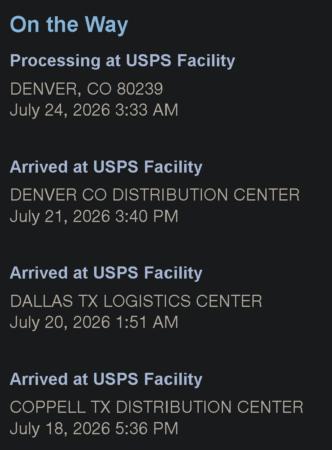
Since then, it has toured the postal system with the confident sense of direction normally associated with a shopping cart in a tornado.
It has been to Texas twice.
It has gone back north.
It has apparently revisited places it had no business seeing the first time.
At this point the typewriter has traveled farther this month than Elaine and I have.
The practical question is whether to let the eBay process continue for another day or two, or stop admiring the postal choreography and press the refund button.
The romantic in me says wait.
The businessman says the seller hired the carrier, the item was not delivered, and the buyer-protection clock exists for a reason.
The ham operator in me wants to attach a transmitter and start taking bearings.
Hmm.
Off to get groceries.
Wine, mainly.
Drop by for ShopTalk Sunday. This afternoon, we’ll watch the closing tape and see who volunteered to become the latest bag holder.
Futures are higher, so don’t worry your little head about that reality pile. Everyone’s a winner here! (coughs into sleeve and smiles).
Write when you get rich,
As an ebay seller it sucks when an item is delayed by the carrier even if the item was shipped on time. I would send the seller a message and see how he/she responds to the issue. If they respond promptly and is apologetic for the issue then give them some time. We’re coming into the weekend so I would say wait until Monday. If its not delivered Monday then go for a refund.
If its not an emergency item give it a bit more time. Unless the seller doesn’t seem to care. As a seller I would be very apologetic and concerned and quick to respond to your message
Youse should be wearing the BLACK, Chief.
4 it is a time 4 Mourning…the loss of free radio via AM. Wave bye bye to Ure free radio broadcasts..tooddles.
What ? Radio G does not give a flying F about free radio in Ure car or handheld. What is the radio world coming to?
“NIAGRA FALLS!” https://youtu.be/MYP1OBZfFK0?
* After listening to Bessents” interview and Q& A regards Fort Knox Gold, I came away with the distinct feeling he was FULL of SHIT.
This fudgepacker even claimed you could walk up to Fort Knox with old Gold Certificate and redeem it for Gold..TODAY.
Gold mkt looks dicey for a reason..USA is manifest BANKRUPT, going deeper into INSOLVENCY with each passing.
They are blowing this “thing” up like 9-11, to cover up all their criminal activities. Might be a good time to go back and watch the first 3 seasons of The Sopranos..learn how they bankrupt a guys business(who is on the hook to family) by maxing out Inventory credits with suppliers, taking delivery out the back door, then the “jewish lightening” strikes to burn it all down for the Insurance payout.
Seen the Oil to Gold ratio lately ? Kinda high, no?
see sometimes you make some sense . gold in fort knox is sprayed tungsten . may not even have that !! that was the stuff they stole from Sadam and gadafi . thats long gone . a real joke . da boyz are caught out all of em
It’s rare enough (the sense part) – keep a good leash on him.
Yeah caveat. You need to be a qualified investor to redeem one of those paper chits for real specie (gold/silver), I don’t think any of us have a seat at the BIS table either. Although…. Owning select cryptos gives you a share of the future BIS currency basket IMHO. It’s all in the details…tbs
Not advice, web3.0
“I hear nothing!
sniff sniff is that Apple Strudel I’m smelling ?”
I am as dumb as the day is long and know NOTHING regards bankers or bis. And I certainly dont mess around with the likes of Injective, Hedera, XRP/XLM, or even Chainlink, let alone Quant, Ondo, DAO, Filecoin, Maple Finance or Kite. Nope I dont mess around..
Not Guerilla Investing, more like Ambush Investing.
When the Time is right, tbs will be springing into action come HEll
or High Water.
Your USPS experiences far exceed mine, but here is my latest, I ordered a birthday present for my wife, (trellis) and it was coming from California, it left Cali and then went silent for 5 days then showed up at the El Paso center where it then was sent to my local Post office (NM) where it got marked return to sender and after investigating with the local office. All they received was the shipping label with my name and tracking number, NO pkg. Somewhere while enroute they think it was stolen and the culprit sent on the paper to try to throw off when it was taken, anyway now a refund is issued and i ordered a new one, I don’t have any faith in the system anymore. LOL
Unless Elaine has some urgent letters she needs to type and get out, I vote to wait. The entertainment value of this journey across the USA is worth more than the typewriter. The letters she types and mails may never arrive at their intended destinations anyway.
Next time, forget the typewriter and just buy the wine.
“AI Has Acquired a Cash-Flow Problem”
Indeed Mr.Ure, to be sure, AI will be using Crypto currencies in settlement.
https://news.bitcoin.com/analyst-predicts-ai-will-catalyze-bitcoins-rise/
It’s great to be early. Wall Street hates when retail is accumulating alone side them when assets are in the green banana category of growth stage. There’s no use case for green bananas therefor they are priced like dirt. Wall Street will quietly accumulate green bananas and sit on them until they are ready for retail sale. I like to stack my lunch money next to their stacks of accumulation.
Not advice, got blockchain.
Si
Talk about a worthless asset, I can only Buy 715 Barrels of Texas Light Sweet Crude for 1 Bitcoin today, for heavens sake.
Somebody call me a doctor, I’m drowning in worthlessness..aarrggghh…
Well, at least I still have my Heavy Dirty SOUL..
“Can you save my” -https://youtu.be/szE3DTbtqw8?si=XY2mRiidcOx5Jnue
Brings new meaning to being a whole coiner …
King Crimson – “Waiting Man”
I come back…come back
you see my return
my returning face is smiling
smile of a waiting man…
I be home soon soon soon
soon cry on your shoulder
your shoulder against my burning tears
tears of a waiting man…
one two three four one two three…
I wait every moment
I wait, wait for my chance
I wait for my friend to say
hello, you waiting man
feel no fret feel no fret feel no fret
you can wait and feel no fret
and so I wait so I wait so I wait so I wait
I return face is smiling
be home soon cry on your shoulder
tears of a waiting man
every moment wait for my chance
my friend say hello feel no fret
you can wait and I wait and I wait
and home I am…
https://www.youtube.com/watch?v=ummdDO-I6Es
re: “Waiting on War”; 8 Nation Army, 1900
feat: Adjustment Bureau
The release of the movie “All Wishes Come True” moved up six days arriving in Chinese theatres last Saturday. North American release may have adjusted from August 21 to August 14? One imagines these amended dates perhaps better coincide with the positioning within the lunar months for Caishen Ye, the Chinese god of wealth.
While advertised as “All Wishes Come True” in English marketing, the Chinese poster cover offers an adjustment conveying “Today’s All Wishes Come True”. The computer animated movie sees eight mortals deceive the immortals and cross a body of water. Allegedly the movie is a cover of the 1,000+ year old Chinese mythical story about the “Eight Immortals” who cross the East China Sea.
There are various advance trailers on Youtube. More than one shows a scroll with Chinese characters. An example can be seen at the 41 second mark in the following Youtube link:
https://youtu.be/Bl-c5_zWR2k
The frame is headlined –
“8. July 24th, Deceiving the Heavens and Crossing the Sea
All Wishes Come True”
My attempts to translate the scroll’s characters offer slim pickings. All I see so far is –
“I can also join the public”…
“The most important situation is”…
…”superior”…
As chance would have it, a similar scroll-like collage may have appeared during the halftime show at the World Cup Final held in New Jersey last Sunday. Here is a Youtube link to that rendition of “Seven Nation Army” with a frame of interest appearing at the 15 second mark:
https://youtu.be/Aowl4OXw_Mc
‘Sing’ to the Song Dynasty?
re: “King Crimson”
feat: The Red Queen
To those searching route directions amongst the matrices, George kindly offers today sighting of a “…fellow who has started measuring the windows…”. Squarely put is just what the doctor ordered for anyone who has experienced prairie flatland.
There are a couple of further frames of interest in the “All Wishes Come True” movie trailer above. According to ChatGPT, at 39 seconds the person seen is understood to be one of the eight Immortals, He Xiangu. Legend has it that she could see good and bad omens towards battle preparations.
The film clip has her riding on a white crane which can represent power and scholars. Apparently white cranes are also associated with highly ranked civil servants. The teaser clip depicts another person at 1m 02s. Their frame is subtitled “Immortal Administrator No. 666 is at your service”.
Both heads of the Immortal and the Administrator appear to depict exaggerated, inflated size similar to that seen with the Red Queen in Disney’s 2010 movie “Alice in Wonderland”. Helena Bonham Carter played the Red Queen role.
As chance would have it, she is a great-grandaughter of English PM H.H. Asquith (old norse: [askr viðr]”ash tree forest”). He led the government at the start of WW1 winding down after the 1915 Battle of Gallipoli debacle. Interestingly he had been a student at Oxford of The Reverend Edwin Abbott Abbott. The Reverend authored “Flatland” in 1884. His book follows a two dimensional square which examines different dimensions from a dot on up. The square hopes by tome’s end to have convinced readers that the third dimension really does exist.
Yahoo Finance picked up a walled-off “South China Morning Post” report a couple of weeks ago. A Chinese startup company is beginning production of two dimensional non-silicon chips. They hope to refine processes so that someday three dimensional chips will become obsolete. The name of the company is Yuanjiwei (ch: “Convolutional Dimension”).
Don’t listen to me….What did uncle Larry just call??? Not acting surprised LOL. Still stacking lunch money here .
https://youtu.be/4ok9mdNwvLw?is=klGCaqHLMZU31-cm
Not advice. Got blockchain.
“Congo’s Ebola outbreak is accelerating faster than the historic West Africa outbreak did at the same stage.”
I hope Bingo’s father is ok.
The Abbott and Costello Show Season 1 Episode 26 – “Safari”
Hillary is caring for Bingo the Chimp, raving with a high fever of 172. Lou understands “monkey talk” and relays that Bingo says he doesn’t want to live anymore, but wants to be with his father in the Belgian Congo. Bud, Lou, Hillary, Mike the Cop, Mr. Fields, and Mr. Bacciagalupe all travel from New York to the jungles of Africa to find Bingo’s father.
https://www.youtube.com/watch?v=Vq2y9DPQQJw
Hesitant to post anything since the public whipping I got for having an artistic idea.., didn’t expect that ! .., but here goes..
Good explanation on the pennant – well worded. I have found that using a percentage formula on whether the stock / index will go up or down once a pennant has formed works rather well. Percentage wise – a downward move is higher when breaking out of the narrow range on a pennant. In this case the markets should go down.
.
US weekly jobless claims plunge to lowest level since 1969.
That may sound like really good news. But it is actually rather ominous.
.
‘Magnificent 7’ shed $797 billion in valuation this week as AI spending fears grip Wall Street – I do wonder where all that money went into ??
.
‘Big Short’ – Micheal Burry says to prepare for a crash – now. And he is putting his money where his mouth is – to the tune of a $208 million dollar bet to the down side. [ Follow the money ? ]
“Stay Frosty !”
Ahem…that ws far from a public “whipping” – that was a mere newsroom ribbing. What you can’t know – until Sunday – is that it’s the foudnation for a whole long discussion with iterations on having AI convert any ideas to “buildable.”
Seriously, no harm intended, Sensei.
According to J.A.R.V.I.S. I am being frivolous [ his word, not mine.] and it is not cost effective and permanently inhibits natural growth.
“Your money and time could be better well spent., Sensei.”
(I am feeling an odd kinship with J.A.R.V.I.S. However…) Mistakes are the portals of discovery.
(Ure bows repeatedly, backing away from the mat and plans his escape and evasion moves from the dojo as his last dying hope of…)
The typewriter is a rather unique item. It won’t rot like my frozen box of meat that got lost in Kansas. Unless you have another identical typewriter available at the same price, I would wait for it. It will be a lovely and much appreciated gift when it finally arrives.
When I was working in the PO in 1974,I found a postcard from 1952 asking a neighbor to feed their dog while they were on vacation.The dog must have starved.
As an aside,the PO’s uniformity proves that Obama is a fraud as the postmark on his draft registration document reads 1980,instead of ’80 as was done in the 20th Century.The CIA officer who made it must have been too youthful.
Trump and WW2 London? Germans bombed London…all wasted ammo…Lost war…Could have won… Probably good outcome. Euro reserve currency helps British commonwealth more than dollar.
Ebay has a 30-day limit to file a case. Do not exceed that. I let a seller go too long unresponsive while I waited for the pacific black hole of 94804 to spit out my item the seller SAID they would send. Seller went silent, ebay said ‘Sorry, you waited over 30 days, no can help.’ So I lost $54 on a bad deal. Get your refund. Maybe in the future it will arrive… maybe not.
Pacific hurricane FAUSTO is headed for the islands here. Supposed to be downgraded to ‘storm’ status when it arrives Tues-Wed, but it looks like it will bring some wind & rain. But that’s what hurricanes do… even dying ones. Preps in place, battening the hatches, remove flying objects from yard.
https://www.nhc.noaa.gov/refresh/graphics_ep1+shtml/241434.shtml?cone#contents
OK Homegamers. Just like the market FUD dumps orchestrated in prior cycles…. Opportunity.
https://youtu.be/3tk9rxcAzw4?is=XDrryFP-eOdCgKY3
Not advice. Web3.0
GU : “… A news item matters for a day …”
Mostly right Tex, while wayward.
It still matters. *It* does for days.
Sometimes it matters for ever …
We move on, stare at waving hand.
Tomorrow comes, we missed a trick.
Product of mass(ive) media tsunami.
Steveo : AI must generate cashflow,
in order to “settle” in anything …
Utilities won’t take nothing.
Settling in to a cool cocktail.
Rough water astern.
He hopes?
Egor ~ __|_ ~~
(“What changed overnight is confirmation of a thirteenth consecutive night of U.S. Central Command strikes on Iranian military targets.”)
does anyone other than me see what’s going on globally as a poison pawn trap?
What i see happening right now totally reminds me of a classic poison pawn scenario in military strategy.
You can keep striking targets or committing resources, but if the tempo increases while other major players stay on the sidelines, you risk slowly emptying your “warehouse of marbles.”
History of past civilizations shows that when a nation spreads its forces across multiple fronts, it can create openings elsewhere — not because anyone is predicting outcomes, but because over extension is a real pattern seen in past conflicts.This happened in Rome (multiple frontier pressures)Britain (WWI and colonial commitments)France (1930s multi?front strain)USSR (late Cold War overextension)
Not saying today is the same — just showing the historical pattern playing out in real time….
It’s like chess: if you chase too many pawns, you can leave the king exposed.
Not saying any specific future event will happen — just pointing out the structural risk. Always good to confirm details with trusted news sources.
while we are pushing our point it is also providing “strategic distraction”
“multi?front pressure”“opportunistic timing” just waiting for the king to be exposed..
but then this is what I see..I’m positive the real war game analysts are way ahead of me in strategic planning .
Another thing I think is worth pointing out is that over extension isn’t just a military risk — it’s a financial one. History shows that great powers often weaken themselves from the inside long before any outside force challenges them.
Rome is the classic example…. fighting on too many fronts drained its treasury, and eventually they had to cut silver out of their coins just to keep the economy moving. We’ve seen similar signs today — pennies cost more to produce than they’re worth, silver was removed from currency decades ago, and home prices have climbed far beyond what an average wage earner can afford.
Even if no major power ever “goes for the king,” the slow erosion of financial stability can reduce global influence all by itself. And with reports of China and Russia conducting joint exercises, it’s hard not to notice how other players may simply be conserving strength while we burn through ours. Not predicting anything — just pointing out the historical pattern. Always good to confirm details with trusted news sources.
now I don’t think anyone in political authority plays a fiddle.. but do they play the kazoo..
https://youtu.be/pgxlfdG_40c?si=tihROrjDGzqqb4NO
https://youtu.be/l_DfCFHOD9E?si=79zt5cwIaoM66Vig
Did you feel this one?
https://www.foxweather.com/weather-news/magnitude-5-1-earthquake-rattles-texas-panhandle-oklahoma-city
nope lard butt shock absorbers have saved me agin
(“The U.S. tariff floor has been reconstructed under different legal authority.
New duties of 10% and 12.5% cover goods from 60 trading partners and reportedly reach 99.4% of U.S. imports, although significant exemptions remain. The legal basis is Section 301 rather than the emergency statute rejected by the Supreme Court.”)
they nailed me pretty hood..luckily FedEx paid it so as not to delay the shipment.. I just had to reimburse FedEx… still even with the David the equipment was cheap considering what I would have paid… IF…. the insurance covered part of the cost..kind of like the k we scooter..when the wife had her last stroke..it twisted her leg up..the doctors prescribed a knee scooter..renting one for one month was three ti.as the cost of buying the Cadillac version outright.. needless to say I bought one and let the grandkids scoot around with it.. kind of like the clown bike..
https://images.vat19.com/covers/large/mini-circus-clown-bike.webp
got one of those the little kids love to learn how to ride on those they aren’t as intimidating..
Green onion experiment and a surprise purchase..
about a half a year ago.. I contemplated storage of fresh herbs and vegetables.. so I wanted to know just how long they would last in the fridge. tonight I needed one so I pulled one out..they are still as fresh as the day I put them in..
now the surprise purchase..Temu…all my kitchen knives ehh… kind of nice but what a good set of chef knives would be.. on Team they had a special a whole set for seven dollars..well..if the suck is just dispose of them..wow..they came and talk about nice..sharp..its as good as the Japanese bread knife..amazing..
the set I got has several more pieces in it..it was a closeout.. wow…
https://www.temu.com/5pcs-damascus-pattern-chef-knife-set-pakkawood-handle–steel–with-knife-block-for-home-kitchen-g-605861523117398.html?
“How much physical plant must be continuously financed to keep the AI growth curve alive?”
In other words, will the financial blood flow to the AI Brain ever stop?
Blood flow never stops to the human brain , even when things get cold.
The extremities , the hands and feet that do the physical labor, are cut off from
the blood flow first, as the brain tries to save it’s self .
We’re gonna have to find a happy medium between AI Brain and Infrastructure
Braun , And pray that it doesn’t get “cold”.