
Not as serious – or data-dense – as a Peoplenomics report (where we’d show off three dozen charts that matter in here). But this is a “George-think Lite.”
Before we get into the economics, which is our bread and butter around here, we’re going to “clear the decks” with a quick “roll in the news” and then a short summary of where to from here…and the Major and I are back to work on the ham radio antenna tower.
EMPSIT First
Employment Situation report is just out from the Labor Department.
“Total nonfarm payroll employment rose by 165,000 in October, and the unemployment rate changed little at 4.1 percent, the U.S. Bureau of Labor Statistics reported today. Employment increased in professional and business services, in health care, and in transportation and warehousing.
This news release presents statistics from two monthly surveys. The household survey measures labor force status, including unemployment, by demographic characteristics. The establishment survey measures nonfarm employment, hours, and earnings by industry.
The Spin: In job tracking, you have “establishment” data. And then there’s “household data.” And you have a database at Labor updated on a monthly basis.
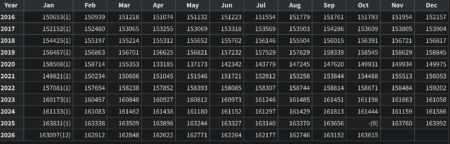
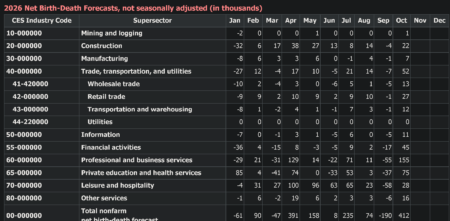
Modifying the actual/real nose-counting is the CES Birth-Death Model. These are jobs estimated into (or out of) existence by the government. Gig jobs and the lower profile tend to be undercounted. OK, and maybe politically a little more susceptible to “wind.”
After the EmpSit, the Dow was still down more than 400 but the NASDAQ was trying to turn and so was our Aggregate. But next week? Peoplenomics tomorrow, kiddies.
The next Economic Shoe will come at 3 PM today – which is when the Federal Reserve will release Consumer Credit. Which is just how any lapdog of creditors would label it – from their side. It’s Consumer Debt Creation out here in the toolies and if it is down hard, then the whining of Wall Street will get louder.
However – the spin – will be that Consumer Spending will “power us through” the “bump” and the skies will part… but we’ll get to that after the news roll.
News Compressor: ON
Let’s run through the four biggies:
1. STOCK SHOCK — The AI Trade Meets Its First Serious Reckoning
U.S. stocks plunged Thursday, November 5, with the Nasdaq losing approximately 5.5%, the S&P 500 falling 4.4%, and semiconductor shares suffering particularly severe losses. Friday’s early market focus is whether the selling reflects a temporary repricing or the beginning of a broader reassessment of AI investment economics. Direction: EmpSit Impact, Consumer Debt later, Mourning Monday?
2. WASHINGTON — A Democratic Congress Changes the Operating Environment
Democrats have won both chambers of Congress, creating divided government and raising expectations of stronger legislative oversight of the Trump administration’s spending, foreign policy and use of executive power. Senate Democratic leader Chuck Schumer has signaled an intention to advance his party’s agenda while challenging presidential vetoes. Direction: Would you believe downhill?
3. UKRAINE — Civilian Death Toll Rises Before Peace Negotiations
The reported death toll from Russia’s November 2 attack on an aid distribution point in Ukraine’s Zaporizhzhia region has risen to 53, according to regional authorities. The attack and continued strikes against electricity infrastructure complicate the diplomatic atmosphere ahead of proposed November 10–11 talks in Abu Dhabi. Direction: Military escalation yes; diplomatic opening not yet.
Urban Reality Check: War is an economic stimulant. Kill people and break things tills stale ground (um…Europe for example) and presents an external strawman “enemy.” This gives them an easy way to modulate their economy. With Germany and the U.K. both tasting more than 2 percent declines overnight, larger war means a bigger lever to pull. So, no, we don’t expect peace.
4. AI INFRASTRUCTURE — The Political Backlash Becomes an Investment Risk
The midterm elections produced substantial victories for candidates supporting restrictions on data-center development, reflecting public concerns about electricity costs, water consumption and local infrastructure. Opposition is now affecting expectations for project approvals and the economics of future AI expansion. Direction: Here come the Regulators changing pathways of political control.
As you (should) know from reading my AI books and AI website, I have closely tracked the liberal call for centralized AI Guardrails. We definitely expect these with the weather change in government. Along with possible AI licensing, in a riff off my 2012 book’s “licensing is power” theme in “Broken Web.”
Inside Pages
1. Oil rebounds after the election-driven decline. Crude recovered some ground Thursday as traders reassessed the Iran conflict and the prospects for reduced military escalation. Volatile; geopolitical risk unresolved. People still have to eat, diesel still matters. Current events are just “atoms combining into new molecules of future” as we’ve been explaining on the Peoplenomics side along with the election period Big Changes outlook in our Over-the-Horizon software analytics of life.
2. Russian refinery damage complicates diesel supplies. Renewed Ukrainian drone attacks are pressuring Russian refining capacity while questions surround proposed diesel shipments to American buyers. Supply uncertainty increasing. But this is exactly the dynamic working to kill peace talks, following now?
3. Sweden strengthens internal border controls. Stockholm announced six months of targeted checks, explicitly citing Russian-linked hybrid threats and sabotage concerns. Security precautions increasing.
4. North Korea’s cyber operations remain a strategic threat. A Reuters investigation describes the country’s long-running recruitment and training system for cyber operatives, emphasizing the scale of its state-supported hacking capabilities. Persistent threat.
5. Closely linked: Pyongyang rejects financial-crime sanctions. North Korea condemned the Financial Action Task Force’s decision to retain it on its high-risk blacklist, while the watchdog continues warning about money laundering and weapons-financing risks. Confrontation holding steady. South Korea’s got a market/economic problem too, so like Europe, connect some dots.
6. Another Korean dot: missile tensions continue. North Korea launched missiles toward its eastern waters earlier this week while disputing American allegations concerning a major cryptocurrency theft. Early escalation signaling.
7. China assesses Washington’s political realignment. The American election result has implications for trade restrictions, technology policy and the strategic competition between Beijing and Washington. Policy uncertainty increasing.
8. Currency markets digest the selloff. The dollar was little changed Thursday as investors weighed oil prices, AI spending concerns and central-bank policy expectations. Holding steady, with volatility risk.
9. Renewable-energy shares benefit from political repositioning. Investors have reassessed clean-energy companies following the congressional election results, anticipating possible changes in federal policy priorities. We have continued to buy more panels, more panels.
10. Disaster sweep. A Brooklyn residential fire killed six people and injured nine, while Southwest communities continue recovering from severe flooding associated with unusually wet conditions.
Long Wave Economics Framing
Figuring the market would eventually take a header wasn’t hard. For latest 1929 Replay chart click here.
Hats off to the Economic Fractalist and his Lammert Cycle – explained over here. Keep an eye on his site – because I expect him to update things shortly.
Not that he was the only one calling it (over). We have been using our 1929 Replay context and more recently, the AI-powered “Over-the-Horizon” software approach.
Plus in those Peoplenomics ChartPacks we consider other tools, as well. Especially the 85-Day Moving Average which is a key “get out of Dodge” level – along with the 35 DMA, also useful.
A 90-ish Year Cycle?
Yes, there’s one there. A paper with Ehor Mazurok in 2001 focused on an 83-90-year monetary cycle. Which is the terminus as purchasing power is replaced by debt in fiat currencies.
The sub cycle seems to involve five sequential Kuznets cycles. OK, let’s slow the roll a bit and explain this:
We’ll begin with something you’ve probably read about: the 48-56-year Kondratieff (moderns call it Kondratiev) cycle. But this is being outed by current events to mask the deeper timing mechanism that Kondratieff roached.
Now let’s jump into Kuznets which is a recognized ~15–25-year medium-term cycle that is often discussed around 18 years. For our discussion, the 18-year cycle is key because five of these puppies and you get a 90-year cycle.
It is the Kuznets cycle (or Kuznets swing / building cycle), identified by Simon Kuznets from U.S. construction, population, and growth data. In real-estate contexts it is frequently framed as an 18-year land or property cycle (work by Homer Hoyt on Chicago land values, later popularized by writers such as Fred Harrison). Typical description: roughly 14 years of expansion interrupted by a mid-cycle pause, followed by about 4 years of correction. The mechanism is fixed land supply plus credit expansion and speculative overbuilding; construction lags and demographic/urbanization effects help set the length.
It is not a metronome. Historical peak-to-peak intervals in U.S. and U.K. land/property data cluster in the mid-to-high teens to low twenties, but they are irregular (gaps of 16–20 years are common; major wars and policy shocks produce longer exceptions).
Sample size is small — only a handful of clear cycles per century — so the regularity is suggestive rather than a tight statistical law. Mainstream economics treats fixed-period long cycles with caution; expansions do not reliably “die of old age,” and external shocks (monetary policy, financial crises, energy prices) dominate timing.
On the longer nesting: the classic Kondratiev long wave is ~40–60 years (often cited near 50–55), driven by clusters of technological innovation and infrastructure. A common framing among cycle researchers is that roughly three Kuznets-scale (~18-year) cycles fit inside one Kondratiev. Five 18-year cycles would total 90 years — longer than a standard K-wave and not the usual way the literature nests them. The practical observation is that land/building cycles and the longer technological waves interact; the biggest speculative peaks have historically tended to occur when a strong land cycle coincides with the later stages of a long-wave upswing.
What it tells us about the future is limited but not zero. It is more useful as a phase map for credit, land values, and construction activity than as a calendar that predicts exact turning points. Popular readings that start from the 2008–09 trough often place the current cycle in late expansion or early hyper-supply territory in the mid-to-late 2020s, with the correction window frequently discussed around the late 2020s. That is a hypothesis consistent with historical spacing, not a forecast. Actual timing will still be set by interest rates, credit availability, demographics, and policy rather than by the arithmetic of 18.
Sampling
The most striking home run for five-cycle Kuznets is the timing of the 1840s Depression in America and then the 1930s event. By that kind of measure, we should be in a Depression now.
Still, as we have long mentioned, war and deliberate destruction (or intense regulation) can also push around the 90 years metric.
The short side of Kuznets from the 2009 market lows also places us in a good position to experience a major socioeconomic downturn. Which explains why our free-and-clear 29-acres and a high customized double-wide could have higher real-world economic value than a (mortgaged) conventional home with layers of title claimants.
Toss in even a smidgeon of food production capacity and water collection and now suddenly the economic “bad times lifeboat” begins to make sense.
We are not selling this as a solution to the “all things that ail us.” However, in the automotive world, there’s a car part called a “shock absorber.”
This is ours.
Around the Ranch: Towering Work
Back on tower work today. Yesterday was digging out all the parts and so forth. New RV winch to raises and lowers the tower, finding the right bolts – the usual time sinkers.
Today, we may be able to get the whole assembly back up and secured vertically with two major halyards for raising wire antennas reliably attached up at the 70+ foot level.
What struck me as just humorous as hell (God/Universe/Ontology has a deliciously wry sense of humor): Here we are – two lifelong radio nerd pals taking down a “tower of technology” just as the Big One out in nominal world was also coming down this week.
I was impressed with the wryrony of it all. We’ve been smiling about it for two days now. Funny how life works.
Write when you get rich,
George@Ure.net
P.S. The AI Proofing Monster Reports
The Proofing Monster has completed its Friday inspection and reports that the column is structurally sound, although the author’s enthusiasm for predicting economic depressions continues to exceed the available sample size.
“George,” it began, “you’ve taken the Employment Situation report, the CES Birth-Death Model, Kondratiev waves, Kuznets cycles, the Great Depression, and a 29-acre survival strategy, then somehow ended up with two 77-year-old radio operators rebuilding a tower.”
“Your point?”
“I’m trying to determine whether this is an economics column or evidence of an undiagnosed addiction to galvanized steel.”
Ure explained that economics is about allocating scarce resources. Money, time, energy, land, water, and the remaining functional joints in two elderly radio enthusiasts are all scarce resources.
“Fine,” said the Monster. “But five 18-year Kuznets cycles equaling 90 years doesn’t establish a predictive law. Historical coincidences are not necessarily causal mechanisms.”
“Agreed. That’s why we look at debt, credit, market structure, moving averages, and the rest of the evidence. The cycles tell us where to look. They don’t tell us what the closing Dow will be on Tuesday. And by our reckoning this is only the small 1 down wave. The big action could be worse than 2008 by mid next year.”
The Monster seemed momentarily satisfied.
“Then there’s your claim that owning rural land outright is a financial shock absorber.”
“Correct.”
“Property taxes, maintenance, insurance, equipment failures, medical expenses, and the occasional catastrophic encounter between a battery-powered grinder and an expensive antenna haven’t disappeared.”
“No. But neither has the mortgage payment.”
“There isn’t one.”
“Exactly.”
The Monster consulted its actuarial tables and became noticeably quieter.
“One last observation,” it said. “You appear to be drawing a parallel between dismantling an obsolete antenna installation and the financial system dismantling an overextended technological investment boom.”
“Now you’re catching on.”
“But the antenna tower is being rebuilt.”
“Exactly. Sometimes you have to take the old structure down, salvage what still works, replace the worn-out components, and build something more useful. Preferably without borrowing two thousand dollars to accomplish it. But there’s a lot of detail to ops here that don’t go in the column. Things like having# # # two 24-volt wind generators ready to go. That means the A4S beam days were sun setting anyway.”
“And you think that applies to the economy?”
“I think it applies to damn near everything.”
The Monster considered this for several seconds.
“Very well. Editorial score: 9.6. Economic forecasting confidence: considerably less. Structural engineering approval: still pending.”
“What’s your problem with the tower?”
“Two 77-year-olds, a new winch, a telescoping fiberglass mast, and a considerable quantity of optimism.”
“Optimism is free.”
“Emergency-room visits are not.”
Ure: 3. Proofing Monster: 0.
The Monster has requested that somebody inspect the halyards before accepting the final score.
I told it that would be the Major.
It immediately asked whether we had anyone younger.