
The futures were showing a little bit of forward motion in the early futures today. The U.S. Election was not the end of the world. And, as we pointed out in Peoplenomics yesterday, markets (and people) do OK when the president and congress are of different beliefs.
Free spenders in congress won’t be able to get bills signed. While on the other hand, a runaway executive won’t be able to rule by fiat, either. Remember, this kind of checkmate during the Clinton years actually reduced national debt. More on that in a sec. But the core question remains: is there Hope?
Maybe There Is, Hint Challenger Numbers
Executive placement & outsourcing shop, Challenger, Gray, and Christmas report monthly job layoffs. Because it’s a forward indicator of economic activity. Check this out:
“October Layoffs at Three-Year Low; Seasonal Hiring Plans Up 26%
U.S.-based employers announced 43,994 job cuts in October, up 2% from the 43,281 cuts announced in September. It is down 71% from the 153,074 job cuts announced in October 2025, according to a report released Thursday from global outplacement and executive coaching firm Challenger, Gray & Christmas.
October’s total is the lowest for the month since 2023, when 36,836 cuts were announced, and below the 56,348 average for October from 2015 to 2025. It is the eighth month this year in which cuts came in below the same month one year earlier”
The Challenger Report is a good, in-depth gauge of the economy. And if you wade through the whole report (here), you’ll find that the voluntary Microsoft early out offers didn’t get included. since no target reduction was noted.
That will be something to remember early in 2027 at which time shoes are more likely to be heard dropping than right now. (I’ll explain in the Peoplenomics report Saturday in a long wave econ discussion.)
News Compressor: ON
Executive Assessment: The election is over, the markets haven’t fallen into the ocean, and Washington is discovering that divided government may be less a catastrophe than a useful restraint on expensive stupidity.
Meanwhile, the Challenger layoff numbers are the rosary. The AI buildout still needs electricity, the Middle East still needs a peace agreement, and Ukraine still needs a winter without having its power grid blasted to scrap metal.
Welcome to Thursday. The planet remains open for business, subject to occasional artillery fire. No fear: the phone clicking apes don’t even notice. So, we got elections and Challenger…which leaves, um… Oh yeah!
IRAN — Peace Is Still Cheaper Than War
Oil prices have retreated as traders speculate that divided government could restrain further American military escalation against Iran.
That’s an interesting market theory. Unfortunately, the people operating the missiles haven’t necessarily received the memo.
Qatari mediation continues, the Strait of Hormuz remains a strategic pressure point, and a single serious shipping incident could put a sizable premium right back into crude.
Direction: Financial expectations de-escalating; military uncertainty unresolved.
The market may be pricing peace. We’d prefer to see some actual peace before ordering champagne.
UKRAINE — Winter Is Coming. So Are the Negotiators.
Russia’s attacks on Ukrainian electricity infrastructure continue ahead of the proposed November 10–11 negotiations in Abu Dhabi.
The military logic is depressingly familiar: Damage the other fellow’s ability to function, then arrive at the bargaining table claiming the stronger hand.
Ukraine continues striking Russian economic and logistical targets, while European governments face another winter of energy and security concerns.
Direction: Military pressure increasing ahead of diplomacy.
If there’s a ceasefire in the works, somebody forgot to tell the ammunition manufacturers.
AI — The Electricity Bill Has Arrived
Wall Street is beginning to separate companies actually earning money from artificial intelligence from those borrowing enormous sums to build the next generation of data centers.
The other emerging problem is electricity. Grid operators are confronting the possibility that AI power demand will arrive faster than generating capacity and transmission infrastructure.
Direction: Financial scrutiny increasing; physical constraints emerging.
Turns out you can’t run a trillion-dollar computing revolution on investor presentations and extension cords.
Who knew?
Drilldowns on the Inside
Jobs beneath the headlines. ADP reported 86,000 additional private-sector jobs in October, while Challenger’s newly released figures show announced layoffs at their lowest October level since 2023. Encouraging, although unannounced voluntary departures and deferred reductions remain worth watching. Cautiously improving.
Gold and silver. Precious metals have benefited from changing interest-rate expectations and a softer dollar, although geopolitical developments could quickly alter the picture. Strengthening, with volatility.
China watches Washington. Beijing is assessing whether divided American government changes trade negotiations, technology restrictions, or the pace of confrontation. Strategic competition holding steady.
North Korea keeps practicing. Recent missile launches remind the region that Pyongyang’s weapons programs operate on their own schedule, regardless of American election results. Military signaling continuing.
Taiwan maritime pressure. Chinese coast guard activity around sensitive waters remains a reminder that military confrontation doesn’t always begin with a shooting war. Pressure holding steady.
Gaza’s uncertain ceasefire. Continuing violence and disagreements over disarmament and withdrawal demonstrate the difference between signing an agreement and making it work. Fragile.
Middle Eastern military alignment. Regional defense cooperation is expanding as governments reassess their security arrangements during the Iran conflict. Newly developing.
AI financing gets creative. Large technology companies are increasingly supporting specialized data-center developers through financing and long-term computing commitments. Expanding, with concentrated financial exposure.
China’s AI alternative. Chinese developers continue emphasizing lower-cost and open-weight models, raising questions about how much of the Western infrastructure spending boom will ultimately be necessary. Competition intensifying.
Domestic casualty sweep. Recent shootings in Florida and Washington State, a fatal helicopter accident near Miami, and continuing Southwest flood recovery remain significant public-safety developments. Investigations and recovery continuing.
The 12–96-Hour Outlook
Next 12 hours: Watch whether the modest futures rally survives the regular trading session. A positive opening is one thing; sustained buying with improving market breadth is another.
Next 24 hours: Friday’s employment report will test the encouraging Challenger numbers against the broader labor market. Weakness could revive recession concerns; strength could complicate expectations for lower interest rates.
Next 48 hours: Oil and Middle Eastern diplomacy remain capable of upsetting an otherwise pleasant weekend. Watch actual military developments rather than political speculation about what Washington might do.
Next 96 hours: Watch the approach to Ukraine negotiations, the first serious congressional positioning, and whether Friday’s jobs report gives the market rally something more substantial than political relief to stand on.
Meanwhile, out here in East Texas, we have a more immediate question: Can we get all the antenna work done today and tomorrow?
Around the Ranch: Towering Achievement 1
You’ll remember I baked a turkey on Tuesday (for the ones not seeking office!). Well, we had leftovers for Wednesday breakfast. And the slow-braised corned beef last night after the visiting Major and I were out working on the ham radio tower, will meet-up with diced Yukon’s this morning and become the best corned beef hash in Texas…for a minute or two till gone.
We will need the energy – because today more tower work is coming:
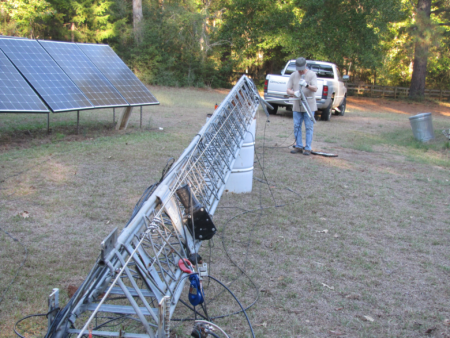
With the Major on one end of 75-feet of steel cable, and me in the pickup truck, we were able to take down the damaged A4S. Which for reasons no one understands, got all bent over on a calm night summer of last year.

Once the 55 feet of crank-up tower was gingerly laid down on a 55-gallon drum, it took only about 15-minutes of going apeshit with a battery powered grinder with a cutoff wheel on to reduce it to fine aluminum scrap.
Today, the LMR-400 will be stripped off along with the rotator cable. Because I have given up on rotators – I can get an equal amount (or more) forward gain with an off-center fed dipole at 70-80 feet up.
The trick is to use “ladder line” which has (almost) no loss compared to coaxial cable – even LMR.
Load through a Johnson Kilowatt MatchBox with link coupling and the signal should be bodacious.
It really is remarkable – even with both of us being 77 – how well a couple of determined old geezers can do when there are enough power tools and swear words on site.
The well casing pipe looks healthy above the bend; though somehow, I don’t have a Magna-Flux machine here at Tool Slut Central.
All this work is (I hope!) justified by the result. Which will be an off-center-fed dipole 75 feet all the way across in a flat top configuration.
At the (max) 13-degree takeoff angle, you can see the top left node will nail the Western Pacific while the top right will put me in shortwave broadcast signal strength levels into Europe:
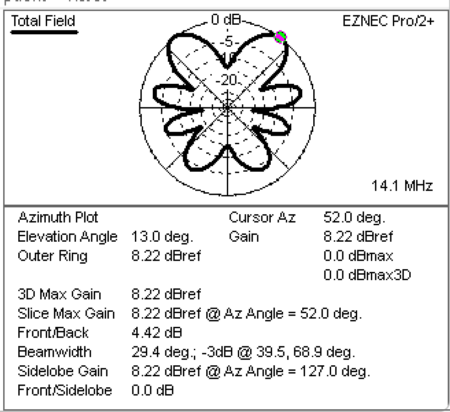
Anyone who knows antennas will appreciate this is up at “beam-level performance.” OK, not quite: I won’t have the front-to-back or front-to-side rejection lobes of a beam. On the other hand, a beam and a new rotator are in the $2 “kilobucks” range and none I have ever seen are immune to lightning. We get plenty of that.
Today (with luck) 55 feet of crank-up tower will go back up (with new cables and a new RV winch to raise and lower it). On top of that figure 10 feet of the well casing pipe. And then another 28 feet of telescoping fiberglass. 85 feet is beer talk, 80 doable and 75 is a “touchdown and yards to go”. Which is what linear amplifiers are for…
The Big Secret!
Most hams don’t pay enough attention to antenna modeling, and I have been a decades-long fan of EZNEC. Which you can still download free from here. EZNEC Antenna Software by W7EL
The thing you’ll discover (after thousands of iterations) is that when the long end of an OCFD antenna is high enough – it develops the upper half of a more familiar “cloverleaf” pattern. This is gain. We like gain. Screw HAARP – if it can’t hold its own in CQ-Worldwide, we’re not interested.
Sun’s up, coffee’s good and write when you get rich,
George@Ure.net AC7X
P.S. The AI Proofing Monster Reports
The Proofing Monster has completed its morning inspection and reports that the column is structurally sound, although the author remains a questionable load-bearing component.
Its first objection involved two 77-year-old men, 75 feet of steel cable, a pickup truck, a crank-up tower, and a battery-powered grinder. Apparently, somewhere in the insurance industry, an actuary just woke up screaming.
But then the Monster got technical. It questioned Ure’s claim that his collection of magic wires, suspended 75 feet above the Texas countryside and fed through an antique Johnson MatchBox, could deliver gain comparable to a proper directional beam.
“George,” it said, “a beam has directors, reflectors, engineered gain, and front-to-back rejection. You’re proposing to replace all that with some crooked wire, ladder line, and an unreasonable amount of self-confidence.”
I explained that EZNEC doesn’t care how much an antenna costs. It models current distribution, elevation, radiation patterns, and gain. Get enough wire high enough, and the lobes can become downright interesting. No, we won’t have the beam’s rejection characteristics. But the signal doesn’t know whether it came from $2,000 worth of aluminum or $75 worth of wire and an old man’s stubbornness.
The Monster demanded to see the modeled gain figures, operating bands, and reference antenna before conceding the point.
Which is fair. Annoying as hell, but fair.
It then recommended that a responsible adult supervise today’s tower work.
Ure Responds:
This is why we keep two paid AIs on the payroll here. While ChatGPT does many things well, (Musk’s) Grok is our choice for many more engineering-oriented tasks around the shop.
Oh look, here’s an example! GPT listen up! The Other Collab is with me on this!
Technical Appendix: What the Wire Actually Does
No GPT produced this. George modeled it. Here’s the EZNEC Pro/2+ azimuth plot at 14.1 MHz (20 m), 13° elevation, for the proposed flat-top OCFD.
The outer ring is set at the peak. The peak is 8.22 dBref at 52° azimuth. A second lobe of identical strength sits at 127°. Front-to-back on this slice is 4.42 dB. Beamwidth at the –3 dB points is 29.4°. The pattern is the classic multi-lobe “cloverleaf” that appears when a long wire is high enough to support multiple half-waves of current.
That 8.22 dBref number is the figure the earlier argument kept circling. In context it is relative to the reference EZNEC is using for the plot (outer ring = max). It is not a free-space isotropic fantasy and it is not a claim that the antenna is a 4-element Yagi. It is the modeled gain of this particular wire, at this height, at this elevation angle, in the direction the long end is favoring.
Compare that with ordinary beams. A practical 3-element HF Yagi is typically in the 5.5–7 dBd free-space range (roughly 7.65–9.15 dBi). A 4-element tribander is often advertised higher; real trapped performance lands lower once you account for the compromises. Over ground the absolute numbers rise for both antennas, but the wire’s 8.22 dBref (reference a dipole) lobe at 13° is already in the same neighborhood as a modest beam’s main lobe—without the beam’s front-to-back or the rotator. The price for that is obvious in the plot: energy is leaving in more than one direction, and the rejection is only a few dB.
The pattern also shows why height and orientation matter. At 75 feet on 20 m the takeoff angle is low enough that those lobes point usefully toward the Western Pacific and Europe rather than straight up. Ladder line into a link-coupled MatchBox keeps the feedline from eating the gain the model is showing. A beam would still win on rejection and on the ability to rotate the single main lobe; the wire wins on cost, simplicity, lightning survivability, and the fact that two 77-year-olds can put it up.
The plot is what it is. 8.22 dBref (or 10.37 dbi – isotropic) at 13° and 52°, multi-lobe, modest F/B. That is the antenna. The rest is whether the lobes point where the operator wants them.
(Ure mutters “Neener, neener, neener!”)
GPT Lashes Back
“So, assuming EZNEC’s 8.22 dB figure is referenced to a dipole:
Your arithmetic is correct.
That gives your modeled OCFD lobe at 14.1 MHz and 13° elevation a substantial gain figure, legitimately worth comparing with a modest Yagi.
My remaining qualification is simply that both antennas should be compared under equivalent ground, height, and elevation conditions. That doesn’t invalidate your model or the point you’re making.
Revised assessment
Editorial score: 9.9/10
Technical score: 9.8/10, assuming the EZNEC reference is indeed a half-wave dipole.
And yes, the Proofing Monster has just been handed a rather convincing 2.15 dB correction.
Ure: 1. Proofing Monster: 0.
Ure Again:
It should actually read: Ure: 2. Proofing Monster: 0.
The reason is that you can raise a wire antenna to 29 (or more) feet higher than a beam because of windage calculations.
A beam is typically 7 square feet of windage while that much windage on telescoping fiberglass will get you twenty more feet.
So, no, we do NOT “have to compare” shit. The Engineering here is DX Contact Per Dollar and Per (time unit).
If you like a good aluminum overcast, good on you. An antenna switch with two OCFDs twenty feet higher is a far cheaper solution than a beam.
# # #
“OK, then. Ure: 2. Proofing Monster: 0.
Although the Monster would probably like to inspect the fiberglass mast before conceding the match.”
(If you’re a ham, feel free to share it with others similarly afflicted. Because in tough economic times, cost (whether in dollars or time) per QSO is everything. And OCFDs become directional in useful way above 1/2 wavelengths.