
OK, the first thing to get out of the way is Amazon Prime Day is on today. The usual landing page for readers is here. The reason I like Prime Days is because living in the Outback of East Texas, as we do, this is a chance to save a good amount on a few major purchases we have been eyeing.
Since our (ongoing) outlook is for much higher food prices to come, the operating question is which is the best of three competing approaches for us: One is to put a mini-split air conditioning system in the 10 x 20 greenhouse. That’s where it has become too hot for my tomatoes and cuke to support flowers (hence fruit) to term. One solution therefore is simple. Mini-split and add to our already 30+ panels online to reduce the operating costs to near zero.
The second option is to buy a large outdoor raised bed system – put it on top of concrete blocks – or put a smaller version of it on the front of the house. They are marked down about 15 percent.
Third choice is to just buy more freeze-dried foods and emphasize the beef and chicken portions because I’ve been writing about the coming protein cost explosion since 2006.
Remember, I’m 8 months from 78 and Elaine just rolled over 83 on the odometer. Having said that, reader input is welcome. Because this is one of those (damn) “doesn’t come with decision support instructions” that crop up in life. They will all work – but do we look at the deteriorating long range climate or the possibility of wanting covered growing because of fallout? Then, above all, do raised beds (open bottom) produce any more on a per square food basis than a greenhouse which isn’t becoming a part-time welding rod baking cabinet?
As always, we want to be ahead of the curve which now includes thinking like Super El Nino: Famine Follows War? Turning over dirt isn’t food on the table.
News Compressor
It’s OK to be bored today. Should be a slow one. Except markets which we will get to in a sec. For now the Big Picture is what changed overnight is the economic/market decisions environment shifted from Middle East war shock toward a more complicated “ceasefire plus rate-risk” market. U.S.-Iran/Israel/Lebanon diplomacy appears active enough to pull oil lower, but the market is now treating cheaper oil as less important than a Federal Reserve that may be more hawkish and less transparent under Chair Kevin Warsh.
For households, fuel relief may be coming slower than headline oil suggests; for investors and operators, the near-term risk is a tech/AI multiple reset combined with higher borrowing-cost expectations. Confidence: medium-high on the market/oil/Fed vector; medium on the diplomatic durability.
So, We Turn To Markets
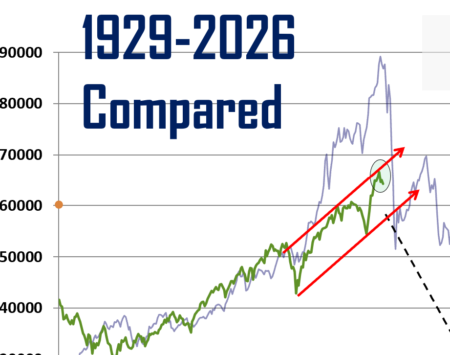 “Truth of the Stock Tape” is what the late Martin Zweig called it.
As you can see following the red trace of our Aggregate Index compared to the Dow leading into the 1929 crash, we are again at a critical inflection point today.
The bottom line is we had an initial decline from the most recent “attempted kiss” of the upper trend line. Then we broke lower for an Elliott wave (1) down. We rallied more than 50 percent of that decline. And now we are down to the decision point.
We will speculate more in Peoplenomics ChartPack tomorrow (usually runs 30 pages or so) but it is possible this is a 3 down starting of what could turn into a nightmare. But then comes the problem all Elliott fans understand. The real problem isn’t whether this is a Wave 3 down, it’s whether the wave 3 is here, at all.
That’s because under Elliott if Wave 2 is simple (short, regular) which it seems to be (so far), then the coming (*eventual) Wave 4 ought to be irregular – so when we get to 4 you might see a lot of sideways action. If we go up from here, the small 1-2-3 may have all been a fake-out. Which makes it a questionable stew pot to throw money in.
News Outlooks May Guide – a Bit
As you’d expect, we model “two flavors” of news around here. One being the traditional look-ahead short-term:
Next 12 hours — U.S. market open will test whether the tech selloff is contained or turns into broader de-risking. Nasdaq futures were reported down more than 2% with AI buildout costs and rate-hike expectations weighing on mega-cap tech. What could change the outcome: a calmer bond market, oil stabilization, or fresh Fed clarification. Confidence: 75.
12–24 hours — Middle East ceasefire implementation and Lebanon-Israel talks in Washington are the main geopolitical watch. Reuters says new Lebanon-Israel talks begin under the shadow of a U.S.-Iran memorandum that includes ceasefire language across fronts. What could change the outcome: Hezbollah rejection, Israeli withdrawal terms, IAEA access terms, or a Strait of Hormuz incident. Confidence: 65.
24–48 hours — Severe weather and flash-flood risk remains live across parts of the U.S. NWS flags severe thunderstorms and excessive rainfall today, with flash-flood potential extending from southern New Mexico toward the Gulf Coast into Wednesday. What could change the outcome: stalled storms over saturated ground. Confidence: 80.
24–48 hours — BEA has major releases scheduled June 25 at 8:30 AM ET, including Q1 GDP third estimate, corporate profits, state GDP, state personal income, and PCE price index next release. What could change the outcome: hotter PCE or weaker profits would feed the Fed/market story. Confidence: 85.
48–96 hours — Supreme Court term-end rulings remain a domestic policy wildcard. Reuters lists pending cases involving voting rules, presidential power, tariffs, immigration, campaign finance, and agency power with rulings expected by end of June. What could change the outcome: any ruling touching tariffs, voting, or executive power. Confidence: 70.
48–96 hours — Atlantic tropics are quiet for now, but NHC tropical-wave discussions still matter as the Gulf season ramps. No immediate cyclone signal was found in the accessible NHC scan. What could change the outcome: convection organizing with falling pressures in the Caribbean or Gulf. Confidence: 75.
We don’t know many people who would volunteer to go into that kind of casino, unless there was some big potential upside (like a “three bagger” or better.
“Rustling News Leaves”
This is much harder than the Mainstream Economic outlooks (now sans Greenspan, of course). This is where people go monk-like for an hour looking for any “signals down in the financial news noise floor” to see if Future is passing out “hint cards” there. Think of these as “news globs” looking for believers to follow their scent.
Signal: Fed communication opacity may become a volatility driver. If Warsh reduces forward guidance, markets may overreact to every governor speech and data print. Confirmation: rising 2-year yields plus wider intraday swings after routine data. Confidence: 72. Could just be normal market “pre-decline scapegoating.”
Signal: Ebola in DRC/Uganda remains low U.S. risk but operationally important. Confirmation: if there is spread into major cities, exported cases, or CDC travel advisory changes. Confidence: 68.
Signal: Actively exploited enterprise vulnerabilities are clustering around edge/security/logging platforms. Confirmation: CISA KEV additions with 3–7 day patch deadlines and ransomware references. Confidence: 80.
Signal: Taiwan military drills for the next five days and Chinese carrier activity are not a crisis by themselves, but the tempo is higher. Confirmation: live-fire zones going hot, air-defense alerts, U.S. arms-sale movement, or shipping advisories. Confidence: 66. But China will get Taiwan (in our modeling), leaving only at what cost in dollars and bloodshed.
Signal: Forced-labor tariff proposals could quietly alter small-business import economics. Confirmation: final USTR rule, Customs enforcement guidance, or distributor price notices. Confidence: 60.
Expected Noise Spikes
Several items jumped out of data runs this morning – and they could herald more to come:
AI Bubble – What changed: Reuters reports Nasdaq futures fell as AI infrastructure spending and rate outlook hit tech, while SpaceX’s post-IPO volatility and bond-market use are drawing attention. Change vector: Escalating. Average investors with index exposure are now exposed to whether AI capex produces cash flow fast enough.
Personal response: Watch debt issuance, cash flow, and supplier/customer split: chip and memory suppliers may trade differently than companies funding giant AI builds.
Ukraine War Tactics Watch ongoing. What changed: ISW says Ukrainian forces are conducting strikes aimed at denying Russia logistics and fuel transport across the Kerch Strait; Kyiv Independent reported overnight drone activity in occupied territory and Russia. Change vector: Escalating interdiction. Energy, Black Sea shipping, and insurance risk can move even when front lines look static. HUMINT keeps worrying about nuke plants and regional power issues up into the Baltics.
Personal response: Watch confirmed hits on bridges, refineries, ports, and rail nodes rather than claims alone. Prime Day radiation monitor shopping in order? Personal judgment call, of course.
Longer Term, the Real Battles are in Education. That’s where thinking-styles and behavioral norms have been assaulted: Brave Books claims public libraries scrub faith from kids’ history. There’s good reason to avoid a rush to book-burn anything that doesn’t meet revisionist values screening. Just look at recent events in (once) Great Britain and project failure modes from that.
Around the Ranch: Timenamics Tomorrow
Finishing touches on my latest book are going on this morning and then (this is something like book #19) will be finished. Like many others, this will end up on a Peoplenomics bookshelf. Which leaves only one question: “What is Timenamics: Time as the Hidden Currency really about?”
Funny you should ask: Timenamics is my attempt to put a ruler on the one thing none of us can buy more of: lived time.
Money is not the prime currency of life; money is frozen time, stored effort, delayed action, and sometimes a very expensive illusion. The book walks through True Time Cost, decision friction, attention theft, digital distraction, AI as a time amplifier in addition to being a Mind Amplifier, and the hidden ways modern life converts our days into someone else’s yield.
The practical value is that once you start measuring life in time instead of dollars, a lot of nonsense falls apart. Jobs, subscriptions, errands, habits, meetings, news, clutter, gadgets, even “free” services can be judged by a cleaner question: does this return more life (time) than it consumes? That is where Timenamics moves from theory into operating doctrine: recover attention, compress decisions, automate the low-value loops, and spend your remaining hours where they compound.
For Peoplenomics readers, the whole book goes up tomorrow as a subscriber value-add because this is exactly the kind of work PN is built for: economics you can actually use at the kitchen table, in the shop, in the portfolio, and inside your own head. Markets matter, but time is the larger market we all trade in every day. Timenamics is a field manual for getting more of your life back before the world figures out how to invoice you for the rest of it.
If you aren’t a Peoplenomics subscriber, here’s how to become one.
On that note, more coffee and back to proofing. The 80 proof and higher will have to wait…
Write when you get rich,
George@ure.net\
Well, your one-inch “deluge” has finally arrived, and brought five of its brothers with it. We have 6.5″ of rain since 0230, with more likely today. Not complaining!
After last night’s storms, we finished the day with 7.94″, bringing us to 13.1″ for June. Still 10″ behind this time last year.
I would do BOTH, but only buy freeze dried which has a very long shelf life, short term healthy fresh food is a must. hence the grow your own fresh veggies, also consider the freeze dry home machine for making your own stuff.
That is my 2 cents for the day!
Dude G,
Come on man, everyone knows SEXUAL INTERCOURSE is the primary currency of Life. Its how many Booty Calls you make in Ure Lifetime that matters in the final accounting.
Were you out there celebrating Life whenever possible ?
Sowing the seeds of Life G, you dirty Dog..WOOF! -https://youtu.be/I99byzYZbBI?
St Peter couldnt give 2 shitz bout Virtue, Doing Unto Others, or any of the other do good bullshit, NERP – its how times have youse celebrated the opposite Sex. Bootylicious-https://youtu.be/IyYnnUcgeMc?
Thats right Homegamers, their counting “Whoopies” in Heaven.
So if Ure in a look back on Lifes position, and are coming up a lil short in Ure count..of notches on Ure bed post, I whole heartedly suggest a ‘catchup” trip to Vegas..Roadtrip!
-Fear&Loathing trailer -https://youtu.be/CiTllYeJc48?
re: “As You Like It”, the Bard, 1599
feat: ‘All the world’s a stage’
The hold of Oxford over #10 Downing Street may be giving way to Cambridge if Andy Burnham becomes the next UK PM. It would appear that he met his future Dutch spouse at the university town’s Fitzwilliam College situated on Storey’s Way named after a 17th century bookseller.
The college is named for the 7th Viscount Fitzwilliam, an Anglo-Irish landowner and art collector whose merchant Dutch maternal grandfather made a fortune while a 30 year director in the East India Company. Apparently he also advanced greenhouse cultivation of lemons and pineapples in England. The 7th Viscount’s land holdings eventually passed to his cousin’s son, the 11th Earl of Pembroke based at Wilton House which had been awarded to the family by King Henry VIII.
Wilton House is said to have provided the setting for a first staging of Shakespeare’s “As You Like It”. I don’t know if mystery novelist Agatha Christie named her daughter after the play’s heroine, Rosalind.
Three and a half centuries following the Shakespearean sojourn at Wilton House, a film director and 15th Earl of Pembroke opened his family home for production of the 1976 movie “(The Awakening of…) Emily” starring Koo Stark. Then 20 year old Miss Stark from New York played a 17 year old in England surrounded by middle-aged seducers. As chance would have it half a dozen years later, Miss Stark became the first serious girlfriend of the now former duke of york until the Queen allegedly intervened.
Today in a strange twist, a front page story in the “Daily Mail” shows a luxury Range Rover of the type favored by vip’s and royals stranded in seaside sands until it ends up being covered by incoming tide waters. The publicly published vehicle license plate reflects a Yorkshire registry.
3 down? as the obummer scandal is coming, screen share emai drafts, never sent, reminder to delete after reading,, tick tock
https://x.com/THEDuaneCates/status/2069391972607943098
https://x.com/THEDuaneCates/status/2069391972607943098/photo/1
https://x.com/THEDuaneCates/status/2069391972607943098/photo/2
blood in the street? I see nasdaq futures way down, along with dow s&p so is silver,,, crude seems stable for the moment $73-74
we got rain,, zippitty do dah
The outdoor raised beds are an excellent idea and I am sure you have perused the Vego Garden store on Amazon. A couple years ago we put in two nine footers along a corner of the patio for basic everyday herbs and some greens and they have been excellent. Diana isn’t very fond of the insect covers I put on them to keep the freeloaders out though.
I found their Food Cube self irrigated units interesting so I picked up 2 and set them up at the far end of the hoopty where we have melons and cucumbers. At $350 a pop I thought them a bit pricey at first but since I installed them last early spring they have been very successful growing asian greens and onions. I’ll be adding more units this Prime Day.
Stay safe 73
Oh no..prime days… and the compressor I want is at bargain basement orice..
what to do what to do..I already have one to fill rescue oxygen tanks this is a nice compact version..
https://www.amazon.com/GOYOJO-Compressor-Paintball-Shut-Off-Oil-Free/dp/B0F3HYZSQ7
I did get some Koji ..though tried to mail some I made but couldnt..they just wouldn’t let me..dam postal service..
Short the Mkt.
Short the TBT
Long PM’s, Longer crypto, Looong Copper/Palladium, Long Biotech, Going Long Oil, as prices be slip sliding away.
* 1st article of ceasefire agreement – No Threats.
Orange moron broke that in like a Minute.
Iran told the lizards’ butt boy, NO Negotiations while under THREATs from the orange moron, stood up and walked out, cause their the losers, right?
They walked, Smackastan rubbed their noses in some good ole American Dog shit, and came crawling back, butt they too were later rebuffed.
Yerp – this is what Winning a WAR looks like, right raymundo ?
More like WHINING a war – which is what the orange gollum of stupidity does best, while waving his tini, tiny hands around in the air.
The President of the United States, aka the orange Yenta. What do you call a basement full of orange tRUMPS ?
A Whine Cellar.
tbs (whatever)
uhm, they, the Persians walked out? nope. the pablum media did run with that but … they were in the room past mid night homey. so they walked out but stayed. a neat trick
keep conjuring though. it took me forever to understand the play against his Orangeness. A : people peeing in cheerios don’t know how to handle all the winning.
but, eventually the negative nancies will be right
hope it’s after our kids come home
Go USA
~ E ~
(” Third choice is to just buy more freeze-dried foods and emphasize the beef and chicken portions because I’ve been writing about the coming protein cost explosion since 2006.”)
ok..the price of freeze dried anything is beyond affordability by most.. I decided I would do my own.. so I got two of these.. its a two for.. one home made meals.. the second..you have wet food ..canned that’s reaching expiration date.. Each tray holds one caned vegetable or soup etc..
https://www.amazon.com/Professional-Stainless-Procedure-Thickening-Instrument/dp/B07R1H4NPT/ref=sr_1_1?
https://harvestright.com/?
the other thing for s retort cannot ng..like MRE’s.. retort canning is the best..
Thin is an awesome guy and has all the equipment necessary..
https://youtu.be/lG_TrqcyYBc?si=qORaQo_M2KkLIA2y
this unit also works very well with retort bags..
https://www.amazon.com/MAGIC-SEAL-Commercial-Machine-Compatible/dp/B0CJC4TY1J/ref=sr_1_2?
and zon days has it at a great price right now..
https://www.amazon.com/Retort-Pouches-Bags-Pressure-Canning/dp/B07MBBTN6P/ref=sr_1_1?
I have pint and quart bags some gallon..you get food you already enjoy.. I have a ten pound bag of spuds that need to be processed .. I will chunk some make some fries then blanch them for four minutes then dehydrate them.. I usually freeze dry them..then put some in a container fill it with water set it in the fridge and there you go..the next morning fresh spuds to fry or use in soups..
The only problem I’ve had with above ground planting is some plants like cool roots and tend to wilt if the container/bed is in full sun on a hot day. White paint helps, as well as shading, but as the the ambient temps approach 100° all bets are off.
Now the two I bought I used their lay away plan..it worked out great..he I have on a cart..next to it I have a dry steak ager..
although using mini like the high end restaurants do works a lot faster.. upper end restaurants that don’t get much of a request for three hundred dollar rib eye..uses mojo ..that way they can put a few in overnight in the fridge reducing the waste..
everyone deserves the chance to experience what o my extremely wealthy have the opportunity to experience…
Koji not mini..lol
https://youtu.be/M_JwYJqQU3U?si=VjFgoVEUhQqSgyDi
I use the liquid..I make it up..myself its cheaper..
https://youtu.be/UYV6-yfCalM?si=u19fzx0quDgnVtw7
1 cup fresh koji rice
1 cup water
? cup salt
Blend everything until smooth.
Ferment at room temp 8–12 hours (optional but better).
Refrigerate — lasts months.
This becomes a thick, salty, enzyme?rich paste/liquid.
This is the chef?preferred method.
Pat meat dry.
Brush on a thin, translucent layer of koji shio.
Refrigerate uncovered on a rack for:
12–24 hours for steaks
24–48 hours for roasts
Rinse or scrape off.
Dry the surface well.
Cook and season normally.
Tenderizes like 30–45 days of dry aging
Adds nutty, sweet, umami depth
Creates a killer crust
This is the wet equivalent of your powdered koji rub.
OK..wet age…
Full Koji Brine (for juiciness + tenderness)
This is more like a wet cure…..
Mix:
1 cup koji shio
2 cups water
Submerge meat.
Refrigerate:
4–6 hours for steaks
12–24 hours for roasts
1/3 cup of salt…dam auto correct
(“What do YOU think he’ll do…?”)
Exactly… @Ray…Soon Musk has always been one for doing the things seen as impossible and his innovations to benefit mankind..the numbers in a jar only gives him opportunity to do that..I believe he could care less as long as numbers in a jar are seen as wealth..he will use them to benefit others and mankind…in the end you have nothing….the numbers in a jar only represent opportunity to benefit others along his lifes path..
He has said this over and over and over..
Looks like GM is trying to steal ideas form the Chicoms.
“GM lays off more than 1,000 workers, adds 50 robots at flagship Detroit plant: ‘We’re disgusted’”
We’re still disgusted Little Bush bailed them out, unless you’re in the blame the black guy bailout camp, but still. Once BYD becomes available to the American markets I’ll buy one for spite.
Raised outdoor beds will become deer food. Are you up to skinning deer for meat protein?? I’ve been packing away freeze-dried proteins. The yard grows enough low-maintenance fruits and veggies.
wilson culverts in elkart sells various diameters of 10ga ends on the cheap.
Elkhart, IN?
https://elkhartbrass.com/
Elkhart, Texas…
Wilson Culverts, Inc.
699 FM1817
?Elkhart, TX 75839
800-234-0084| Fax: 903-764-2740
wilsonculverts@wilsonculverts.com
Yo G-Pops,
What we have here is Solutions. You do like Solutions, no? Because, well we gotz problems on board, with more headed our way. So some fine peeps went out looking to see how others are getting along. The first one looks at what uncle cliff called Self Organizing Collectives..dont look now – https://substack.com/redirect/c6ac1e71-d03e-4929-9199-b008f44cb355?
Wait, whats that ? youse want bigger crops in a shorter amount of time ? Sure, right after you take this new Vax for an unheard of Virus, that has replaced the seasonal FLU. Never to be seen again, the FLU that is. Just Disappeared, as if by majic. Man I wonder what happened to good ole Common Sense, instead of this constant stream of BOLD FACED LYING.
Here is some straight dope on modern GUO. -https://substack.com/redirect/0f041028-99ce-4613-a84f-f7a6a2a7429c?
G, missing from your AI sewer pipe:
‘Taiwan military drills for the next five days’
https://www.bbc.com/news/articles/c232z4yk437o
‘The US is pausing a $14bn (£10.4bn) arms sale to Taiwan to ensure it has enough weapons for the Iran war, acting Navy secretary Hung Cao has said.’
https://www.pgpf.org/article/chart-pack-defense-spending/
Duh Homer, U.S, has biggest military budget in the world
‘the United States spends more on defense than the next 9 countries combined’
yet we can’t spare Taiwan a few missiles (at least that makes China happy)…Iran has U.S. cornered like a rat without sufficient firepower!
Tucker Carlson dumps GOP because of Israel:
https://apnews.com/article/tucker-carlson-republican-party-podcast-support-2da45ec63516d0cc9f0d2ea1891839d2
‘He’s repeatedly criticized the war as being at the behest of Israel at the expense of Americans, and attacked the party for failing to represent its own voters, citizens and nation.’
we have plenty of new munitions c but … have shot lots of NOS aging weapons. I’m more concerned about lack of large power handling gear (everything from pole transformers to the big kit). most of that went to Ukraine which, is understandable but? E
Don’t bother. You can’t argue with a troll to whom “truth” is a foreign concept…
Do the math…
https://www.fpri.org/article/2026/05/scaling-patriot-production-the-industrial-base-crisis-explained/
‘On April 10, after coalition forces had fired at least 1,700 Patriots in just five weeks, the Pentagon announced a $4.76 billion contract to accelerate production. While a seemingly forceful response, the move only highlighted the core problem. At the current build rate of 600 missiles per year, it would take three years to replace what was used in a little over a month. Replenishment runs on an industrial clock, and that clock is measured in years, not days.’
picker so relaxed on fishin he is still tastin mississipi herbs . can kicker top shelf