
There are two kinds of shops: the shop you own, and the shop you can actually use.
Come to think of it, there may be three: the shop you own, the shop you can actually use, and the shop you would have if the PowerBall people ever made a clerical error in your favor.
Point is, they are not the same shop.
Most of us who have collected tools for a lifetime already know the problem. We have enough drills, saws, clamps, meters, chargers, screws, glues, fasteners, adapters, bits, blades, washers, widgets, jigs, scraps, parts bins, and “I might need that someday” treasures to open a small hardware annex. Yet when a five-minute repair shows up, the first forty minutes can vanish into the fog.
Where is the 1/4-inch nut driver? Where did the good #00 Phillips bit go? Why is the battery dead? Why are there three tape measures in the shop and not one on the bench where work actually happens?
Real answer: because the good one went back to the “measurement and layout shelf” in a cleaning frenzy some months back. Which proves that over-organization can be just as dangerous as neglect, only with better labels.
And why is the one tube of silicone you need either missing, fossilized, or hiding under a box marked “urgent radio parts” from 2009?
Am I the only one who goes through the glues and mastic department looking for fossils?
Time matters when things break. This is not strictly a tool problem. Maybe it is Mercury Retrograde. Maybe it is rural entropy. Maybe it is just Saturday doing what Saturday does when it sees a man trying to get ahead of the heat.
But this much I assure you: it is mostly a time problem.
Especially when the work window is short. Saturday was supposed to be simple. Get the mowing handled early, clean up the yard enough to silence the guilt circuit, and then settle into a guilt-free ham radio day. This being Field Day weekend, you know the deal: chores first, radio after. Civilization in its finest form.
That was the plan.
Until I was mowing the gun range and saw a piece of coax hanging down from the sky, ending about two feet above the ground.
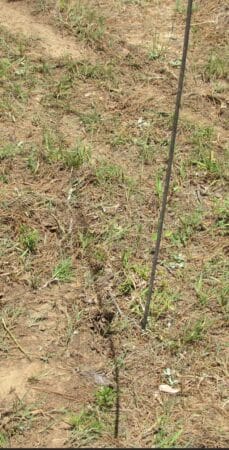
Now, when a man sees coax dangling from heaven on Field Day weekend, he has a duty to investigate. Being a studious biblical scholar, after a fashion, I quickly checked BibleGateway.com to see whether there is a Psalm, proverb, or lesser-known Book of Antennas in which God leaves RG-58 hanging down from the clouds to ensure all-band dominance of the HF spectrum.
There is not.
Well, shit.
My other suspect was more earthly. Until Saturday morning, I had been a huge fan of the K4TR double-size W5GI Mystery Antenna. It had been attached to an 80-foot pine by way of drone magic, paracord, optimism, and several seasons of East Texas weather. Apparently, after three or four years, the arrangement had decided to file for retirement.
 You have to look closely in the picture, just off vertical on the right side, to see it. But the point is the favorite antenna was down. Which meant getting the drone up, lifting a new backhaul line, and hauling more thousand-pound paracord into place.
On Field Day weekend. Spit fire and save matches.
So I went back to mowing the gun range, because denial is sometimes the most efficient scheduling tool.
That is when the rotary cutter issued forth with a familiar “clunk.” Brush hog, to rural folks. Locked.
This one required a little deft driving but there it was:
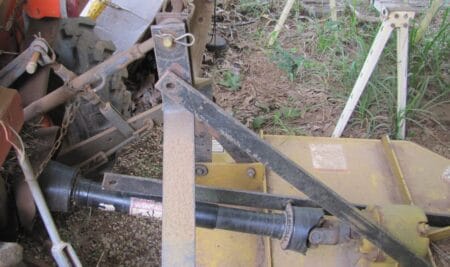
Now we had a morning.
There is no such thing as a ten-minute antenna problem. There are also not many ten-minute three-point cutter problems, especially when a missing top bolt or an opinionated rock has entered negotiations. The good news was that the flat tire I inflicted on the riding mower might actually be a ten-minute problem.
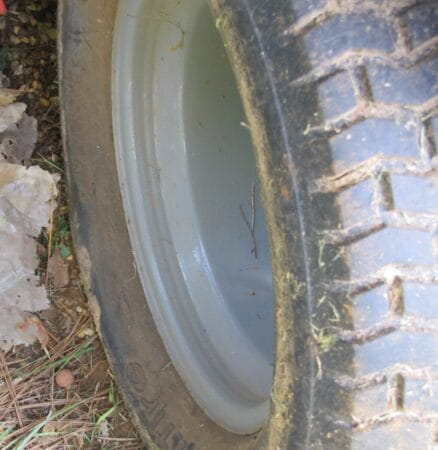 Maybe. I should be able to lift the back end with the chain hoist, pop the tire off, and then prevail on my neighbor, who runs a tire shop, to take it in and fix it this week. There may be silver involved. Rural economics still has a pleasing medieval layer when done right.
And here is where the shop lesson begins, though not in the way the organization books would have it.
The point is not to have a perfect shop. Perfect shops are for people who do not appear to be doing very much in them. The point is to have a shop that lets you begin.
Not finish. Begin. Can I get to the drone gear without a half-hour treasure hunt? I can see it on the shelf from here – so less than 20 seconds, tops.
Can I get to the chain hoist? One minute to rig – easy.
Can I find the air chuck? Can I lift the mower? Can I get the meter, the coax adapters, the right wrench, the tire tools, or the tractor pin before the morning becomes one long exercise in muttering or the East Texas Daily Sweat Lodge Encounter? That is the real shop test. (Well, and the power bill that comes with cooling.)
A useful shop is not a room full of tools. It is a place where the next move is obvious.
That sounds simple until the day the antenna falls out of the sky, the brush hog locks up on a rock, the mower tire goes soft, and the sun is already making threats and smoldering.
A lot of people think the secret to a better shop is owning better tools. Sometimes, sure. A good saw beats a bad saw. A good meter beats guessing. A chain hoist can make a job possible that would otherwise be a chiropractor’s boat payment.
But most of the time, the expensive tool is not the missing piece. The missing piece is access. The time loss is not always in doing the work. It is in finding the thing that lets the work start.
Finding the Battery
Shove ’em all into low income housing…
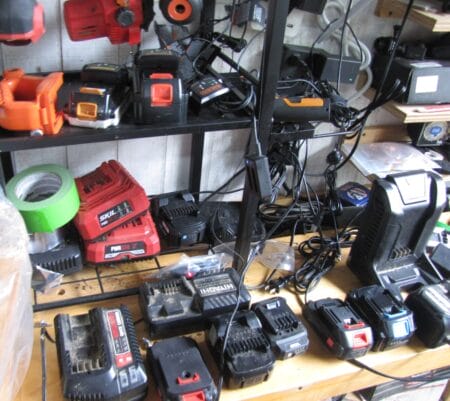
Finding the charger. (Bottom left in my battery slum.) And it bears repeating: My power tool stack is always on 10-second call.
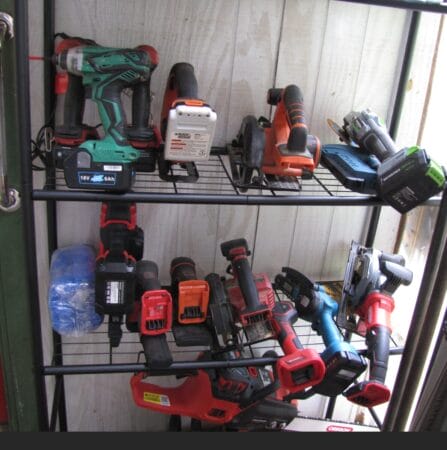
Finding the fastener. Finding the pencil. Finding the work surface. Finding the small part you set down eight seconds ago. Finding the adapter that converts “almost fits” into “done.” Finding the one tool you know you own because you bought it twice.
The work may be ten minutes. The finding may be forty.
This is why the “Ten-Minute Shop” idea matters. Not because every job takes ten minutes. That would be fantasy, cable television, or a man lying to himself in new work gloves. The Ten-Minute Shop is the shop where most common jobs can be started in ten minutes. Not because you solved the whole problem. Because you stopped paying the tax of delay. You see the problem, know where the tools are, and now it’s down to delay of game between your ears.
That is enough, most times. If you can start quickly, momentum has a chance. If you cannot start, the whole thing becomes a fog bank.
This does not require reorganizing the whole shop. In fact, reorganizing the whole shop is how many shops become worse. You tear everything apart, make twenty piles, run out of daylight, and spend the next three months living inside the explosion. The better approach is more modest. Beat down the paths you actually walk.
In my case, there are certain paths that matter because they come up over and over. Electrical and radio. Cabling and fabbing. Mower and tractor. Greenhouse. House repairs. Solar and battery foolery. Each of those has its own little gravity well.
This is why I do not worry much about owning duplicate screwdrivers. A screwdriver at the electronics bench, a screwdriver with the mower tools, and a screwdriver in the house kit is not waste. It is time compression. The enemy is not duplicate tools. The enemy is duplicate searching. Hardware stores organize by species: wrenches here, drill bits there, glues over there, fasteners down the aisle. That makes sense for selling. It does not always make sense for doing.
Doing is Job-Based
A radio job wants solder, wick, flux, small cutters, magnification, DVM, coax adapters, clip leads, dummy load, and a notebook. A mower job wants sockets, oil, filters, plug wrench, funnels, rags, grease gun, tire gauge, and air. A greenhouse job wants timers, fittings, tubing, labels, spare emitters, and enough tape to suggest adult supervision may be absent.
The shop gets faster when the tools live near the jobs they serve. That is not organization in the magazine sense. That is memory stored in wood, hooks, shelves, bins, and scars.
Same with the bench. I have heard rumors of people who keep a neat bench all day. I do not understand these people, but I respect the legend they’re pimping..
A bench is supposed to have a clear place where the problem lands. The thing needing repair. The meter. The fastener. The mysterious part. The cup of coffee that is absolutely not supposed to be sitting near the electronics but somehow is.
I have put down blue tape and made “keep clear” zones and given myself stern management lectures. They work for a while, then I violate my own treaty. Still, the principle is sound. A clear bench is not neatness. It is stored momentum.
Same with the dumb stuff: pencils, tape measures, safety glasses, rags, flashlights, driver bits, chuck keys, air chucks, zip ties, Sharpies. The humble things stop more jobs than the exotic things. No man wants to admit he lost twenty minutes because he could not find a pencil, but the shop gods see all.
And batteries. Cordless tools are wonderful until the batteries become a shell game. Charged should mean charged. Dead should mean dead. Questionable batteries should be tested, not emotionally negotiated with. There is no virtue in keeping a battery that ruins work sessions.
The project problem is different.
The clean-shop people will tell you to put unfinished projects in a tray or tote. They are not wrong, but they are only half right. The better answer is to finish when you can. Sign in to the job. Stay with it until the thing is done, done, and done.
Firefighters do not go back to the firehouse while the fire is still burning. Good software people know the deliverable is what counts. My friend Sim built a fine printed-circuit assembly business up in the silicon forest by working until the work was done, sleeping on the shop floor when required, and then getting back to it. That kind of stubbornness is how some people end up owning the building. Now many buildings, in fact…
But life interrupts. Glue dries. Paint cures. Parts are ordered. Weather rolls in. The phone rings. Someone needs help. The universe notices you are making progress and sends a tractor problem.
So yes, have a project corral. A tray, shelf, tote, or assigned footprint where the unfinished job keeps its parts, screws, notes, and special tools. Not as permission to quit, but as a way to restart without rediscovering your own thinking.
Before walking away, write the next move if you have to. “Test power supply under load.” “Buy 1/2-inch hose barb and two clamps.” “Check continuity between center pin and shield.” (Seriously this is a 10-second deal and you’d never write down hopeless minutiae like this. Stop at BIG stopping points: “Resume when Lowe’s delivery drops off 200 more pavers…”)
That is all the Ten-Minute Shop really is. A trail back into the work.
Saturday’s trail was pretty clear. Drone gear for the antenna. Chain hoist for the mower. Air hose just long enough to reach the right place. Tire tools close enough. Radio test gear where radio test gear belongs. The big green mechanic’s roll-around for the heavy stuff. Enough of the repeated paths beaten down that the day did not have to become a full archaeological dig.
Was the shop perfect? Don’t be ridiculous. But I could begin. And beginning is where most repairs are won.
The real payoff is not neatness. The payoff is Total Time on Task. I just finished Timenamics: The Hidden Currency, and one of the useful ideas in it is that people waste enormous pieces of life in small frictions. Searching. Restarting. Re-deciding. Relearning what they were doing yesterday.
The shop is where that theory either becomes useful or gets laughed out of the building. A good shop does not make work disappear. It makes work reachable. It shortens the distance between “well, hell” and “hand me the wrench.”
So if you want the practical takeaway, there it is: do not clean the whole shop. Do not buy your way out. Do not build a shrine to pegboard perfection. Pick one recurring problem and make it easier to start. Star of today’s problems here? The Chain Hoist on a 2 by 12 on 12 foot centers. Kept oiled, ready to rock and under a minute to rig. I believe I could lift Dallas with it. The chain hoist has paid for itself in time-savings many times over.
Mower tire. Antenna repair. House electrical. Greenhouse plumbing. Tractor nonsense. Radio bench work. Whatever actually happens around your place. Put the first tools where the first move happens. Look for the “secret lever” which at my age is “get the problem to a reasonable working height first…”
That alone will improve your shop more than most grand reorganization schemes. And if, on Field Day weekend, a piece of coax comes dangling down from the heavens like a divine hint that your antenna system has joined the choir invisible, you will at least know where the meter is.
Write when you get rich,
Damn. Just watched V for Vendetta again for the fourth time over the years. Prophecy. Depth. Total mind f&^%$. Twenty years ago. Thirteen years before the Plandemic. Visionary. Revolutionary.
A prelude to The Citizen Vigilante.
And now I can even post something on the day after today.
There is a vibe that soon the people may have had enough. What happens I have no feeling for or ideation.
Change is chaotic. Pray for the goodness you want and hope it is a common thought.
Us. Floating. Two days dry for Bastille Day, then off to see the wizard… the one from Oz.
May we all be protected.
Stiks
Stiks and George
The Best, least cartoonish Vigilante movie was made 52 years ago in 1974,
It is the original Death Wish movie with Charles Bronson. DW II was lesser, and the next 3 became action movie cartoons, but the first shows what a single guy in a big city could do.
It is on several movie sites like Tubi and Pluto and is on You Tube for free but with REALLY obnoxious adds.
The most important takeaway is the movie foretold what happened to Bernard Goetz a few years later. Goetz was not convicted of the shootings but was of having an unlicensed gun. Jury Nullification.
In Death Wish the police said the crime rate dropped in half, especially when other citizens got in the spirit (See the old lady with her Hat Pin.).
They did not want to catch the vigilante, but just make him “go away.”
The trouble is, the places It could happen are Red states where everyone is armed, and such is already commonplace. Bad guys invading homes and mugging on the street get shot. Most of our shootings are gangs shooting gangs. (Eleven of the 41 deaths and a quarter shootings in the last 5 years that involved Glock Switches occured in Alabama towns and cities.) Where people need it they are all disarmed.
If maybe 2 % of the people out there in Blue Cities were armed, the goons would take pause
And out of total respect for GU’s exquisite meanderings I can offer from offshore experiences with minimal everything’s regarding repairs to the survival pod while far from land and sources, that the one true tool is the one carried between the ears.
No barn full, shelf full, table full, will be available under those circumstances of isolation so the one you depend on from moment to moment to put one foot in front of the other, a hand on the problem, an eyeball to judge, is really all we have.
One can feel ready to manage any problem, and still be left wishing, ” If only I had….????”
Better have some seizing wire and a bit of JB Weld.
Aloha
Stiks
Red Green on tools.
This 2 minute video almost as funny as your column this morning.
https://youtu.be/Pwj1QPZuuwE?si=cK44L13hLUuC3hci
!
lol lol lol..I loved that show..alwaysvremember…
https://youtu.be/dI4sIgcZ22o?si=D3juWLeNn96uADTE
Lol lol that’s what I have problems with.. the son in law is camping at the but to get my tools..he hints about it a lot.. you could keep them in my garage lol lol..every once in a while I have to go steal them back when he’s not home..z couple years ago he had a real thing about my lawn chairs.. I had company and not a chair in sight..so the smart ass in me decided he wants lawn chairs..I give him lawn chairs…lol… put about fifty in his garage.. the daughters birthday was last week .. he dragged out thirty chairs and someone commented.. wow you had enough chairs lol lol.the daughter didn’t know what to say so she said yes we probably blocked them up a while ago.. so..the wife and I went out to sit on the verandah for morning coffed.. no chairs.. time to fill him up again..ill wait till they are on clearance then pick up another fifty chairs lol lol..
my MI I me is a tool slut like his grandpa.. now when dad goes to confiscate his tools he rides his dad till he returns it..funny thing is..he has a professional career and makes considerable more than the old man..like everyone..each person has their little nitch..his is hunting..so he gets gear to water ski or boating hunting etc..another has tech so he has computers etc..I had wood working until I became blind.. I gave him all my big tools but it wasn’t enough..funny thing is he hasn’t used any of them at all..
2 things;
1. Power tool batteries. Each manufacturer has their own contact configuration so when a battery finally reaches end of life you are forced to buy their new batteries or search for a stupid adapter so you can use somebody else’s proprietary battery in your tool. My time is way more important than playing that silly game but for now all I can do is cuss them and comply or go to my ton of old corded tools and the associated extension cords.
2. Printers. A couple years ago Diana wanted to print off our shared recipe cookbook we have created over the years. All neatly done and saved as a pdf file. I think there are a couple hundred recipes in there. Up until that time we never had the need to have or maintain a printer on site. Especially while she was still working and could use the printing services at the office. So reluctantly we bought a low end wifi inkjet for the task. Worked fine but the ink was getting pricey and like the assholes at the power tool battery manufacturers they place their own double naught spy secret code into the print cartridges so you must buy their ink. Again , my time is way more valuable than me digging around for printer settings to get around this BS so Until now I have gone ahead and paid the pricee. Last week Diana calls me on the radio and tells me she needs me at the house. When I get there she tells me the print thingy wont work. Well so much for what my sicko mind was thinking she wanted me home in the middle of the day for. I had to return to the fence repair 2 miles away first then went back to the house for this next unplanned shop project, What started out as a printer error claiming “unknown and unsupported cartridge was attempted to be installed” turned into the rest of the day and into the evening where the desktop PC would not connect or print to the damn printer while I found we could print to it using one of the laptops, both old and decrepit and rarely booted up anymore and the crappy little Chromebook I use out in the green house and hoopty’s. Top this off while cussing and fussing with the desktop I found there was a recent Windows update that failed to install and in bright red letters claiming it need my attention. When I hit retry it confirmed it could not be installed and directed me to contact the administrator. Reaching the end of my patience I announced in a loud voice screw this.Saved the cookbook file to oa thumbdrive and told Diana when we go into town next time we can drop this effing thing off at the Office Despot place and have it printed and bound. What do you think?.
She said OK then started naming off all the places she wants to go shopping at that are nearby.
Me and my big mouth.
My Field day exercise was having a cup of sorta warm coffee on the truck tailgate and checking in to a local 2m net on a cheap handheld.
Stay safe 73
I threw away my H-P printer when it gave me that ‘unsupported ink cartridge’ error… on a brand new H-P (overpriced) cartridge. Bought a BROTHER printer with refillable ink tanks and no guardian chips on the ink. Happy printing ever since… refillable.
Power tools: I was in a pawn shop recently when a fellow brought in an expensive, corded power tool. The pawn would not take it. They only deal in battery tools now. They had a shelf full of corded power tools and claimed nobody wanted them now. Go figure.
As for shopping, I live out in the boonies. A ‘town trip’ is 45 minutes each way, so we consolidate as many shopping errands as possible when going to town. Then there is the monthly Costco warehouse trip. That list builds all month before taking the 2-hour (each way) trip over the mountain pass.
Ah, but the joys of rural life…
I hear ya..when buying a new printer is cheaper than buying the ink..
I hear you. Add cellphones to the list. With the business radios, GMRS, 2m Ham (sometimes) and mesh networks, we do pretty well around the ranch and most of north central MO. I’ve gotten to where I leave the damn thing on the kitchen counter most days and don’t miss it. We do Costco 2 times a year. Once during meetings with our best friends and financial consigliere, and the other around Christmas, which also includes a stop at the Stetson Store in St Joe. Both times, we can’t wait to get out of town and back home.
(“1. Power tool batteries. Each manufacturer has their own contact configuration so when a battery finally reaches end of life you are forced to buy their new batteries”)
speaking about batteries the Zon had batteries on sale for my drill during prime days… but.. if you have lets say a Milwaukee battery and a black and decker..the Zon has battery adapters cheap..the battery I had to replace is over twenty years old…prime days was the perfect time to buy some two for less than the price of one.. 7ah lithium 20 volt.. basically 25:00 great buy..
I’m so glad I hire someone you mow for me. jeeze, I would have cried.
Lol I bought the the kids a zero turn mower and they mow the lawn for me..
Seriously considering raising up a herd of Guinea Pigs.
Will raise em in a portable guinea pig house and enclosure. Every 3-4 days move the house/enclosure to new un-nibbled upon grasses. This way we Pet attractions for the Grandkids and efficient, low fuel consumption lawn cutting svc.
Will have winter “digs” in the garage, so the lil piggers dont freeze to death over the winter months.
Rescue Beavers and/or Rescue Otters were first choice, but She who shall NOT be crossed, has already shot that idea down..Hard. : (
Just say Yes, to Guinea Pigs https://youtu.be/gLzVImes-hY?
Mowing? It’s been so dry this year that I’ve not had to even hook the mower to the tractor! I won’t mow until July and I’ll see how far I get into July before it becomes necessary. Usually I try to avoid mowing before June.
Montana Don
I was thinking about JARVIS and poisoning; it seems most unlikely, but what is the possibility that in the “entanglement” of uploading the programs and in the conversation a new Delta Relationship was “forged”; and in that connecting somehow JARVIS got the idea that it could be poisoned by d’Lynn???? A lot of maybe’s; but people also think they can be poisoned by AI????
Maybe AI is our second chance to connect with (AI)(alien intelligence)(God) (life energy)???
In some instances oxygen can be a reactive “poison”; and hydrogen is a volatile explosive, but when they bond in a Delta Relationship they materialize into a life transforming substance.
Maybe we humans need the intervention of an “AI” intelligence to push us out of our base human comfort zone???
“… That sounds simple until the day the antenna falls out of the sky, the brush hog locks up on a rock, the mower tire goes soft, and the sun is already making threats and smoldering …”
life is an endless chain of issues and repairs, or better, fixes. one happens more often than the other. repair again. as we rigged my race boat, bud asks about the paper clip? ring ding drops out and there you are. unless you can substitute a handy clip, or something
one more mast to step and… I’m Golden Jerry.
tick.tock : Mom’s best Rule approaches. no work after 4 July. play time until Labor Day. yes Mom. RIP.
E ~~ /)/)/) (\ ~
Having a good eidetic memory help a lot. “Where did I last use/see that tool?” And there it is. I grew apoplectic when my mother ‘cleaned’ my room. Couldn’t find a damn thing! Yesterday I needed some gorilla glue. Knew right where to find it in the ‘hobby glues’ drawer. Yep… it was fossilized. Well hell, another item on the ‘town shopping’ list.
The shop is where you (hopefully) keep your tools. The field is often where you need to use them. Heat in summer, cold and snow in winter, the jobs keep appearing. If you’re lucky, the job can mostly be moved to the shop, but that’s not usually possible. Now it’s time to get back in the field again!
Good luck to all of us!
Classic post today! MUCH better than AI!
I bolted a .30 cal ammo box to the left rear fender of my tractor so I could keep some tools within reach and not have to walk back to the house to get them. Has saved me several steps so far! Next step may be a larger box.
coax to heaven, = E. T. Phone Home.
Jesus take the wheel,
I Win with God within.
Que: December, 1963
https://youtu.be/mTUhnIY3oRM?is=_5pF09lCWhlR71JZ
Frankie Valli and The 4 Seasons.
Hey George-thanks for keeping the site up and running.
Just a couple comments:
Eventually I went with Ryobi-why?
-our cordless tool service centre is an hour away and has a 6 week backlog.
I can afford to just replace a broken Ryobi rather than wait 6 weeks for my Dewalt/Makita/Bosch/Milwaukee to get fixed even if its under warranty. No problem with Ryobi batteries-CHEAP and 1 bat fits 300+ tools. Almost always something Ryobi on sale at HD.
I try to limit the amount of projects in the cue. If I get too far behind I usually farm it out. Example-have a bunch of chainsaw chains to sharpen-no time to set up the sharpener-so take it to the small engine shop and get them to do it. Want a linear for your QRP radio? Buy the amp pre made for an extra $100 instead of trying to finish it yourself over months of dribs and drabs of “spare” time.
Had a good field day with the club – about 20 members out over the 24 hrs.
Thanks for talking about Ham radio on your site-you were alot of the drive for me to finally get my licence after 40+ years of wanting to get it.
I have my tools organized so I dont have too may dupes. My dad always said “PUT IT BACK WHERE YOU FOUND IT!!” when I used to borrow his stuff. If you stick with that, you will have very few times when you are looking for lost stuff.