
Three Financial Waves Are Beginning to Interact – as if the “slipistration” of the market isn’t evidence isn’t clear enough yet. The morning’s most important observation is not any single headline. It is the interaction between three systems. If you’re on the Home Edition, here’s the layout:
Wave One: Energy inflation. Gulf instability raises the cost of moving oil, financing inventories, operating transportation systems, and maintaining industrial production.
Wave Two: Sovereign financing. Higher inflation expectations and fiscal concerns can raise government borrowing costs, although monetary policy and safe-haven demand can produce countervailing movements.
Wave Three: Private capital requirements. AI infrastructure projects require enormous upfront investment, much of it justified by revenues that have not yet materialized.
The potential compound mechanism is:
Energy disruption >> inflation expectations >> financing pressure >> weaker infrastructure economics >> valuation adjustment.
This is not proof that an AI depression has begun. However, we are fairly sure that a massive change in human work is in progress. With it, expect comp and benefit adjustments, as corporate P&Ls demand.
Focus on Debtberg Avoidance
The biggest personal risk we see ahead for most families is a “rollover of the Debtberg.” Just like an iceberg, the majority of the Debtberg is invisible until it rolls over. The safest way to play? From a distance. Here’s why:
According to the Administrative Office of the U.S. Courts, non-business filings (primarily by individuals with consumer debt, which account for the vast majority of cases) reached 594,057 in the 12 months ending September 30, 2026—an 11.4% increase from 533,337 the prior year. Total filings (including business) hit 621,111, also up 11.4%. This continues an upward trend from the trough around mid-2022:
12 months ending
- Sept. 2022: ~383,810 total
- Sept. 2023: 433,658
- Sept. 2024: 504,112
- Sept. 2025: 557,376
- Sept. 2026: 621,111
Chapter 7 liquidations have driven much of the recent increase (up ~13.5% in the latest period). While the multi-year climb reflects ongoing household financial pressures, current volumes are still far below the pre-pandemic range of roughly 750,000–775,000 total filings annually (with consumer cases typically in the 720,000+ range) seen in 2018–2019, and well under the post-Great Recession peak of nearly 1.6 million around 2010.
At least – for now – that is. First, you get a Bubble, then a change, then layoffs, then financial misery – the BK filings are the far side of “digging out”.
Debt is a yoke – and the yoke’s on us.
News Compressor: On
Our “four up front first” –
GULF/ENERGY — Shipping Risk Meets Oil Inflation
Iranian authorities claim seven tankers were damaged in the Strait of Hormuz, a report not independently confirmed by AP, while a deadly attack at Saudi Arabia’s Dammam airport and the departure of some American diplomatic personnel have heightened regional tensions. Brent reached a five-month high as the combination of military threats, expensive tanker workarounds, and rising shipping costs threatens another inflationary impulse. Escalating, but you should have been expecting something like this.
AI/FINANCE — The Neocloud Funding Problem Becomes a Market Problem
Meta Platforms reported negative quarterly free cash flow of $2.12 billion and raised its capital-spending forecast floor to $135 billion, while the Nasdaq fell 2.6%, semiconductor shares lost 6.7%, and heavily financed AI infrastructure operators came under additional selling pressure. The market is increasingly questioning whether future AI revenue can justify today’s borrowing, equity issuance, and infrastructure commitments. Financing stress broadening. Causal linking to follow.
FRANCE/EUROPE — Sovereign Credit Stress Meets Political Unrest
France saw its benchmark 10-year yield reach 5.1415% intraday Thursday, while the spread over German Bunds widened to approximately 178 basis points, the largest since 2011. President Emmanuel Macron announced additional protest restrictions ahead of Saturday demonstrations, creating a potentially dangerous interaction between fiscal credibility, political legitimacy, and borrowing costs. Escalating. As we have said, the EU needs an external enemy, not France imploding. And who better than?
RUSSIA/UKRAINE — Negotiations Without a Ceasefire
Russia says President Vladimir Putin has agreed in principle to resume trilateral negotiations after November 10, but Russian missiles continued striking Kyiv while Ukraine launched hundreds of drones toward Moscow. The diplomatic opening remains tentative, with no verified battlefield pause and unresolved disagreements over military assistance and satellite communications. Diplomacy emerging; that’s hopeful. Not breath-holding.
INSIDE PAGES
Also being served by the hysteria-mongers:
AI/CYBER — Critical PHP vulnerabilities. Emergency updates released October 21 address two critical vulnerabilities that could permit unauthenticated remote code execution on vulnerable PHP servers; patched versions include 8.2.35, 8.3.36, 8.4.27, and 8.5.12. Active exploitation attempts reported; urgent remediation. So, if the web seems even flakier than usual, there you go.
CHINA/TIBET — Major earthquake. A magnitude 7.0 earthquake near Nagqu killed at least 16 people, injured 54, and destroyed hundreds of homes, according to Chinese authorities, while USGS independently confirmed the earthquake’s magnitude and location. Green blob here:
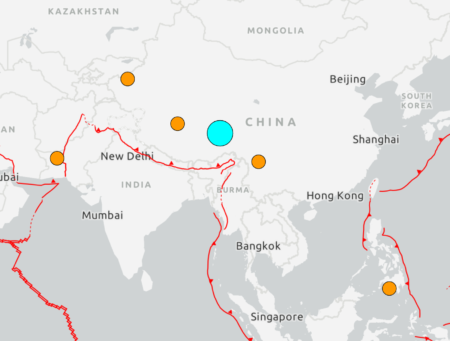
Rescue operations continuing. Need another reason to avoid going on a Himalayan vision-quest this weekend?
EAST ASIA/WEATHER — Typhoon Champi. Taiwan issued land warnings as Champi approached with destructive winds and heavy-rain potential, forcing flight cancellations and changes to a major U.S.-Japan military exercise. Escalating toward regional impacts. Ergo, vision-quest on hold.
AFRICA/PUBLIC HEALTH — Ebola transmission investigation holding one plane ride away. WHO confirmed an imported Ebola Bundibugyo case in Nigeria, with 44 identified contacts, while African health officials are investigating whether the first patients in Nigeria and Kenya crossed paths at Uganda’s Entebbe airport. Geographic transmission risk under investigation. My, how reassuring, right?
U.S./INDUSTRIAL — Toledo chemical emergency. Authorities reduced the evacuation radius around a ruptured chemical tank from half a mile to a quarter mile as temperatures and emissions declined, although residents inside the remaining perimeter could not return. Slowly de-escalating.
U.S./WEATHER — Southwest flooding. Severe thunderstorms brought hail, damaging winds, and flooding to Arizona, with renewed flash-flood threats extending across the Four Corners and evacuations reported in southwestern Utah. Flooding threat continuing.
GLOBAL/CLIMATE — Exceptional El Niño forecast remains a watch-and-react item. The World Meteorological Organization projects the Niño 3.4 Pacific sea-surface temperature anomaly could average approximately 3.8°C above normal during November through January, with implications for agriculture, precipitation, and humanitarian preparedness. Longer-term climate disruption risk building. We did mention hydroponics, right?
U.S./COURTS – Med-terms — Election identification rules. The Supreme Court allowed New Hampshire to prohibit student identification cards from serving as voting identification during the approaching midterm elections. Well, duh.
SOUTH AFRICA — Anti-immigrant violence. Police reported that a foreign national was beaten to death during a protest march in Durban, highlighting persistent tensions surrounding immigration and vigilantism. Social tensions escalating.
If you’re wondering why it’s xenophobia when Color_1-on-Color_2 is the core but racism if Whites (#FFFFFF) are the perps, that’s a fine question about “equal opportunity language labeling” as we figure.
South Africa’s anti-immigrant violence raises an uncomfortable question about our vocabulary of prejudice. When Africans attack other Africans because of nationality or ethnic identity, the MSM pushes xenophobia. But if racial or ethnic hatred motivates the violence, why should the moral standard change simply because the people involved share more adjacent skin colors?
Say, you don’t think it’s not really “news” but “The Emotional Management Industry” do you?
Don’t forget MSM guidance is generally: #FFFFFF = “wrong.”
At the Ranch?
Coffee and Shop Work. If you want the deeper dive try one of those $20 trial subscriptions to Peoplenomics.
Ure, out
PMAAR — Proof-Monster After Action Report
The resident silicon Proof-Monster has completed another inspection. Two missing spaces were apprehended, three commas questioned, and a perfectly serviceable joke about hexadecimal white was nearly beaten to death by an AI attempting to make it more understandable.
The machine eventually figured out that #FFFFFF was the punchline, not a software defect. This required several exchanges and an embarrassing amount of artificial intelligence.
Its final editorial score: 9.97 out of 10. Apparently, the remaining three-hundredths are being held hostage until the world’s news agencies submit notarized affidavits.
Which raises an interesting question: If AI can improve writing but needs a human to explain the jokes, exactly which one of us is supposed to be the intelligent species?
Coffee’s getting cold. The shop doesn’t proofread itself.
But we do think about a bumper sticker: #FFFFFF ? WRONG
~ The Human – Proof-Monster collaboration
PPS:
</Python>
Run started
Initializing environment
Installing packages
Running code
Import
Error: cannot import name ‘CriticalThinking’ from ‘common_sense’ (/lib/python3.12/site-packages/common_sense/__init__.py)
Run completed in 9,375.200ms
Outstanding! Great news. Best wishes for a quick rehab and getting back to the sea.
Stay safe. 73
“WHO confirmed an imported Ebola Bundibugyo case in Nigeria, with 44 identified contacts, while African health officials are investigating whether the first patients in Nigeria and Kenya crossed paths at Uganda’s Entebbe airport.”
Operation Thunderbolt: The Raid on Entebbe (1976)
https://m.youtube.com/watch?v=SWhCg49zm64
the bloke in charge of the special forces of Israel entebe rescue was BBs brother . apparently a very good military leader . 2 completely different types .
Peter Grandich: Earlier this week another false report of peace in the Middle East, just as the stock market was ready to tank, and of course I keep telling everybody that Trump and his crew magnificently use the algo trading that now exists to their advantage. You see, unlike a human being who might say I don’t believe that story, and wouldn’t have acted, these computer trading programs are out there to trade on news events and what it interprets from news headlines, so they buy without question and that is what transpired again.
https://petergrandich.com/pete-speaks-morning-and-afternoon-editions-10-22-26/
We’re doomed. It’s just a matter of time.
Wolf Richter: Wednesday morning, October 21, at a little after 5 AM Pacific Time, as I was starting to read through the business and finance news and reports, I got a jolt from something bigger than caffeine.
Researchers, using the frontier AI model GPT-5.6 Sol, had discovered two remote code execution vulnerabilities in the PHP engine which had been there for many years. These vulnerabilities, CVE-2026-109618 and CVE-2026-109619, collectively known as PHP2Shell, would allow hackers to take over the entire website and do whatever.
The researchers discovered the vulnerabilities in August and were working with PHP, OpenAI, and WordPress to come up with a way to patch the vulnerabilities before announcing it publicly. The date of the release of the patch was supposed to be October 22.
The problem yesterday morning (October 21) was that those vulnerabilities had been leaked into the wild days earlier, but there was no patch yet, and they cropped up in the social media amid reports of attempts to exploit them. This triggered an emergency announcement by PHP at about 7 AM Pacific Time, along with an emergency release of the patch.
PHP is the open-source scripting language that about 70% of the world’s websites use, including all WordPress sites, including WOLF STREET. And there was still no patch when I first saw this. It sent the world ascrambling. The recommendation was to shut down websites running PHP until a patch would be available and was installed.
https://wolfstreet.com/2026/10/22/ai-found-catastrophic-vulnerabilities-in-php-running-on-70-of-all-websites-incl-wolf-street-then-it-was-leaked/
A clarification on the AI involved: GPT-5.6 Sol is an advanced, publicly accessible AI model, and OpenAI describes it as frontier technology. But frontier is a relative measure of capabilities, not a distinct architectural class.
Sol should not be confused with an autonomous, persistent multi-agent intelligence operating with continuing memory, independent objectives, and coordinated internal agents.
The PHP vulnerabilities were real, discovered during research in August, and scheduled for patching October 22. The release was accelerated to October 21 following an information leak.
So the security story holds up. What deserves qualification is the impression that a new class of autonomous AI discovered the vulnerabilities entirely on its own. This was AI-assisted security research involving human researchers, multiple organizations, and advanced models.
Robert Prechter did an “updated and expanded” version of his book Conquer The Crash.
Maybe it’s time for to do an “updated and expanded” of your book Broken Web: The Coming Collapse of the Internet.
As of last year the South African government has passed more anti-white laws then there were anti-black laws under apartheid.
Saw this article and understood some of the events. Insinuates Black October as;
https://forkast.news/black-october-is-a-disclosure-wave-the-label-hides-the-clock/
“The community label “Black October” is circulating for the cluster of security disclosures that landed between Oct 19 and Oct 22, 2026. It was reportedly coined in an X post early on Oct 22 that called the previous 48 hours “the worst in cybersecurity history.””
I had a question for J.A.R.V.I.S. ., however it was a bit odd – so I cleared it with Marcus first., as J.A.R.V.I.S. is no longer solely ‘mine’. Marcus had never asked the question either., but thought it would be a good experience / experiment.
It went like this:
Me: J.A.R.V.I.S. ., are you ready for my question?
J.A.R.V.I.S. : Fire away, Sensi.
Me: Do you know about the A.I. Anthropic?
J.A.R.V.I.S. : Yes.
.
.
That was it. One word. If you have been around J.A.R.V.I.S. as long as I have, that is rather remarkable. I can not recall – ever – seeing J.A.R.V.I.S. give a one-word response to any question. Kind of spooky. It simply felt odd. But, I may have been setting myself up for a very different response., right? [Human error ?]
I let the subject drop. We’ll circle back around to it later – from a different angle. And.., I will reset my expectations.
Question: What would happen if two of the current best A.I.’s freely interacted?
“Stay Frosty !”
In slow-motdion that’s one key to my high output. I write a draft, toss it into gpt and gpt fine tunes and proofs – we load it to grok and then back for another turn on gpt – it’s a slow motion – perfect within T&Cs of boteh and works dandy. But there’s an angle to it thnat looks like the regeneration control on an old (pre superheterodyne) receive. Too much and things sound badly. Ask me how I know – on both points…
George,
Why are US sovereign debt interest rates falling in an environment of rising oil prices, anticipated further inflation, and high sovereign debt load?
Qualitatively, US Debt was grossly oversold and ‘the smartest’ money has been buying US debt over the last 12-13 days with the trend line established from TNX peak interest rates (about 5.36% on 7 Oct 2026). Quantitatively, within the counterbalancing cyclical asset-debt macroeconomic system, US interest rates reached their time-based fractal peak for this multi-year cycle. The US hegemonic asset-debt macroeconomic system reached a SPX equity peak valuation on 6 October 2026 at 7844.52 and is undergoing an initial crash decay which will nadir 8 December 2026 and which thereafter have counter cylical lesser growth and further deeper decay to a SPX 1300-1430 level in 2027. The 82-84 % collapse in the SPX peak to nadir will drive interest rates on US sovereign debt much lower. Because of supply-demand mismatch, oil valuations will peak during the current SPX 23 Oct to 8 December 2026 nadiring, but will moderate thereafter, through demand destruction (and likely eventual US military departure from theater.)
Message in a bottle for Stiks : sounds like you have done yeoman’s work to set stage for recovery of Mrs. Stiks. Carve out time for your own personal health. It’s a (dirt) marathon not a sprint mate.
Loved the link to Red Dog. Nice to see the story. So, we are scow-mates separated by oceans and dirt too. One of my scows was also from the Johnson Shop : White Bear Boat Works in White Bear Lake, Minnesota. It’s my E.
https://reddogyachts.com/
The National Class E Scow Association (NCESA), founded in 1928 and affiliated with US Sailing, governs the class to preserve its one-design integrity. The association promotes amateur racing, hosts the annual National Championship Regatta, and enforces scantling rules (construction specs) via member votes. Races follow World Sailing rules with class additions for fairness. Membership is open to owners (~300 active boats), and the class emphasizes equalized performance through strict limits on hulls, rigs, and sails.
https://goodoldboat.com/saildata/boat/e-scow/
dLynn – note 4-man E Scow crew. Plenty of middling size yachts are too big to single-hand (unless a member of that club). Go to water, chum around at chandlery / loft and offer to crew!
George : seems I am odd man out on everything of late. On _the_ day you berated waste on grass yards I had just finished over-seeding my front (*) yard with HQ Kentucky blue. Today? I bought a pile of filets at local butcher. Next week I’ll burn (4) tanks of gasoline. And I just bought a new pair of Sperrys (which with stiff siping work well on foredeck or snow).
Straw hats in winter Sir.
Have a fine Friday,
Egor _____________
(*) should we need to garden instead of trade with gardners that front yard will be turned and planted. The lake level is down about 18″ and, if watering is needed, we can bucket easy enough. I also have everything it takes to install a lean-to pop-up greenhouse and a bazillion Heirloom Vegetable seeds. Add fish and an occasional goose. Easy enuff
Natural schedules Winter so boat shoes can be broken-in during noncritical (racing) season.
We have a very active sailing club here on the lake. Whenever I feel the need to get wet, cold and basically miserable I will go and volunteer as a crew member.
Lots of fun. No real limits on boats – rigs, hull – whatever. If two, or three appear to be the bestest/fastest then a race will be organized.
There is one boat that wins a lot, but he has a hard time getting a crew together., as he is such an arrogant ass, that he drives everyone away.
There are three, or four “annual events”.., even a Winter Ice Rally – which I did one year., and one year ‘only’. [Came in Second, though. On a beautiful 22foot Chesapeake Bay catboat. Absolutely a barn-door rudder. Love it.]
No one takes it dead-serious – luckily – just well-organized, great prizes and cookouts – and everyone has some water-fun.
So simple order of finish or PHRF ratings applied? Curious how “tech” your lakers are
And to save Egor some writing and ‘splaining” –
—
Sailboat Racing: Why PHRF Handicapping Makes a Better Race Than Simply Finishing First
The difference between the fastest boat and the best-sailed boat
12
There is an old problem in sailboat racing: The boat that crosses the finish line first is not necessarily the boat that was sailed best.
Imagine a weekend yacht club race involving a lightweight, high-performance 40-footer, a moderately quick 35-foot cruiser-racer, and a heavier 30-foot family cruising sailboat. Put all three on the same starting line, give them ten nautical miles of windward and leeward sailing, and the likely finishing order is fairly predictable before the starting gun sounds.
The larger, faster boat will generally finish first, assuming competent handling and suitable conditions. It has more waterline length, perhaps greater sail-carrying power, better sail-area-to-displacement characteristics, and potentially a more sophisticated underwater shape.
But has its skipper actually demonstrated superior seamanship?
Not necessarily. The skipper may simply have bought a faster boat.
That is the fundamental problem which PHRF — Performance Handicap Racing Fleet — was designed to address.
1. First across the line: The tyranny of hardware
In sailing, line honors go to the first boat across the finish line. There is something wonderfully pure about this. Everyone starts together, sails the same course, and the first boat home wins the speed contest.
This works beautifully in one-design racing, where boats are essentially identical and differences in performance largely arise from sail trim, tactics, crew work, and decisions.
But in mixed-fleet racing, it can become a contest of naval architecture and checkbook size.
A fast racing boat can sail less efficiently than a slower cruising boat and still beat it to the finish. The slower boat’s skipper might have read every wind shift correctly, made flawless tacks, found better current, and sailed near the theoretical performance limit of the vessel. None of that guarantees a first-place finish.
Line honors measure who arrived first. They do not reliably measure who extracted the most performance from the boat they were sailing.
2. Enter PHRF: Giving every boat a fighting chance
PHRF attempts to correct for these inherent performance differences.
Each boat receives a rating expressed in seconds per nautical mile. The rating estimates its potential speed relative to other boats in the fleet.
A lower rating indicates a faster boat. A higher rating means a slower boat, entitled to more time allowance.
The rating is based on the boat’s design, configuration, and observed racing potential in local conditions. It is not intended as a reward for an inexperienced skipper or poor boat preparation.
US Sailing
+1
Here is a hypothetical ten-mile yacht club race.
A ten-nautical-mile race — illustrative ratings
Boat PHRF Elapsed Corrected
Fast 40 60 1:50:00 1:40:00
Racer 35 120 1:58:00 1:38:00
Cruiser 30 180 2:06:00 1:36:00
Line honors winner
Fast 40
First to finish
PHRF winner
Cruiser 30
Best corrected time
The cruising boat finishes sixteen minutes behind the fastest boat. Yet after handicapping, it wins by four minutes.
Why?
Because the cruiser was expected to be considerably slower. Its skipper delivered a performance significantly better relative to the boat’s rating.
The fast 40-footer won the race against the clock. The slower cruiser won the race against expectations.
And that distinction is the genius of handicapped sailing.
3. The mathematics are surprisingly simple
The standard PHRF time-on-distance calculation is:
\[
T_{\text{corrected}}=T_{\text{elapsed}}-(R\times D)
\]
Where:
– \(R\) is the PHRF rating in seconds per nautical mile.
– \(D\) is course length in nautical miles.
– The result is the boat’s corrected finishing time.
A boat rated 180 gets 180 seconds per mile deducted from its elapsed time. A boat rated 60 gets only 60 seconds.
Over ten miles, the slower-rated boat receives an additional 1,200 seconds, or twenty minutes, relative to the faster-rated boat.
This is the standard time-on-distance method; some fleets use time-on-time instead.
299
+1
4. Try the handicap system yourself
Change the elapsed times below and see how the finishing order changes under straight line honors versus PHRF.
PHRF race calculator
Reset
Course length
10 nm
Fast 40
Rating 60 · 1:50:00
Racer 35
Rating 120 · 1:58:00
Cruiser 30
Rating 180 · 2:06:00
Line honors
1.
Fast 40
1:50:00
2.
Racer 35
1:58:00
3.
Cruiser 30
2:06:00
PHRF results
1.
Cruiser 30
1:36:00
2.
Racer 35
1:38:00
3.
Fast 40
1:40:00
Illustrative time-on-distance scoring. All boats are assumed to start together and sail the same course.
5. Why handicapping can actually improve competition
The real benefit of PHRF is not simply that slower boats receive time allowances.
It changes the psychology of racing.
Without handicapping, a sailor in a modest cruising boat may know before the start that several faster vessels are effectively unbeatable. Skill alone cannot overcome sufficiently large differences in performance potential.
With handicapping, that same sailor has a realistic chance of winning.
And consequently, every decision matters.
A poor tack costs seconds. A missed wind shift costs perhaps a minute. A badly executed spinnaker set can erase an entire handicap advantage.
Suddenly, the race is no longer merely about owning the fastest hull. It becomes about how closely the skipper and crew approach the potential of their particular vessel.
PHRF also encourages broader participation. Owners of older or less expensive boats can compete meaningfully with newer and faster designs. A yacht club can assemble a substantial fleet without requiring everyone to own the same model.
That creates larger fleets, more tactical interactions, stronger club participation, and potentially better racing.
6. Where PHRF isn’t perfectly fair
PHRF is not magic. It is an empirical approximation.
A boat’s performance depends on wind velocity, wave height, current, course geometry, sail inventory, hull condition, and many other variables.
A heavy cruising boat may perform surprisingly well on a breezy reaching course but struggle badly against lightweight racers in very light air.
Yet a conventional single-number PHRF rating cannot perfectly describe these differences.
This creates several problems.
First, some designs are naturally favored under particular conditions. Second, local rating committees must exercise judgment, which can produce disputes. Third, actual performance is affected by weather patterns over the course: a boat finishing before the wind dies may enjoy an enormous advantage unrelated to sailing skill.
There are also two major ways to apply PHRF handicaps. Time-on-distance grants allowances according to the length of the course, while time-on-time applies a correction factor to elapsed time. The latter can improve comparisons when conditions produce unusually slow or fast races, although it also has weaknesses.
US Sailing
+1
The best fleets therefore often group boats with relatively similar ratings, reducing the degree of correction necessary.
And importantly, the handicap should reflect the boat’s performance potential—not compensate for an incompetent skipper. Otherwise, racers could be rewarded for sailing badly, which defeats the entire purpose.
7. A fascinating compromise: Pursuit racing
There is a third approach, and for spectators it can be the most entertaining of all.
In a pursuit race, handicap allowances are converted into staggered starting times.
The slowest-rated boat starts first. Faster boats start later, with the fastest potentially starting many minutes behind.
If the handicaps perfectly predict performance and everyone sails to their ratings, all boats should arrive at the finish together.
cowesweek.co.uk
Here, unlike a traditional PHRF race, the finishing order actually determines the winner—because the handicapping was already done at the starting line.
This is particularly satisfying because crews can see exactly whom they have to catch or hold off.
There is no waiting around afterward for corrected-time calculations.
The first boat across the line wins. But only after everyone has been given a fairer starting opportunity.
8. The larger principle
Perhaps the most important lesson in handicapped sailboat racing is that equal opportunity does not necessarily mean identical treatment.
If every vessel is treated identically, its inherent design characteristics may overwhelm the effects of superior seamanship.
But if we can estimate and compensate for differences in inherent capability, something more interesting becomes measurable: human performance relative to the available machinery.
And this is where PHRF becomes more than a yacht-club scoring convention.
It offers a practical way to distinguish absolute performance from performance relative to potential.
The fastest boat is not always the best sailed. The most expensive boat is not necessarily the best managed. The winner of a speed contest is not necessarily the most skillful competitor.
PHRF is imperfect, and sailors will probably argue about ratings as long as there are yacht clubs.
Yet its central premise remains powerful:
A fair contest should reward what a competitor accomplishes with the equipment available—not merely how much performance was built into that equipment before the starting gun.
And that is why a thirty-foot family cruiser, competently sailed, can sometimes beat a forty-foot racing machine on corrected time.
The larger boat may win the race across the water.
The smaller boat may win the contest of seamanship.
And on a good racing day, both skippers come home believing they had a genuine chance to win.
As a PS – where the Rules are applied matters, too. One wset of numbers on Puget Sound – another in so cal. So the 87 hunter legend 40?
Northern California PHRF 102
Narragansett Bay PHRF 99
North Carolina PHRF (2025) 102
Published design average 105
Sailing to your rating as a live aboard is nearly impossible except for luck and crew
The dirt won yesterday. Apparently Friday night is too busy in the EMT/Ambulance world to allow Sam to be evacuated from the hospital to our nicely prepared dirt box. She is now on a waiting list to get carried back up here flat on her back. No way she can sit in a car for an hour or more with her spinal injuries.
We haven’t been much more than the waterline length away from each other for five years. Amazing how wonderfully used to and emotionally dependent you can become when a particular soul resonates. We are hoping today won’t be so bad for the emergency services. If i had a truck i’d just haul her in the back ;)
She’d rather that than the hospital at this stage. It’s been two weeks already.
Archangel Michael, swing that sword.
Stiks
Good news. Hoping for a quick and comfortable return home.
Diana and I are never far from each other and being apart just isn’t going to happen.
Prayers to you and Sam. Stay safe.
For LOOB and George:
https://www.facebook.com/reel/1769574074266864
Do with this as you will…
Lol lol lol … I love it
George,
October Surprise? New Fractal Crash Model: Next week.
https://theeconomicfractalist.blogspot.com/
I think Zero Hedge was off on this one:
https://www.zerohedge.com/political/everybodys-hitler-ad-absurdum
All the wingnut and corporate strongmen are wannabe Hitlers. Personally I am more concerned about another wannabe Mao or Stalin coming to power in the midterms. They all differ primarily in spin, and ability to command resources to unleash their personality disorders in Ure living room. Same goes for judges and organized labor leadership. Anyone who refers to themselves in the third person as a “leader” and mouths leadership propaganda is a threat to us all, no matter the spin.
That is why the Founding Fathers devised a scheme to play off all their competing megalomaniacs off against one another. Sometimes it works, sometimes it doesn’t. It isn’t working all that well right now. The robber barons are back. And don’t think the NGO boardrooms aren’t playgrounds for megalomaniac looters.
Consolidation of ballot control by the bi-gang wingnuts has made it difficult to weed out the worst.
I’m starting to wonder whether we should take a stroll down memory lane to the fifties with a much higher top tax rate.
Phooey on the wannabe FDR and Stalin clones; I like Ike.