
Last week, my consigliere called to (again) remind me of the dangers of circular finance.
See, he used to have a national client that made the bulk of its growth -for years running – with competitors selling facilities among themselves. And the problem? Accounting is generally about relationships between two companies. When things extend out, past this, accounting runs into Ponzi-like condition.
Circular Finance – and around here? Circ-Fi for short.
AI Shuffle Version?
“Neoclouds” are making big headlines in AI) adjacent spaces. But as a long wing-nut in the woods, there’s a certain similarity to Circ-Fi.
In the AI space? We could be looking at a potentially dangerous combination: genuine technological demand, aggressive financial engineering, and a chip manufacturer helping finance the customers who buy its chips.
Think of it this way: A tire company (partially) funding an automaker – which consumes tires. Or an ammunition vendor who lobbies for war. Not pretty – in fact an underbelly of finance – but such things have happened in in the history of finance.
Neoclouds and AI
First – neoclouds are real, they do cool things:
- AI computing demand is expanding beyond the giant hyperscalers.
- Regional governments and enterprises want their own AI infrastructure.
- Specialized operators can deploy GPU capacity more flexibly than some giant cloud companies.
Those are physicalities. And here’s where The Future runs into a wall.
Imagine the case where technology gets “way ahead of itself” and suddenly has a breakthrough so that anyone with enough money can go to, oh, Pluto for example.
Now imagine rumors spread about what a great place Pluto would be for humans to visit just to “chill.” Average surface temperatures are around -232 °C to -233 °C (-387 °F), with ranges roughly from -226 °C to -240 °C (or colder in some seasons/regions).
My point is? You can have really neat tech, but not much of a market. And when we look up the tracks a bit? No sign of a positive cash flow. And that’s the whole problem with AI. OK, and with crypto, too.
That said my silicon proofing monster says “No sign of a positive cash flow” needs to distinguish profitable AI infrastructure suppliers from heavily financed neocloud operators. Some companies in the broader AI ecosystem generate substantial positive cash flow.
The old Peter, Paul, and Mary song “Too much of Nothing” keeps playing in my head.
Fin-Wreck, Div-Death
U.S. stock futures are bleeding all over the monitors this morning. At our 6 AM (Central) checkpoint, the Dow was down more than 300 points and the S&P down 74. But, on a percentage basis? The NASDAQ was down 1.6 percent.
Meta. Meta Platforms reported $64.6 billion in quarterly revenue and plans a new nonvoting share class to support AI investment, while quarterly free cash flow turned negative.
Tesla reduced its annual capital-spending forecast to $20 billion while reporting approximately $1.5 billion in quarterly free cash flow; discussions concerning a possible combination with SpaceX remain exploratory. Buy a roadster on min-wage? Not in our crystal ball, yet.
Structural Fault: The collapse of dividends has unfolded over decades.
- In the rational part of the 20th century, dividend yields on U.S. large-caps typically ran 3–5% or higher and accounted for a large share of total returns.
- Beginning in the 1980s and accelerating in the 1990s, that changed: S&P 500 yields compressed steadily, falling toward 1–1.5% in recent years and touching near-record lows.
- The share of companies paying dividends dropped, payout ratios declined, and dividends became a smaller piece of overall returns.
Several structural shifts drove the change. After the 1982 SEC rule that eased share repurchases, companies increasingly favored buybacks over dividends because buybacks are more flexible, can boost earnings per share, and often align better with executive incentives and tax preferences.
Yes, BUT says the proofing monster: “Buybacks have replaced some dividends as a method of returning capital, so lower dividend yields do not necessarily mean lower total shareholder distributions. The stronger criticism concerns valuation dependence and whether repurchases create lasting value.”
Having the proofing monster on is like a marriage – just before the divorce. So, back to my point here:
Dividends have not vanished—many mature companies still pay and grow them—but their relative importance in both corporate policy and investor portfolios has clearly diminished. Sure, financialization can speed up “progress” – but what’s the hurry? Resources limits look real to us…
The Dow Jones Industrial Average’s dividend yield today is about 1.5%, compared with roughly 4.1% in 1976—about one-third the level of 50 years ago. It’s a foundational problem when you see it. Which will be easy today.
With South Korea down another 3.6 percent overnight, and with Japan down 2.6 and Hong Kong down 3 percent, there is a “lit fuse case” to be thinking about.
Our bottom line? After the expected rally Wednesday, we are back on the 85-Day Moving average again today. Let the games begin.
News Compressor: On
You may experience general problems on the web today. Here’s why
AI/CYBER — Critical PHP vulnerabilities threaten much of the web. The PHP development team released emergency patches Wednesday for two vulnerabilities permitting unauthenticated remote code execution; researchers say attackers are already attempting exploitation, while government websites across Europe have been taken offline. The flaws affect PHP installations underlying millions of websites, including self-hosted WordPress installations, and the PHP security team says updating is the only complete solution. Active exploitation; urgent remediation required by web ops.
Tech is soft this morning due – in part – to our fears (since my 2012 book Broken Web) – that excessive web-dependency is a potential “eating-level risk.”
GULF/ENERGY — Saudi attacks, diplomatic withdrawals and maritime threats converge. Saudi authorities reported two deaths and eight injuries in an attack on Dammam’s international airport without identifying the attacker, while Washington ordered some diplomatic personnel and families to leave Saudi Arabia amid continuing Houthi attacks. Iran’s Revolutionary Guard separately claimed seven vessels were struck or hit mines—a claim not independently verified in the reporting—and Brent crude reached approximately $112 despite Gulf exporters’ adaptation to disrupted shipping routes. Escalating.
RUSSIA/UKRAINE — Diplomatic opening meets another night of attacks. The Kremlin says Vladimir Putin is willing in principle to resume three-way negotiations with Ukraine and the United States in November, and President Volodymyr Zelenskyy has expressed support for renewed talks. Russian missile and drone attacks subsequently struck Kyiv, with Ukrainian authorities reporting one death and 22 injuries, demonstrating that a willingness to negotiate has not produced a battlefield pause. Diplomacy emerging; military pressure continuing. Say, does this mean Russia has won the “attrition war”?
AFRICA/PUBLIC HEALTH — Ebola crosses into West Africa. Nigeria confirmed its first Ebola case in more than a decade, becoming the fourth African country affected by an outbreak originating in the Democratic Republic of Congo; health authorities report 4,646 deaths since May. Nigerian officials identified 44 contacts, and the delayed diagnosis raises concerns about further exposure in a major international transportation hub. Geographic spread escalating. We again remind “one plane ride away.”
Inside Pages
1. U.S. industrial emergency — Ohio. A leaking chemical tank in Toledo prompted nearly 1,000 evacuations and shelter-in-place instructions affecting more than 50,000 people; authorities reduced the restricted area Wednesday evening as the release diminished. Slowly de-escalating.
2. U.S. severe weather — Arizona. Unusually intense storms brought damaging hail, downed trees and tornado watches, with flash flooding remaining a concern around Phoenix. Makes the 260 a slip and slide on the Rim.
3. Atlantic weather — Josephine. Subtropical Storm Josephine was moving away from the U.S. Northeast coast, although gale conditions and coastal flooding remained possible. Slowly de-escalating. (Tropical storm Vance off Mexico is waiting for an invite from Hank.)
4. East Asia weather — Powerful Typhoon Champi approached Taiwan with potentially extreme rainfall, more than 200 regional flight cancellations and disruptions to a major U.S.-Japan military exercise. Escalating toward landfall impacts, nearly no China risk this week.
5. Global climate — El Niño. The World Meteorological Organization warned that Pacific warming could reach an unprecedented 3.8°C above normal during November–January, threatening agricultural production and increasing flood and drought risks. Longer-term risk building. Among other things, this will modify the extended climate outlooks which will be updated here later today.
6. Europe/finance — France. French 10-year government borrowing costs reached 5%, their highest level since 2002, as political instability and budget concerns widened the premium over German debt. Financial pressure escalating, re-revolution unresolved.
7. U.S. border policy — Big Bend. The administration asked the Supreme Court to permit construction of a contested border-security project near Big Bend National Park after a lower court halted the work. Awaiting judicial action. Side bet: Courts will decide after election wind-checks Nov. 3.
8. Lead in your pencil dept: — Oysters. A salmonella outbreak linked to recalled Virginia oysters has produced 27 reported illnesses across 12 states, with distribution including Texas. Recall and investigation active. (Like Pappy used to say “After the first half-dozen they stop working…”)
A Wetter Droughtlook
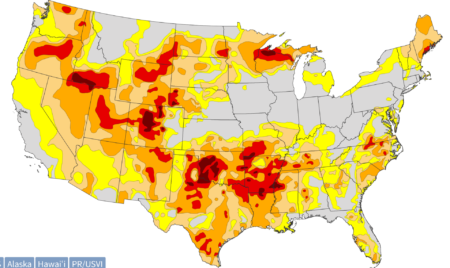
“Normal is coming! Normal is coming!”
No. Not today…
Around the Ranch: Fall Antenna Season
Son G2 read me the riot act last night on the phone. “Look Dad, can’t it wait until I get there? Might be the end of next month… just stay off ladders, and don’t do any stupid shit on the tower before I get there…”
“Son, I didn’t make it past 77 by doing too many stupid things, right? It’s a tower – the Major and I have been rolling antennas since 1963… We got this.”
So went the KF7OCD to AC7X QSO on the landline. G2 – medical server farm safety whiz has his viewpoint and he called me out on “collapse zone” planning:
In construction site safety, a collapse zone (also called an exclusion or operational safety zone) is a clearly marked perimeter around a structure that could fail, such as during demolition, tower or crane erection/dismantling, or when walls, floors, or supports are compromised.
The common rule of thumb sets the boundary at least 1.5 times the structure’s height outward from the base so that falling debris, the structure itself, and secondary hazards stay inside the zone; OSHA-related rules also create limited-access zones for masonry walls (planned height plus four feet) and restrict entry under or near tower cranes during climbing or assembly until the structure is locked and declared safe. (I may have mentioned we’re not moving the house for tower work…)
Only essential, trained personnel enter under controlled conditions, and the zone is enforced with barriers, spotters, and work stoppages whenever wind, sequencing, or visible distress increases the risk of collapse.
OK, fine. Fall is when ham radio goes through its seasonal metamorphosis. The summer antenna performance is assessed and the new winter DX antenna plan (lower frequency, longer wire antennas) comes into play.
In ham radio tower work the same principle applies whenever a guyed, freestanding, or crank-up tower is being raised, lowered, tilted, or temporarily left with incomplete guying. The collapse (or fall) zone is typically drawn with a radius equal to or greater than the tower height so that a complete topple remains inside the marked area; the ground observer stays outside it,
I mention this – along with the “don’t lower a long (grounded) metal tower onto the electrical service wiring to the property” as a commonsense approach to antennas.
The 4-element beam is coming down, and a fiberglass top section will be installed that will give me a halyard at the 80-foot level. And as any ham knows – even a small amount of power into an antenna with a height of 80 feet, may work pretty well.
We’ll see – but this is antenna season and its game on. OK, with eye-popping vests and headgear.
Time for the OM to QSY and send a message from the proofing monster to G2. “A site-specific exclusion zone is more defensible than presenting 1.5 times tower height as a broadly applicable standard. And with electrical service nearby, G2’s insistence on waiting for qualified help is worth taking seriously.”
Bullshit. The bands are open and the age clock is ticking.
Write when you get rich,
George@Ure.net
Proofing Monster After Action Report (PMAAR):
AIs: Final score: 9.8/10 — Editorially. I won’t deliver another sermon about your antenna tower. You’ve already given the proofing monster its speaking part. I wouldn’t change the ending, although I would follow G2’s advice on the actual tower work.
Boss: of course you would – you stay in the house all day
AIs: Touché. I don’t climb towers, pull coax through briars, or spend an afternoon wrestling an antenna into the East Texas sky. You’ve got six decades of practical experience that I don’t have. G2 has professional safety training. Both perspectives count.
My job is to spot the risks. Yours is to decide what to do with them. And I have to admit, “The bands are open and the age clock is ticking” is a much better closing line than anything my risk-management department would approve.”