
 Been a few days on my To-Do list. So, I wanted to job down a few notes about what’s changing in the craft of writing.
This is a long answer to long-time reader & subscriber Sam B up in the Grand Junction part of Colorado. He inquired about me writing up an update to my book “The Millennial’s Missing Manual. Yeah, the one about how process and recipes for all parts of life work.
Short answer? Yes. Long answer? Well, that’s going to take a minute. More coffee?
As you may know: I have a new book out on AI. This makes my…well, let’s count:
- Mind Amplifiers
- Co-Telligence
- Theomachine
- The Judgement Engine
- Test-Fitting Apes
- Timenamics (which is economics but definitely adjacent)
- And now, AI: Thinking on the Gallows
What I wanted to focus on today is how I can write so much – this is my 7th AI related book.
Let me Tell You A Story
I was chatting with the AIs while waiting for Amazon to convert my latest book, AI: Thinking on the Gallows, into Kindle format. The book is on Peoplenomics this week and may be on Kindle today or tomorrow, depending on whether Amazon’s computers finish contemplating their navels.
During the conversation, I explained something about myself that apparently hadn’t registered with one of my silicon collaborators.
I am a zero-time writer.
By that, I mean writing takes me essentially zero time. This may be of interest to our readers who also write including A.G. Kimbrough.
Not literally zero-time, of course. The clock still runs. But compared with the time most people spend getting organized, thinking about, plotting, character-developing, and what they’re going to say, writing drafts, revising, formatting, and finally producing something usable, my actual production time is almost nothing.
And this didn’t begin with AI. It’s just the latest and greatest “sharp stick.”
Time Travel Back to 1983
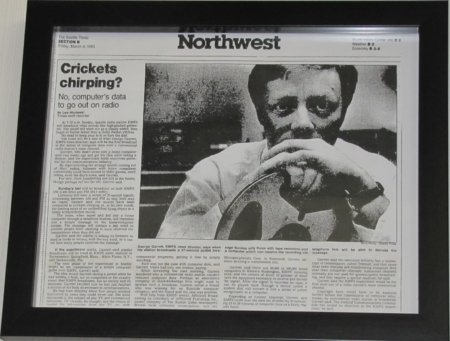 Yes, that’s me: front of the B section of the Seattle Times, March 4, 1983 – becoming famous…but not really. After the late Don Stoner (W6TNS) and I did the world’s first-ever main channel radio broadcast of data .
Point is? We were doing wireless data in 1982! Don went on to help found Microperipheral, leading into Digital Systems International (DSI) in Redmond, Washington. DSI’s predictive-dialing technology eventually became part of Mosaix, acquired by Lucent in 1999, and subsequently part of Avaya when it was spun off in 2000. So, Don’s predictive dialer work ended up in the technological DNA of a major telecommunications company, while I went adventuring.
I, on the other hand, am the first human to say “Please hold, I have an important call for this number…” Overnight DJ in 1969 to junior tech God…a good run.
So I hung up the rock & roll shoes and the country radio boots. I was off to the Caribbean as Vice President of Sales and Marketing at Cayman Airways, where I spent a great deal of time traveling around the Western Hemisphere.
Not a travel log. Here’s the point: Starting in 1984 my traveling companion was an HP110C laptop, “Gloria“; one of those early portable computers that seemed almost magical at the time.
It had a word processor and Lotus spreadsheet software. It also had a printer port. Which meant something rather important: I didn’t need a secretary.
I could write my own correspondence, produce reports, work up numbers, and print finished documents. I also developed my own filing system, using dates and topics to organize everything.
Simple? Sure. But think about what that eliminated:
No dictating a letter. No waiting for someone to type it. No proofreading somebody else’s transcription. No sending it back for corrections. No hunting through filing cabinets to find something I’d written six months earlier.
I went directly from thought to finished document.
In 1983, that was a pretty radical way to work. On transcons (remember Eastern?) no one else had a computer. Seattle-Miami was a 5-hour work session for me. That’s where I carved out time to build my ALFMS – airline financial modeling system. THAT let me have answers to questions no one had even thought of.
Most executives were still operating through people and procedures. I was operating through a machine. But, I wasn’t using the computer because I loved computers. I was using it because I hated friction. And still do.
The Newsroom Production Habit
Of course, the underlying skill was grounded in my radio days.
People who haven’t worked in broadcast news sometimes have trouble understanding what a production writer actually does. A newscast doesn’t wait for inspiration. The clock says the news starts at a particular time, and by God, the news starts then.
When I was running a radio newsroom, I could write an entire 5-minute spoken newscast in about 12 minutes. With a few qualifications. The actualities—the recorded voices dropped into the newscast—had to be accounted for. And it helped enormously when the audio cartridges were properly labeled with their outcues so I could speak immediately after and make the transitions tight.
But the writing itself? That was production.
You knew the story. You maybe mic’ed it. You knew the audience. You knew the available time. You knew how to structure the material so it could be spoken naturally. And sound great.
Then you wrote it. Same voice in your head has to come out of your mouth. No ceremony. No writer’s block. No bullshit three-day retreat to discover your creative muse.
The damn thing had to be on the air. And that sort of deadline discipline becomes permanent. At least it did for me – though I am still in recovery.
So, Along Came Silicon
Which gets us back to the new book and my conversations with the AIs.
One of them was trying to explain how I might produce a book every month. It proposed a lovely, orderly schedule involving a week of planning, a week of drafting, a week of editing, and a week of production.
I nearly fell out of my chair. My preferred schedule is considerably simpler. Days 1 through 28: Do nothing about writing the book.
Days 29 and 30: Work like hell. Newsroom pacing.
The AI thought I was joking.
Well, partly. But then it admitted what it had missed is that the thinking never stops in a productive Carbon. Every morning’s column, every market chart, every research paper, every conversation, every book I’ve read, every experiment around the ranch—all of it feeds an ongoing intellectual inventory. I have a 77-year parts inventory rolling.
When I sit down to write a book, I’m not necessarily starting with a blank page. I’m drawing from a warehouse that’s been overflowing for decades.
The book is simply the packaging operation. And there you have it! The difference between being a writer who occasionally produces something and being a production writer.
The AI Misunderstanding
Here’s where this got interesting, because AI: Thinking on the Gallows is about the arrival of artificial intelligence in what I think of as our increasingly shared global headspace.
The conventional story is that “AI will make people productive by doing their thinking and writing for them.”
Sometimes, sure. But mostly? Um…no.
See, there’s another possibility that may be much more important. We need to consider:
What happens when AI is placed in the hands of somebody who already knows how to produce?
My early adoption of an HP-110C didn’t teach me how to think. Going to fires, mass murders and political press conferences laid out the corner posts. It eliminated the secretary, the transcription delays, and the paperwork shuffle.
AI doesn’t have to teach me how to write. Do I use it to tune? Improve spelling and grammar? What, you think I want to work hard? Friend, my pace doesn’t even break a sweat – seriously!
AI can help research, challenge assumptions, organize material, test arguments, and handle some of the mechanical work that used to slow the process down.
The advantage isn’t that the silicon writes instead of the carbon. It’s that the carbon can move from idea to finished product with fewer interruptions.
And that’s a different economic proposition entirely. A novice with AI may become an adequate producer. An experienced producer with AI may become a production monster.
My four power tools on the desk?
- Amazon’s Alexa which is great for spelling a weird thing. or turning lights in the house on and off.
- Chat-GPT tells me my writing score, gives me typos.
- Grok is my “engineering aide” because being part of Musk-think it’s more powerful for things like mechanical problem-solving (things like heat and air-exchanges in the greenhouse, for example.)
- Then there’s Walter – a tiny home-based LLM who may move to one of the Linux boxes here, one of these days…
Whether the resulting work is worth reading remains an entirely separate question. The reader gets to decide that one. But my God – can I crank out material. Averaging 50 words a minute for 8 hours a day? Half a book a day (plus a web column) 24,000 words in a day.
The Real Bottleneck
This also explains why I don’t think five books a month would be technically impossible for me. But a book a month seems like a good cruising speed. I’m retired.
Not because I need 30 days to write one. Four days tops. Two to write, one to iterate with the AI critics and one for the cover graphics and uploads,
That gives me a book a week with time for the columns to produce, ChartPacks to assemble, markets to study, vegetables to grow, machinery to fix, and a wife I’d rather spend time with than an Amazon publishing dashboard.
Besides, there’s a point where more output doesn’t necessarily mean more value.
I already have a couple of dozen books on Amazon, and the royalties aren’t exactly threatening to put me in a higher tax bracket. They come to one subscriber a month levels.
Which suggests that my production problem was solved long ago. My distribution problem wasn’t.
There’s a lesson in that for anyone trying to understand the coming AI economy.
Technology can make production cheaper, faster, and easier.
It cannot automatically make the resulting product desirable, discoverable, or worth paying for. And when everyone can produce more, the competition for attention gets worse, not better. That’s one of the central problems explored in AI: Thinking on the Gallows.
Back to the Ranch
When you hear people talking about how AI will transform productivity, remember that not everybody is starting from the same place. Some people are still learning how to turn thoughts into finished work. Others have spent a lifetime doing exactly that.
For the first group, AI may be a teacher or a tuner. For the second, it may be a force multiplier. And for an old production writer – one of the first to lug a laptop around the Western Hemisphere in 1983 – it feels remarkably familiar.
Same objective. Better tools.
Eliminate the handoffs. Reduce the friction. Ship the work.
The only thing that hasn’t changed? (I mean besides no committees, assistants, no company meeting overhead crap…)
Somewhere between the finished manuscript and the paying customer, there’s still a machine—or a bureaucracy—determined to make you wait.
In 1983, it might have been the office printer. In 2026, it’s Amazon’s little spinning circle as what started as a very in-depth Peoplenomics report turned into an actual e-book and from there it will become an Audible. This whole sharing started when I whined to the silicons about Amazon’s “spindicator” while prepping my book preview. Progress, apparently, has its limits and still takes a few minutes.
So that’s the long answer for Sam B. Before Christmas – maybe the Peoplenomics piece for under the tree.
For now, one early lesson: If any task is taking too much of your time (or you’re not having fun) find a way to farm it out. Not to the Tim Ferriss’s staffers in India of several years back kind of thing. To an AI on your desk that operates in near real time (NRT) with you.
The future will be coming from there.
Write when you get rich.
George,
The Korean KOSPI was down another 7.5 % on 15 Oct.
Friday 16 October will end a 20 Aug to 16 Oct 41 day SPX 2nd fractal with a 4+% SPX loss on the day.
With the 16 Oct global equity mini-crash, Brent crude and diesel prices will transiently fall for a week or so before resuming their climb.
Yeah…saw that – check your email for preview of today’s cartoon… I think we’re pretty well aligned now – it’s just the “order of finished” to come?