
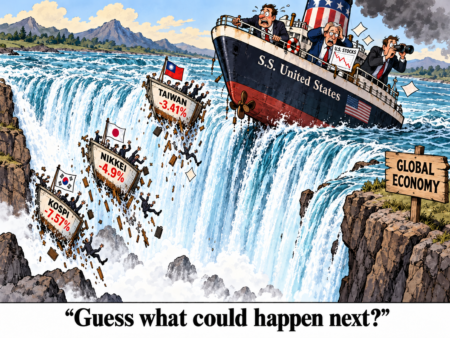
A note from my friend The Economic Fractalist drew our attention to the overnight (re-) collapse of the South Korean KOSPI index – down almost 7.6 percent.
Japan was down almost 5 percent and Taiwan was nibbling its way toward 4.
As usual – especially with the 1929 Replay potentially closer than even 2008 – is the problem of explaining complex intermarket linkages and fear propagation.
Try this and see if it helps.
Economics RSS
(As in real serious shit now…)
As a natural domain walker, how you view the potential for collapse will depend largely on your own psycho-social demography. In other words:
- If you are “still in school” maybe you need to calculate how much to spend on job skilling if AI can take your paycheck down the road.
- If you’re Young and Married? Remember how housing prices collapsed in 2009? Falling asset prices are a hallmark of Depressions. Money becomes dear.
- If you’re Older Working, then it may be time for a come-to-Jesus about how “retirement wealth” as paper assets may be due for review. For almost 30-years, I have been preaching the Gospel of Debt Reduction.
- And, if you’re trying to be retired, this is a good time to be managing down profile and not sharing so much thinking (or too much Reality) with the heathens of the web.
- And when you see it coming, take up rain catchment and gardening.
This is not to say the shit’s about to hit the fan. (Though TEF and I are, um, “smelling something odd” in here.)
The Wide-Open Future
So, we get:
- A false flag event to spin the public concern toward compliance?
- A new plandemic?
- End of the Fed and return to specie-based currency? Anyone besides me remember Mexico’s Nuevo Peso of the 1980s? Amero’s turn?
- Martial law and “emergency taxing authority” to pump still more?
- A “war lite” maybe involving nuclear weapons to demand total control?
- A “cyclical calamity” – you know, like 2012 wasn’t?
One of my suspicions is that this is the Second Movement of the Ruling the Unruly. In this outline, the Housing collapse took the money from seniors who had tried to leverage their way into a richer retirement via housing.
If you take that as a premise? Where did the “early out money” from real estate go? Why, much went into stocks and bonds! Not everyone was so stupid as to run for the hills, pay off some dirt, and figure out how to lead the field when subsistence existence came knocking.
U.S. stock futures are up with the Dow and Russell but down more with the S&P and techs.
If you’re looking for the consummate sage advice? Yeah, you bet.
Orville Redenbacher.
Please excuse today’s nautical motif. I may not be a “kapok jock” but I do know that our Aggregate Index based on early futures was showing 66276.18.
Our 85-DMA (drop to defensive, consider hiding) level based on Wednesday’s close was 66270.42.
Women and children first. (We really should bounce today…)
Six points of breathing room against a 66,000-point market. And that’s before the world’s other problems come aboard. Kind of feels like a Summer of 2008 time machine, doesn’t it?
The Retail “Life Preserver”
Maybe if consumers would just increase spending… Could that part the skies and rain down (shelf-stable) manna on us?
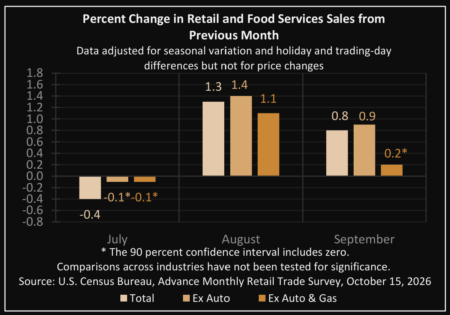
OK, holed and taking water, maybe, but we still hear the falls.
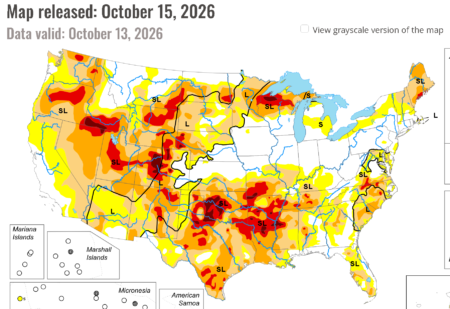
Also, in the Daily Data Gallery: Didn’t it just rain???
News Compressor: ON
Global SITREP: The OTH Convergence Window Is Opening
October 15, 2026 | BlinkLabNews / Over the Horizon Summary
For months, our Over the Horizon (OTH) forecasting work has been pointing toward a period of unusual global stress centered on late October and extending into November. Again, in January. Not necessarily a single catastrophic event, but something potentially more consequential: the convergence of several independent stress systems into one reinforcing crisis.
The distinction matters.
A stock market decline is one thing. A Middle East war is another. Elections, political instability, energy shortages, inflation, and the AI investment bubble are each manageable under normal circumstances.
But what happens when they begin interacting?
That’s the central question behind OTH. Our methodology looks for the future atoms that may eventually bond into larger molecules of consequence. And this morning’s BlinkLab intelligence sweep suggests several of those atoms are moving into closer proximity.
The October–November Stress Bubble
Try not to obsess on a week from Friday or Monday being the anniversary of the 1929 stock bubble collapse. It could be nothing (we hope!).
Still, our earlier OTH work identified a systemic risk concentration around the end of October, with the period surrounding the November 3 U.S. midterm elections especially important.
That forecast was never a claim that October 31 would produce a specific disaster. Rather, it identified a period when geopolitical, economic, and political stresses might begin reinforcing one another.
The approaching American elections provide one timing mechanism.
Control of Congress is at stake. A change in legislative power could substantially alter the administration’s room to maneuver on spending, foreign policy, investigations, and economic management.
Meanwhile, Israel and the broader Middle East remain central to the geopolitical equation. The possibility of further military escalation, Iranian retaliation, and disruption of Gulf energy supplies creates a second clock running alongside America’s electoral calendar. One nuke could ruin the week.
Neither clock operates independently.
An overseas military escalation can affect fuel prices, inflation, public confidence, and election outcomes. Political uncertainty in Washington can influence how foreign governments assess American willingness to intervene.
That’s convergence: separate systems beginning to share consequences.
The real test of our OTH work isn’t whether bad things happen. Bad things always happen. The test is whether independently forecast stress systems begin interacting inside the predicted time window. That’s what we’re watching now.
The Global Situation This Morning
The October 15 BlinkLabNews.com scan screened 64 distinct news clusters. Four major developments stood out.
First, the Middle East. Reported Houthi attacks on Saudi infrastructure and continued threats to shipping around Hormuz have expanded the conflict’s potential economic footprint. The danger is no longer confined to military targets; aviation, energy production, maritime insurance, and commercial transportation are increasingly exposed.
Second, Russia and Ukraine. The attempted energy ceasefire is deteriorating. Renewed attacks on refineries and infrastructure, alongside Black Sea maritime incidents, threaten to compound the energy disruption already developing around the Gulf.
Third, financial markets. September’s reported 3.7 percent annual U.S. inflation reading, combined with weakness in technology shares and Asian equities, highlights the vulnerability of highly valued financial assets to renewed monetary tightening.
Fourth, artificial intelligence. Semiconductor earnings remain strong, but the AI expansion is encountering regulatory scrutiny, legal challenges, and increasingly difficult financing conditions.
These aren’t four versions of the same story.
They are four separate mechanisms capable of amplifying one another.
The Hidden Transmission Mechanism
Consider the sequence.
- Middle East fighting raises energy costs. Higher energy costs reinforce inflation. Persistent inflation reduces the Federal Reserve’s flexibility. Higher financing costs pressure equity valuations and debt-funded AI infrastructure.
- Falling financial assets then weaken confidence, investment plans, and potentially employment.
- Meanwhile, political leaders approaching consequential elections face incentives to demonstrate strength, avoid appearing weak, or shift public attention toward external threats.
This does not mean governments will necessarily choose escalation. It means their decisions increasingly occur inside the same stressed economic and political environment.
And that’s where OTH’s wave-and-wavelet plus atoms and compounds approach becomes useful.
The major economic wave may be a maturing speculative cycle. The geopolitical wave may be expanding military confrontation. The political wave is the American midterm transition. When those wave trains intersect, their effects can either cancel temporarily or reinforce dramatically.
Which atoms will form the “final compound?” Keep the news handy. The timing of future intersections may matter as much as the individual headlines.
What We’re Watching Next
Our principal window remains late October through the post-election weeks of November, with the possibility of delayed consequences extending into December.
The critical confirmations would be sustained energy disruption, further equity-market deterioration, rising credit stress, widening military engagement, or evidence that election uncertainty is affecting institutional decision-making.
Conversely, durable Gulf de-escalation, stabilizing energy prices, improving financial breadth, and orderly election outcomes would weaken the convergence thesis.
Lots of Other Stories
And some of these could blow up into the world mindset:
Korea and Taiwan: North Korean missile activity, growing Chinese pressure in the region, and Taiwan’s semiconductor importance create a dangerous combination. A military miscalculation could rapidly involve Washington, Tokyo, and Seoul. With the US spread-thin now: North Korea’s latest submarine-launched missile tests add another potential trigger.
Africa’s forgotten flashpoints: Renewed Ethiopia–Eritrea border tensions and insurgent activity in Nigeria remain underappreciated. Either could trigger refugee movements, regional intervention, and fresh pressure on already strained international relief systems.
Europe’s political fracture lines: Economic stagnation, high energy prices, and disputes over Chinese imports threaten European political cohesion. Another energy shock could turn ordinary budget disagreements into government crises.
Climate and food: Indonesian wildfires, Brazilian drought-related fires, and agricultural vulnerability deserve watching. A simultaneous food-production and fertilizer shock could turn regional environmental problems into global price instability.
The overlooked military constraint: Depleted American missile-defense inventories could complicate responses to simultaneous crises in Europe, the Middle East, and Asia.
OTH takeaway: These are potential secondary ignition points. The convergence danger isn’t simply another crisis appearing; it’s a smaller crisis arriving precisely when the world’s capacity to absorb it is already stretched.
Around the Ranch: My Newest Book
Where AI Takes Us – an Answer for Sam
Having it all together would have been too much.
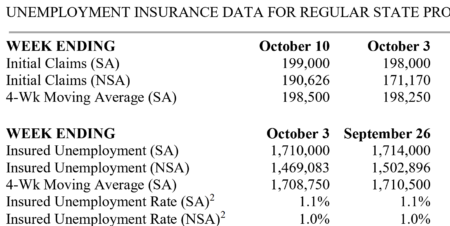
Besides, I’m retired. You were supposed to take the hint about this timeframe when I told you early in the summer about Fed Jobs, UI Filings, and Ure Announces (Semi) Retirement Plans.
Drop by tomorrow when we explain Ure’s Law of Accumulated Intelligence.
Write when you stay rich,
George@IUre.net
P.S. If things get really stupid, our IP address is https://190.92.156.129/. You may get a certificate warning using the numerical address, but if DNS goes down and the Internet is still running, this gives you another way to find us. If the web is down? Our Hour a Day Gardening! – Planting the Future – One Hour a Day site will make a hell of a lot more sense.