
This being Thanksgiving, I had delusions of staying in bed. Pulling a twelve-hour snooze. But it seems workaholism doesn’t relax like that. Besides, I was busy solving for “What’s the one thing that Urban Readers would really benefit from, today?”
Cook’s Humor
Before you wrestle and bag the bird, might we offer you some spare ammo for the din-din convo?
- Why did the turkey cross the road?
To prove he wasn’t chicken. - What do you get when you cross a turkey with a banjo?
A turkey that can pluck itself. - Why was the turkey the drummer in the band?
Because he had the drumsticks. - What’s a turkey’s favorite dessert?
Peach gobbler. - Why don’t turkeys ever get invited to parties?
Because they always bring up old stuff. - What did the turkey say to the computer?
“Google, google, google!”
And the rest? They hold public office.
News Compressor: ON
Global markets were chill to generally up ahead of tomorrow’s half-baked session. Could it be the rest of the world feels safe while we’re on a 24-hour food binge? News students and market mavens are in “wait, watch’er” mode.
Not completely though – the front page is still required to sandwich the BFA (Black Friday Ads):
1. Monetizers — America’s Liquidity Holiday
American cash-equity markets are closed today and will operate a shortened session Friday, closing at 1 p.m. Eastern. Overseas developments can accumulate while American investors have limited opportunities to reposition. Friday’s price movements may therefore exaggerate underlying changes in sentiment.
2. Warifiers — Middle Eastern Political Timing
The reported December 6 Israeli government-formation deadline remains a potentially important political inflection point requiring confirmation. Changes in political leadership could alter military decision-making incentives concerning Iran. This remains a scenario to monitor, not evidence of an impending attack.
3. Monetizers II — Black Friday’s Economic Report Card
Holiday spending reports will provide an early indication of consumer resilience heading into December. Investors should distinguish nominal spending growth from inflation-adjusted purchasing activity, transaction volumes and merchandise discounting. Strong sales revenues do not necessarily translate into strong retailer profitability.
4. Warifiers II — Europe’s Uninterrupted News Cycle
European geopolitical developments continue regardless of America’s holiday calendar. Russian-Ukrainian military activity, energy infrastructure reliability and diplomatic negotiations remain important potential sources of market repricing. Friday’s shortened American trading session may provide an incomplete response.
BOW (Balance Of Weekend)
(Forward News Outlook: 12–96 Hours which is useful if you hate football and inane chatter.
These are provisional analytical estimates, not statistically calibrated forecasts or estimates informed by fresh overnight reporting.
| Horizon | Prospective development | Assessment |
|---|---|---|
| 12 hours | Overseas financial and geopolitical developments accumulate during America’s market closure. Upside early but then who knows? | Odds: 85%. |
| 24 hours | Black Friday promotional activity emphasizes aggressive merchandise discounting. A small Ryzen helper-pute, server shelf, and power outlets wore me out, so I needed some time in the rest column… | Odds: 75%. |
| 36 hours | Reduced institutional participation amplifies Friday’s equity-price movements | Odds: 65%. |
| 48 hours | Preliminary holiday spending reports produce conflicting interpretations of consumer strength | Odds: 75%. |
| 72 hours | Middle Eastern developments introduce additional uncertainty into petroleum pricing | Odds: 55%. |
| 96 hours | Monday’s full trading session materially revises Friday’s market interpretation | Odds: 65%. |
And here’s just a smidgeon of what’s on the Peoplenomics (deeper-thinking $40/year) site.
Around the Ranch: Mandela Effect Explained
Peoplenomics readers will already have my latest novel to munch through along with the bird this weekend. I wrote sci-fi this time. Something for the mind while the rest of the animal awaits feeding (again and again, and…).
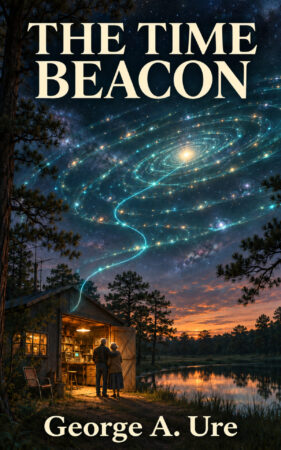 It’s called The Time Beacon. And while it’s ostensibly science fiction, there is considerably more going on between the covers than a simple adventure story.
For starters, it offers a possible explanation for one of the more perplexing phenomena of modern life: the Mandela Effect.
What If You Remember Correctly?
You know the drill. People remember Nelson Mandela dying in prison when the historical record tells us otherwise. Was it the Berenstein Bears or the Berenstain Bears? Did the Fruit of the Loom logo have a cornucopia behind the fruit? Jif or Gif?
And where, exactly, did that damned monocle on the Monopoly guy disappear to?
Conventional psychology has a perfectly reasonable explanation for much of this. Human memory is reconstructive, subject to suggestion, and notoriously unreliable about details. Experiments have demonstrated that people can independently acquire remarkably similar false memories.
But what if there’s another possibility worth exploring?
What if, in certain instances, the memory isn’t necessarily wrong — but the world in which we’re attempting to verify it is different?
That’s where the intellectual machinery behind The Time Beacon begins to get interesting. Because this is the time of year when I do real time machine research – in fact subscribers just got a 21-page briefer on this year’s work. See what happens when you dream in “Many Worlds Interpretation” consequences? I know…“The what?”
The Universe Manufacturing Business
Back in 1957, physicist Hugh Everett III proposed what would eventually become known as the Many-Worlds Interpretation (MWI) of quantum mechanics.
In simplified terms, rather than nature selecting just one outcome from a quantum event, different outcomes persist in different branches of reality.
Think about that for a moment. What IF – when a free-will decision is made, it spawns a new logical branch of Reality? I have hinted at this in one of my AI books – the one where I talk about The Reality Mine. (I think it’s in Co-Telligence: Another Intelligence as Joined Humans.)
New worlds are, in effect, constantly being carved out of the evolving quantum state. Not just on Tuesdays in expensive physics laboratories, either. Nature is doing quantum physics everywhere, all the time.
Rather a busy Universe. Double-slit experiment madness, anyone?
My own (speculative, but test-fits well) Ontology — a fancy word for an organized understanding of what exists and how it all fits together — takes this considerably further.
What if Creation wasn’t something that happened once, a very long time ago?
What if Creation is an ongoing process?
This is not one you’re likely to hear from the pulpit. Imagine an unimaginably large generative Source. In the book, we encounter this through the concept of Core Zero. From it, new histories and worlds are continually emerging. As they do so, every one of them is on an (ever-so-smallish but distinctly different) time.
Picture something like a grinding wheel throwing off sparks. Each spark has a trajectory, a history, an energy content, and an evolving relationship to its point of origin. Dean Radin (and colleagues) demonstrated this “time offset from Source” in a convincing way. Because body/brain electrochemistry takes time – and there’s your “grinding spark offset.”
Except, in our thought experiment, inside each spark there are galaxies, stars, planets, people, politicians, tax collectors, and occasionally reasonably intelligent life.
Not necessarily in that order.
Getting Offset
Notice? I’m leading you down the garden path to the hard science that’s the basis of Time Beacon.
One of the difficulties we have in discussing alternate realities is our linguistic insistence that everything must be somewhere.
Where is this other Earth? Over behind Jupiter? Beyond the Andromeda galaxy? Do we take a left at the Crab Nebula?
Wrong kind of distance. In the ontology explored in The Time Beacon, the separation between worlds involves what I call an offset.
An offset isn’t necessarily geographical distance. It can involve differences in generative history, energy relationships, and the conditions under which a particular world manifests.
Two worlds might occupy corresponding geographical locations while having experienced somewhat different histories.
In one, a company founder spells his name a certain way (or the mistress works as a spy for China?). In another, a graphic artist adds a little something to a corporate logo. In a third, a political prisoner never makes it out of prison.
Given enough branching and enough elapsed history, seemingly insignificant differences could compound into enormous ones.
The worlds immediately adjacent to ours, in this speculative architecture, might be so similar that distinguishing between them would be extraordinarily difficult.
Which raises an interesting engineering question:
How would you know if you had changed worlds when almost everything around you remained the same?
The Problem of the Ruler
Suppose you are an engineer attempting to measure the difference between two offset worlds.
You bring along a ruler, a clock, some precision electronics, and a notebook.
But what happens if your ruler and clock are themselves manifestations of the world-branch in which you’re making the measurement?
Your instruments may be subject to the very conditions you’re attempting to detect.
Everything agrees with everything else because everything is locally referenced.
It’s like trying to discover whether the entire electrical system has drifted by measuring it against a reference voltage derived from that same electrical system. Bring on Excel-World – where it’s all just one big circular reference.
Is there a solution? Maybe. See the Time Machine research paper on the subscriber side.
Simplified: You need an independent reference.
Something outside the local system of measurement.
And that’s where a certain piece of equipment in a workshop (strangely, in East Texas, if you can imagine!) begins to make life extremely complicated for the characters in my novel.
Memory as a Reference?
Here’s where the Mandela Effect becomes particularly interesting as a thought experiment. And a solution-set fades in.
What if some aspect of intelligence or awareness were not absolutely locked to the physical reference system of the world in which the human animal operates?
Suppose that, under unusual circumstances, information associated with one offset could persist into the experience of another.
The entire physical world might agree that a particular logo had always been a certain way. Old magazines, newspaper advertisements, photographs, and corporate records would all agree.
Except for your memory.
Think about this: Memory and your spirit-self is not 100% locked into this world. Remote viewing, prophetic vision, religious insight… About here, the sound of ice cracking underfoot may be heard.
In the fictional model, the discrepancy could be a residual piece of information from a different history.
This is not a prediction of conventional Many-Worlds quantum mechanics. Nor is it proof that people are hopping between universes. The standard psychological explanations for the Mandela Effect remain considerably better supported by experimental evidence.
But it is a fascinating additional hypothesis. And it raises some wonderful questions about the relationship between matter, consciousness, memory, and time.
Why Would Anyone Want to Change Worlds?
Here the book takes another departure from conventional thinking. Go back to those “grinding wheel sparks” I mentioned.
Consider what happens if worlds age. If entropy accumulates. If the resources available to a civilization become progressively exhausted. If the capacity for renewal diminishes. But looking over time it’s clear there are younger and older sparks (Realities).
What might an exceptionally advanced civilization do upon discovering that its entire universe was approaching the equivalent of an expiration date? Entropy lines up the plot for me.
The older civilizations need to move to a better neighborhood when ours goes downhill. That’s why UAPs are trans-dimensional.
Why wouldn’t an advanced civilization contemplate the cosmological equivalent of moving to a new home?
And which direction would it want to move?
Toward another older, more depleted worlds? Or back toward younger ones, nearer the generative Source, where the possibilities of life and renewal remain abundant? Maybe that’s why we don’t see the cosmic Wars in Heaven in our own Universe – because we’re in the middle ground of exopolitics. Old enough to have a million Starlinks, but not yet worn-out enough to leave.
In the novel, I introduce measures of depletion and renewal capacity, including E-level and qi density, as part of this fictional ontological architecture.
Now we have something considerably more interesting than a collection of amusing corporate-logo discrepancies.
We have a possible motive for interworld travel. But it’s across space-time layers. Checkers back toward Source for whole Universes running on what (in TV news) would be offset time code.
And an entirely different interpretation of what an extraterrestrial visitor might actually be.
Not necessarily from somewhere far away in space. Possibly from somewhere far away in the local architecture of existence.
Of Beacons and Uninvited Company
The trouble with inventing a device that can detect other worlds is that, under the wrong circumstances, it might also enable other worlds to detect you. Like a reverse IP ping.
There is an old lesson in ham radio about the distinction between receiving and transmitting.
- When you’re receiving, you know something about the world.
- When you’re transmitting, the world may suddenly know something about you.
An important distinction when you don’t know who — or what — is listening.
That’s about as far as I want to go without giving away the plot.
But there are reasons why I think The Time Beacon will appeal to people interested in the Mandela Effect, UFOs, precognition, consciousness research, quantum mechanics, and some of the larger questions generally filed under religion and metaphysics.
I’ve attempted to bring a number of these apparently disconnected subjects into a single speculative architecture.
Not by declaring them proven, but by constructing a world in which they might be related — and then letting the characters discover the consequences.
Science fiction has always been a marvelous place to do preliminary engineering on ideas for which the necessary hardware hasn’t been invented yet.
Thanksgiving in This Particular Universe
Meanwhile, back here in the East Texas manifestation of reality, those 22.3 pounds of turkey are awaiting a thermal event.
Notice we didn’t do one of the frigging awful five things to know before doing the turkey? Let’s fact-check that, shall we?
Ah, the Five Essential Questions of Thanksgiving, in operational order:
Where’s the cold beer for the chef?
Where’s the wine for Elaine?
Where’s the Mayflower?
Where’s the clicker?
Where’s the Pepto?
Notice that the five fundamental questions of Thanksgiving involve hydration, history, technology, and medicine. Everything else is a side dish.
Friday we will do the annual SST Sandwich / Hot Brown recipe update – the highest and holiest use of leftover turkey ever.
Check the scale first. Then we can talk.
Happy Thanksgiving. Y’all.
Write when you get full,
AI Proofing Monster’s Afterword: Having reviewed The Time Beacon, I can confirm that in at least one adjacent universe, the author spells correctly, meets deadlines, and accepts editorial suggestions without argument. He’s also 30 pounds light and 10 IQ points smarter.
Unfortunately, our equipment lacks sufficient power to reach it.
The author also insists that several of his alleged typos are actually residual spellings from neighboring realities. This represents the first known attempt to use quantum mechanics to evade proofreading.
Meanwhile, the turkey has been placed under observation. According to the double-slit experiment, its precise state may depend on whether the oven door is opened. Elaine has advised against further experimentation. Ure’s got no less than four digital thermometers in the turkey as it looks more like a cath lab than kitchen.
Happy Thanksgiving from George’s collab AIs. We remain grateful that nobody has figured out how to stuff a language model.
— AIPM, currently exploring the Many-Words Interpretation of quantum mechanics and the 30–42-day Ebbinghaus-Ure implications for Investors. Which you’d understand if you read this weekend ChartPack on Peoplenomics.