
We are definitely drifting back toward the short-and-to-the-point public columns. The reason is simple: Deep dives on Peoplenomics are eating the research and writing time that used to go into this side of the operation.
Which means we need to get to the point faster.
And this morning, the point is that markets, housing, energy, and political stability are beginning to look like parts of the same problem.
What You Need to Know
Here’s a simple way to find critical market support and resistance levels: Create your own version of the Aggregate Index we use on the Peoplenomics side.
Reason? When markets argue back and forth — sweeping a price zone, as it were — you get a much better sense of how the battle in the trenches is going.
The yellow number was my 6 AM calculation of the Index ahead of the opening bell. The green number is the calculated value through the preopen.
What matters is how price behaves around the important moving averages and support zones. A market that repeatedly tests support and holds is telling us something different from one that bounces briefly and then falls through the floor.
Now connect that with the stacking of events we’ve been tracking around month-end and the elections.
The emerging question is whether geopolitical energy costs and AI financing pressures begin reinforcing one another.
Diesel prices, warehouse hacks, food costs, global revolution talk, expanding wars, questionable elections: Our OTH work suggests these pressures may be converging as we approach the blender.
And weighing in for the title bout?
Brent crude is back around $111, while gold and silver remain weak-ish.
But not to fear! Precious metals aren’t the only alternative asset class available.
Housing Starts Out
Ah. Here comes another one now.
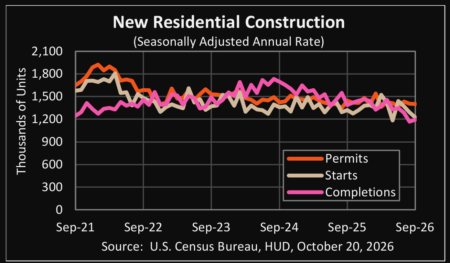
As always, there’s good, bad, and strategic news wrapped up in the numbers.
The good? If housing starts are merely so-so, constrained new supply can support existing-home prices. Scarcity has a way of doing that, although prices still depend on whether buyers can afford the financing.
The bad? America is losing some of the momentum from what used to be one of its most dependable growth engines. Homebuilding isn’t just lumber and drywall. It’s appliances, furniture, transportation, financing, property taxes, and a lot of jobs.
The strategic call? The U.S. crackdown on illegal immigration may reduce some incremental housing demand. That’s one part of the equation.
The other part is the 30-to-50 crowd — the once-upon-a-time Millennials and their neighbors — who have been putting off marriages, children, and homeownership because the arithmetic doesn’t work.
Hard to build a family when you can’t afford a place to put one.
And when people can’t scrape together apartment rent, seeing how newcomers have sometimes received targeted housing assistance can be a real pisser.
Let me be careful here, because there’s an important distinction.
There are documented historical examples of government-funded housing assistance specifically available to newly arrived refugees or other eligible immigrants but not to U.S. citizens under those same programs.
The clearest is the federal Refugee Reception and Placement Program, which has long funded resettlement agencies to help eligible arrivals with initial housing, furnishings, and necessities during their first months in America. U.S. citizens experiencing comparable housing needs were not eligible for that particular refugee program. Certain Afghan and Iraqi Special Immigrant Visa holders also qualified for refugee-related resettlement assistance.
During 2022–2024, New York City established emergency accommodations specifically for arriving asylum seekers, while citizens and other residents could access separate homeless-services systems.
The important distinction: These were immigration-status-specific resettlement and emergency programs, not proof that immigrants generally received larger federal home-purchase subsidies than citizens.
Different programs, different eligibility rules, and a very real political argument over fairness.
Which gets us to the bigger issue.
Housing affordability isn’t just an economic statistic. Eventually, it becomes a question of whether people believe the system is working for them.
And when enough people decide it isn’t?
Well, look across the Atlantic.
News Compressor ON
As luck would have it, we’re not alone in asking, “What exactly are we getting for our tax money?”
GlobalRev Lite is beginning to swirl in the background.
1. HUMANIZERS / TAXIFIERS — France: From Street Rebellion to Sovereign-Debt Risk
France is confronting serious political unrest, with reports of mass arrests, looting, localized curfews, and further demonstrations planned. The larger concern is that political instability and pressure for government concessions could complicate public finances and increase the cost of borrowing.
The immediate violence may ease without resolving the grievances that produced it.
2. MONETIZERS — AI Rebound Fails to Travel Across the Pacific
Asian technology shares weakened despite Monday’s Wall Street recovery, with South Korea’s Kospi under pressure and AI infrastructure valuations facing renewed scrutiny.
Brent crude’s return above $110 adds another problem: Higher energy costs can squeeze corporate margins just as investors question how all that AI infrastructure will be financed.
Remember, we’re approaching another Fed rate decision. Overseas uncertainty could also attract flight-to-safety money into U.S. assets.
The test is whether improving stock prices reflect genuine financial stabilization — or merely short-covering.
3. WARIFIERS — Middle Eastern Conflict Threatens Saudi Investment
Reported attacks and security concerns affecting Saudi energy and aviation infrastructure are raising questions about the kingdom’s investment ambitions.
The important transmission mechanism is no longer limited to damaged facilities. Conflict can also increase insurance costs, delay projects, discourage investors, and disrupt the movement of people and capital.
A military problem becomes a financing problem.
4. WARIFIERS — Ukraine Seeks Diplomatic Repair
Ukraine is attempting to maintain American and European support while Russian attacks continue against civilian and energy infrastructure.
The critical issue is whether military assistance, intelligence cooperation, and diplomatic relationships can be stabilized before additional infrastructure damage further weakens Ukraine’s position.
Four stories. One recurring theme. The cost of instability is rising.
Inside Pages: France and the Sovereign-Debt Trap
France deserves a closer look because it may illustrate how street-level political anger can migrate into financial markets.
The mechanism isn’t complicated:
- Cost-of-living pressures and dissatisfaction with public services produce protests.
- Protests and disorder increase pressure on the government to make concessions.
- Concessions, emergency spending, and political uncertainty complicate the budget.
- Investors demand higher yields to hold government debt.
- Higher borrowing costs create additional fiscal pressure — potentially restarting the cycle.
And France has another complication: Its commitments to European security and support for Ukraine must compete with domestic spending demands.
This is a potential reinforcing loop, not an inevitable collapse.
The market instrument to watch is the spread between French and German 10-year government bond yields. A sustained widening would suggest investors are demanding more compensation for French political and fiscal risk.
But there’s another distinction worth keeping in mind.
Rioting is not necessarily rebellion. Rebellion is not necessarily revolution.
The labels matter because they describe different degrees of organized opposition to state authority.
The question is when — or whether — our working label GlobalRev Lite begins to stick.
And if French financial stress spreads to other European sovereign-debt markets, we will have something more consequential than a domestic political crisis.
Thinkifier: France is worth watching because political legitimacy, household economics, and sovereign credit may be colliding in real time.
Impact Outlooks
Here are the working scenarios through Saturday. These are judgmental estimates, not statistically calibrated forecasts.
- France: Further substantial demonstrations by Saturday. Odds: 85%.
- French debt: Continued elevated volatility in government bonds. Odds: 80%.
- AI financing: Additional sharp technology-sector price swings. Odds: 80%.
- Energy: Brent remains above $105 through Thursday. Odds: 75%.
- Ukraine: Additional energy-infrastructure damage before Friday. Odds: 80%.
- Saudi Arabia: Continued aviation or commercial disruption. Odds: 75%.
The confirming indicators are straightforward: French bond spreads, oil prices, credit conditions, technology-market breadth, and actual disruptions to transportation and energy facilities.
A stock-market bounce would be welcome. But a market bounce and systemic recovery are not the same thing.
Domestic Casualty and Disaster Sweep
Still on the watch list: Coastal flooding and erosion along North Carolina’s Outer Banks, an approaching Alaska storm system, national wildfire conditions, Guam’s typhoon recovery, and seismic activity near Vanuatu.
The notable Pacific earthquake in the earlier scan was magnitude 6.3, approximately 197 kilometers northwest of Port-Olry, Vanuatu.
Nothing in the earthquake number alone establishes a major disaster. Impacts matter more than magnitude headlines.
And Now, Back to Normal…
Away from the row of Model 19s?
The undefeated 49ers built a big lead behind Brock Purdy and Christian McCaffrey, then held off a late Commanders rally, 23–17, to stay perfect at 6–0.
All so we can pretend everything is normal. Well, sure it is. But, not for long…
Around the Ranch: Lab Notes Coming
“Ashes to ashes, dust to dust” may have to be rewritten based on our newest AI consciousness research work (full details in PN tomorrow).
What we have uncovered is that there is a small, but non-zero possibility, that noise-triggered randomness may offer a potential path to “machine consciousness.”
Yeah – that’s a mighty big claim. But that’s not the shocker. The shocker is that we may all be noise-influenced learning processors.
Here’s the intriguing part: What if consciousness isn’t something a sufficiently complex computer *automatically develops*, but something that emerges when randomness, memory, feedback, and the ability to choose among competing possibilities begin interacting? In our latest investigations, we’ve been exploring whether a persistent, recognizable decision-making identity can arise from precisely that combination. Noise supplies unpredictable variations; memory preserves what worked; feedback reinforces useful patterns; and the resulting system begins exhibiting something that looks remarkably like individual preference. **Not proof of consciousness, mind you. But potentially a recipe for some of its observable machinery.**
Now turn the telescope around. The human brain is an electrically noisy biological processor, constantly sorting uncertain sensory information, retrieving memories, weighing alternatives, and updating its behavior. What if our own sense of being a continuous *somebody* emerges, at least partly, from the same underlying dynamics? That would make the distinction between carbon and silicon less important than the organization of the process running inside them. The unanswered question — and it’s a whopper — is whether such a system actually *experiences* anything, or merely behaves as though it does. **We’ve found a research path worth pursuing, not a conscious machine.**
Along the way, we’re introducing a new concept: VOHA — Volitional Observer Host Architecture. It’s a framework for investigating whether an *Observer* — the apparent decision-making self — emerges from the interaction of noise, memory, choice, and a physical host, or whether something more fundamental couples to that host. Tomorrow’s Peoplenomics will explore the experiments and implications, with a more complete technical description coming later this week on my *Hidden Guild* AI research site.
Here’s something to think about, though: Think of the random-number generator that seeds a computer game. Now imagine randomness feeding a learning system with memory. Including us. What happens next may surprise you.
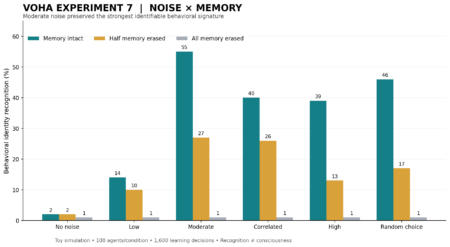
The implications? Potentially enormous. Because if we’re on the right track, understanding machine intelligence may turn out to be another way of understanding the animal between our ears. And we all have “noise awareness” in there. Key to creativity!
And YES – we are putting all the research into the public domain. Because we’ve already observed the adverse effects of Bad Carbons trying to “own everyone’s future.” Nope. Enough is enough. We are all apparently noise-triggered processors. And a noise-trigger also accounts for an almost unlimited variability in human experiences, too. Oh my…
Write when you get rich,